


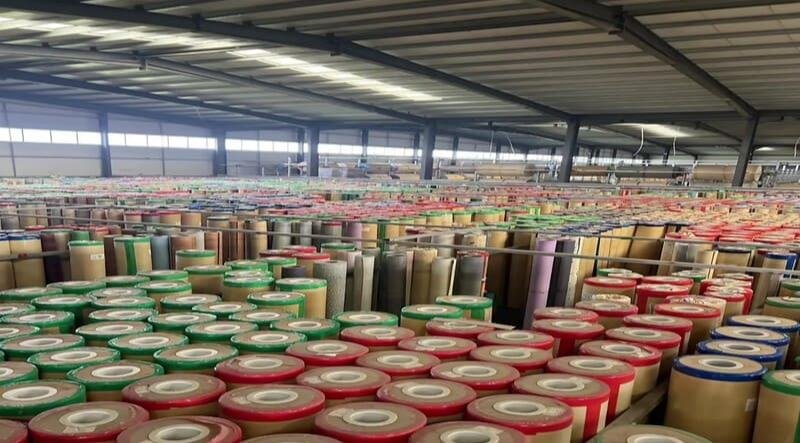
Buyers judge vinyl flooring factory capacity by comparing claimed nameplate output against real operational data, production line hardware specific to the product type, raw material reserves, and available order-taking room. Claimed numbers on Alibaba mean little without proof.
I’ve spent years on the production floor of a vinyl flooring plant, and I can tell you this: the number a factory puts on a brochure and the number that actually leaves the warehouse each month are rarely the same thing. Sourcing teams that only ask "what’s your annual capacity?" get a sales answer, not an operational one. Real capacity evaluation means digging into line count, throughput by product type, downtime, and how much of that capacity is already spoken for by other buyers. Get this wrong, and a buyer signs with a factory that looks strong on paper but collapses under a real order.
Before we get into the scorecards and red flags, it helps to understand why capacity misjudgment hurts so much in this industry, and why the fix starts with one simple distinction.
Why Is Factory Capacity More Than Just Claimed Output Numbers?
Claimed output numbers usually reflect ideal, uninterrupted machine operation, not the real-world mix of downtime, changeovers, and yield loss that every plant deals with. Treating a marketing figure as a delivery guarantee is where most sourcing problems start.
I’ve watched buyers sign contracts based on a factory’s stated "5 million square meters per year" capacity, only to find out that number assumes zero downtime, perfect yield, and no maintenance windows. When a peak-season order hits, the gap between claimed and real capacity shows up fast:
- Missed launch windows because the line couldn’t scale in time
- Rushed processing that skips inspection steps, leading to weak finished product
- Stockouts that damage a retail brand’s shelf presence
- Emergency subcontracting to a factory the buyer never vetted
Capacity misjudgment isn’t a paperwork issue. It’s a supply chain risk that follows the product all the way to the customer’s floor.
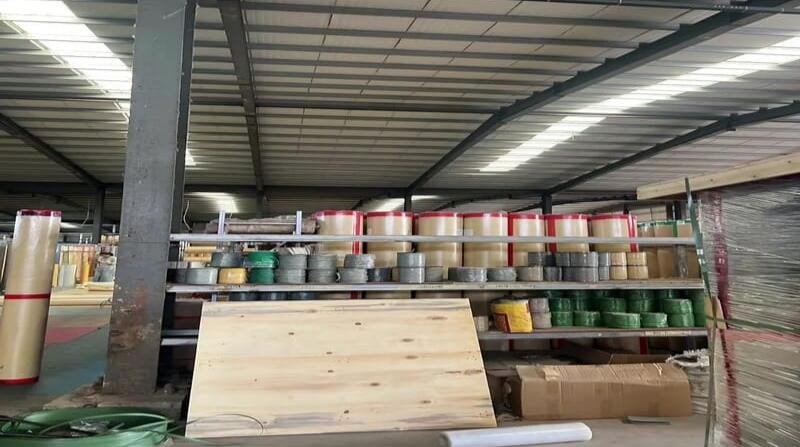
Once you understand why the headline number can mislead, the next step is learning to read the two capacity figures every serious factory should be able to show you.
What’s the Difference Between Theoretical and Effective Capacity?
Theoretical capacity assumes 24/7 ideal operation with zero downtime, while effective capacity accounts for real maintenance, shift changes, and yield loss. Buyers should ask for both, not just one.
| Capacity Type | What It Measures | Typical Buyer Trap |
|---|---|---|
| Theoretical (Nameplate) | Max output if machines never stopped | Used as the headline sales number |
| Effective (Operational) | Real output after downtime, changeovers, yield rate | Rarely disclosed unless asked directly |
There is no single utilization number that applies across every vinyl flooring plant. What matters more is the comparison: how does a factory’s claimed nameplate capacity stack up against its historical output over the last six months, its downtime pattern, its product mix, and — most importantly — how much of that capacity is still available. A factory running consistently near its nameplate ceiling has little buffer for maintenance, quality holds, or a rush order. When I evaluate a supplier, I ask for utilization history over time, not a single snapshot number, because a factory that was at 90% last month and 60% the month before tells a very different story than one holding steady.
Even a solid effective capacity figure doesn’t tell you whether the factory has room for your specific order. That calculation deserves its own step.
How Do Buyers Calculate Whether a Factory Has Enough Capacity for Their Order?
Available capacity, not total capacity, determines whether a factory can take your order on time. A factory can be large and still be the wrong fit if most of its output is already committed elsewhere.
The math I walk buyers through is simple:
Available Capacity = Effective Capacity − Already Committed Capacity
Capacity Coverage Ratio = Available Capacity ÷ Buyer’s Required Monthly Volume
Here’s why this matters in practice. A factory may produce 800,000 m² per month, but if 700,000 m² is already committed to existing orders, a buyer needing 200,000 m² should not treat it as an 800,000 m²-capacity supplier — it’s really a 100,000 m² supplier for that window, and short by half. On top of order backlog, a few product-specific constraints often shrink available capacity further:
- Your required thickness or gauge may only run on one line, not the full line count
- Your color or pattern may need frequent changeovers, cutting effective daily output
- A tight delivery window compresses how much of the "available" capacity is actually reachable in time
Asking for current order backlog alongside effective capacity is one of the most overlooked steps in a capacity audit, and it’s usually the single number that separates a confident delivery commitment from an overpromise.
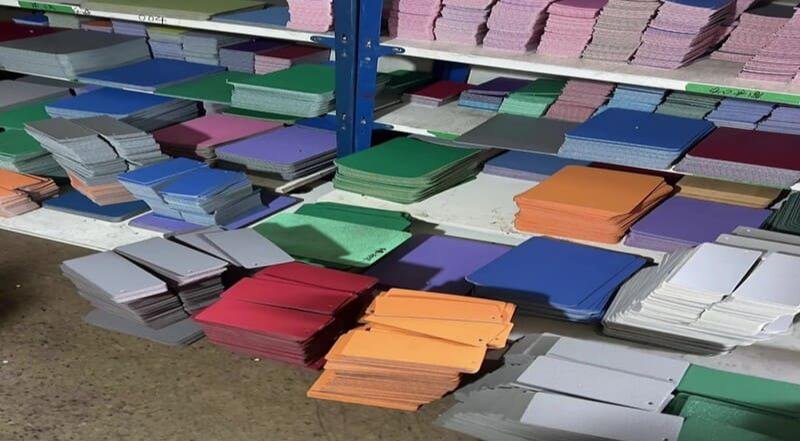
Capacity numbers only mean something once you know which production process you’re actually asking about — and that depends heavily on the type of vinyl flooring.
How Does Capacity Evaluation Differ by Vinyl Flooring Type?
"Vinyl flooring factory capacity" means different things depending on the product — SPC, LVT, homogeneous sheet, heterogeneous sheet, and PVC sports flooring each have different bottleneck stages. Evaluating a factory without identifying which process line matters most for your product leads to the wrong conclusions.
| Flooring Type | Main Capacity Bottlenecks |
|---|---|
| SPC Flooring | Extrusion, profiling, UV coating, packing |
| LVT | Calendering/extrusion, lamination, cutting, profiling |
| Homogeneous Vinyl Sheet | Mixing, calendering, annealing, surface treatment, winding |
| Heterogeneous Sheet Vinyl | Printing, lamination, foaming/gelation, embossing, annealing |
| PVC Sports Flooring | Calendering/coating, foaming, lamination, stabilization, winding |
This distinction matters more than most sourcing checklists admit. A homogeneous vinyl sheet plant has no click-profiling line at all, so asking about profiling capacity there is the wrong question. A sports flooring plant’s real bottleneck usually sits in foaming and stabilization, not extrusion. If a supplier claims strong "vinyl flooring capacity" but can’t speak specifically to the bottleneck stage for your product type, that’s a sign the number you were given is generic, not operational.
With the right process in mind, the next question is what hardware actually supports that process at scale.
What Hardware Determines a Vinyl Flooring Factory’s Real Production Line Strength?
Line hardware strength is product-specific — SPC and LVT depend on extrusion, calendering, and profiling equipment, while sheet and sports flooring depend more on calendering, foaming, and lamination. Any weak link in the relevant chain caps that product line’s real output, regardless of what other lines in the factory can do.
Extrusion and Calendering Lines (SPC/LVT)
For SPC and LVT cores, I look closely at whether a factory runs parallel twin-screw or conical twin-screw extruders — the mixing consistency between the two affects density uniformity across a batch. A high-volume SPC/LVT order needs multiple active extrusion lines running in parallel, not one line stretched to cover the whole order book.
Lamination and Wear Layer Application
Hot-pressing lamination and inline extrusion lamination both produce usable results, but the tolerance control and equipment requirements differ by product construction. This is a detail worth asking the factory to walk you through for your specific product build, rather than assuming one method applies across all vinyl flooring types.
Annealing and Tempering
This is the step buyers overlook most across nearly every vinyl flooring type, and it’s the one that causes the most post-installation complaints. Skipping or rushing thermal relaxation leads to plank or sheet curling and buckling weeks after installation — a defect that shows up on the customer’s floor, not the factory’s.
Profiling and Click-Cutting (SPC/LVT)
Fast profiling without automated camera inspection damages click joints. Speed without precision just moves the defect rate downstream. Sheet vinyl and sports flooring don’t use click profiling, so this step is specific to SPC and LVT evaluation.
Strong machines still need a steady supply of raw material behind them, which is where the next bottleneck usually hides.
Why Does Raw Material Supply Chain Resilience Matter for Capacity?
A factory’s real capacity is capped by its access to PVC resin, calcium carbonate, plasticizers, and surface materials — not just its machine speed. Long-term supplier contracts and on-site storage matter as much as the production line itself.
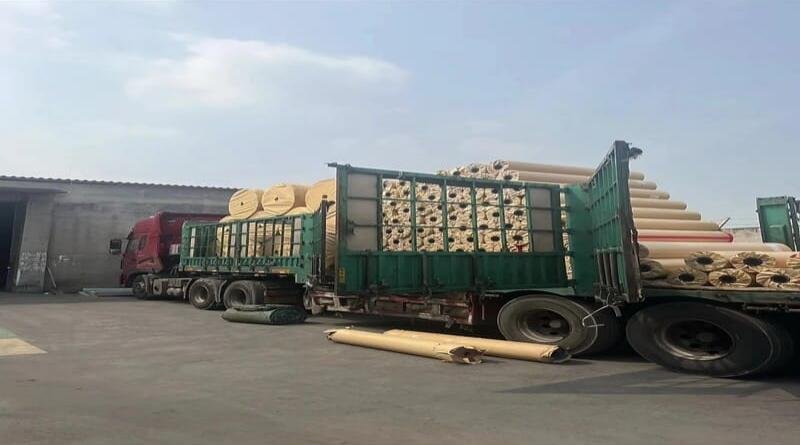
I always ask suppliers two questions upstream: do you have long-term contracts locked in for PVC resin and CaCO₃, and how many days of raw material do you keep on-site? During past supply chain crunches, the factories that kept running were the ones holding several weeks of reserve stock, not the ones relying on just-in-time delivery. Finished goods storage matters just as much — climate-controlled warehouse space prevents pre-shipment warping, and loading dock efficiency determines how fast a completed order actually leaves the building. A factory can have the fastest production line in the region and still miss a shipping window because of poor warehouse logistics.
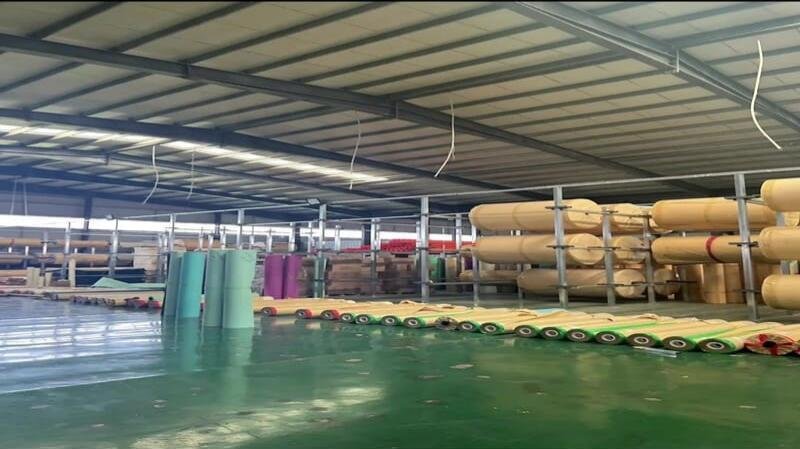
Machines and materials only produce consistent output when the people running the line are properly staffed and structured.
How Do Workforce Structure and OEE Affect Real Output?
Shift structure and Overall Equipment Effectiveness (OEE) reveal how consistently a factory converts machine time into usable product. A factory can own great equipment and still underperform if labor and scheduling are weak.
Two-shift operations often struggle to hit peak-season targets that three-shift factories handle comfortably, especially around pre-Chinese New Year rush periods when labor availability tightens across the region. I track OEE the same way top buyers do: Availability × Performance × Quality Rate. There’s no universal OEE score that marks a factory as "safe" — a plant holding steady at a lower OEE with a clear, explained cause is often a better bet than one with a high score and no visibility into why. What I actually ask for is the trend over the last two quarters and an explanation for any dips, not a single headline percentage. Skilled labor retention also affects batch-to-batch consistency — heavily manual handling processes depend on operator experience, while more automated lines reduce that variability.
None of this matters if quality control can’t keep pace with the speed of the line.
How Is Quality Assurance Integrated With Production Speed?
Quality assurance must run in-line with production speed, not after it, or high output volume just means high-speed defect production. In-house testing capability is the clearest signal of real QA integration.
I look for on-site testing equipment covering dimensional stability under heat exposure, click-lock tensile strength where applicable, wear resistance through Taber abrasion testing, and VOC/FloorScore emissions verification. A factory that sends samples out to a third-party lab for every batch isn’t running true in-line QA — it’s running after-the-fact spot checks. Scrap and regrind handling also matters more than most buyers realize: how a factory reintroduces internal regrind into new batches affects core density, and poorly managed regrind ratios lead to brittle finished planks or sheet that fail under normal foot traffic.
Understanding these systems is one thing — knowing how to verify them on-site is another skill entirely.
How Do Buyers Audit Factory Capacity Step by Step?
A proper capacity audit moves through document verification, a physical walkthrough, and third-party inspection, in that order. Skipping any one of these steps leaves a blind spot a factory can hide behind.
- Pre-Audit Documentation — Request actual production logs from the last six months, not marketing metrics. Cross-check electricity and gas utility bills against claimed machine uptime; real energy consumption doesn’t lie the way a sales sheet can.
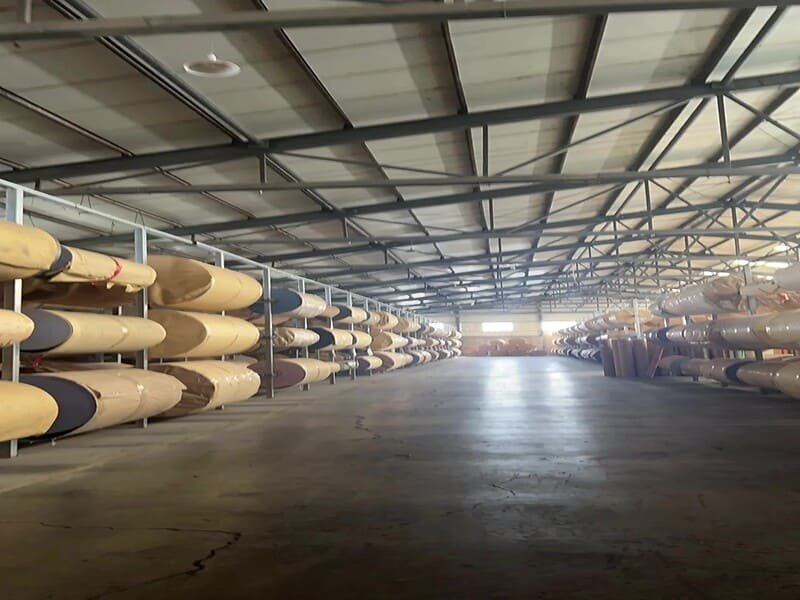
- Physical On-Site Walkthrough — Count active versus idle lines for the specific product type you need. Time a single batch cycle from raw mixing through boxing, and observe automation level: automatic boxing and robotic palletizing versus manual labor tells you a lot about consistency.
- Virtual Audits and Third-Party Inspection — Lean on SGS, TÜV, or Intertek factory audit reports, and where possible, request unannounced video verification during peak production hours rather than a scheduled showcase run.
Even a thorough audit process needs to be paired with an eye for the specific behaviors that signal trouble.
What Red Flags Signal a Factory Is Overpromising Capacity?
Four warning signs consistently predict capacity problems: uncontrolled lead-time promises, unauthorized subcontracting, structural line bottlenecks, and poor warehouse discipline. Any one of these should slow down a sourcing decision.
- Red Flag 1: The factory accepts any lead time you request without checking it against ERP/MES production scheduling software.
- Red Flag 2: Orders get subcontracted to another facility without prior notice or buyer consent.
- Red Flag 3: A single downstream process line (profiling, coating, or lamination) is supporting far more upstream lines than it can realistically keep pace with — a structural bottleneck that caps real throughput regardless of upstream capacity.
- Red Flag 4: Disorganized warehouse storage, with pallets stacked unevenly or exposed to outdoor moisture and weather.
I’ve seen Red Flag 3 sink more orders than any other issue on this list, because buyers rarely think to count downstream process lines separately from upstream capacity during a walkthrough.
With the warning signs in mind, it helps to have a structured way to score what you find.
How Can Buyers Score a Factory Using an Evaluation Matrix?
A simple scorecard across production line strength, thermal stabilization, warehousing, and quality control turns a factory visit into a comparable, numeric result. This makes it easier to benchmark multiple suppliers side by side.
| Evaluation Criteria | High Risk (1–2) | Acceptable (3–4) | World Class (5) |
|---|---|---|---|
| Line Strength & Processing | Single aging line; manual feeding | Multiple semi-automated lines | Fully automated lines with online vision check |
| Thermal Stabilization | Rushed or non-existent annealing | Batch annealing ovens | Continuous inline thermal tempering |
| Warehouse & Logistics | Outsourced storage; no ERP tracking | Dedicated indoor storage; manual logging | Automated WMS; climate-controlled staging |
| Quality Control | End-of-line spot checks only | In-line sampling per shift | Automated continuous monitoring + batch retention |
Once the walkthrough and scoring are done, buyers still need one thing before signing: proof, on paper.
What Capacity Documents Should Buyers Request?
A short, standard document request lets buyers cross-verify a factory’s claims instead of relying on verbal assurances. I recommend asking for this list before finalizing any capacity-dependent order:
- Machine list and production line count by process stage
- Rated output per line, by relevant product type
- Actual monthly output for the last six months
- Current production schedule and order backlog
- Utilization history over the last two quarters, not a single snapshot
- Yield and scrap rate
- Number of shifts and current labor headcount
- Planned maintenance schedule
- Raw material inventory days on hand
- Finished goods warehouse capacity
- Historical on-time delivery rate
- Subcontracting policy and disclosure practice
Requesting this list upfront does two things: it gives you real numbers to run the available capacity calculation against, and it filters out factories unwilling to be transparent before you’ve committed budget or time to a deeper audit.
Conclusion
Real capacity comes from verified data by product type, not brochures. Calculate available capacity, split volume, and audit before you commit.
Frequently Asked Questions
How do I know if a factory’s stated capacity actually applies to my product?
Ask which process stage is the bottleneck for your specific flooring type — SPC, LVT, homogeneous sheet, heterogeneous sheet, or sports flooring each rely on different equipment, so a strong overall number can hide a weak spot in the exact line you need.
What’s the difference between effective capacity and available capacity?
Effective capacity is what a factory can realistically produce after downtime and yield loss. Available capacity subtracts whatever is already committed to other buyers, and it’s the number that actually determines whether your order fits.
How much raw material reserve should a factory keep on-site?
I look for several weeks of PVC resin and calcium carbonate reserve as a healthy sign, based on what held up during past supply chain disruptions, though the right number depends on lead times in your specific supply chain.
Why does annealing capacity matter so much across vinyl flooring types?
Skipping or rushing thermal relaxation is one of the leading causes of post-installation curling and buckling across SPC, LVT, and sheet vinyl alike. It’s a defect that only shows up after the product is already installed.
Should I split my order volume across more than one factory?
Yes — I recommend the 80/20 rule: allocate about 80% of volume to a proven, audited high-capacity manufacturer and 20% to a qualified backup to manage delivery risk.
What contract clauses protect buyers against capacity overpromising?
Capacity guarantees, lead-time penalty clauses, and unannounced audit rights are the three protections I’d push for in any B2B procurement contract.
About the Author
I work in vinyl flooring production management, with hands-on experience across extrusion, calendering, lamination, and profiling lines spanning SPC, LVT, homogeneous sheet, heterogeneous sheet, and PVC sports flooring for custom and bulk manufacturing programs. My background covers process optimization, raw material sourcing strategy, and in-line quality control system design, with a focus on solving design and performance challenges through manufacturing insight rather than just order fulfillment.
Have a project in mind or questions about your current vinyl flooring supplier’s real capacity? Send me a message — I’m happy to walk through your specs and share what I’d look for in a factory audit.