


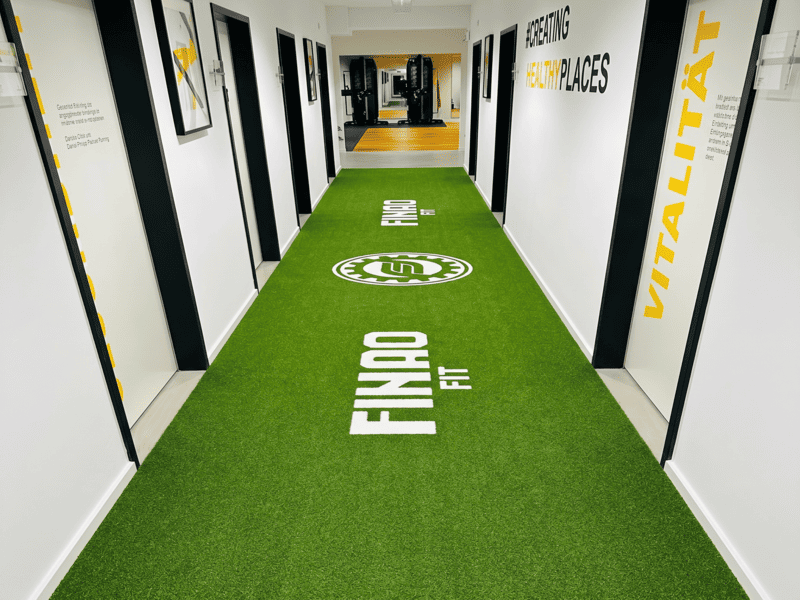
You choose turf for tight sled lane corners by selecting a short 10mm to 15mm textured nylon pile with a minimum 40 oz face weight, backed by a polyurethane layer, and installing it using a full-bed polyurethane adhesive setup to resist lateral rotational torque.
I have worked as a gym turf customization specialist for many years. I see many gym owners design beautiful functional zones only to watch their turf fail at the turnaround points. A straight sled track only deals with linear friction where the sled moves forward and backward. But when a member pivots a 300 lb sled in a tight 90-degree or 180-degree corner, the forces change completely. The sled feet apply extreme lateral torque which twists the turf fibers and pulls the backing away from the floor. Standard artificial grass cannot handle this stress. It quickly wrinkles, splits at the seams, or loses its fibers completely. My goal is to share the technical specifications and installation steps you need to build a turnaround zone that lasts.
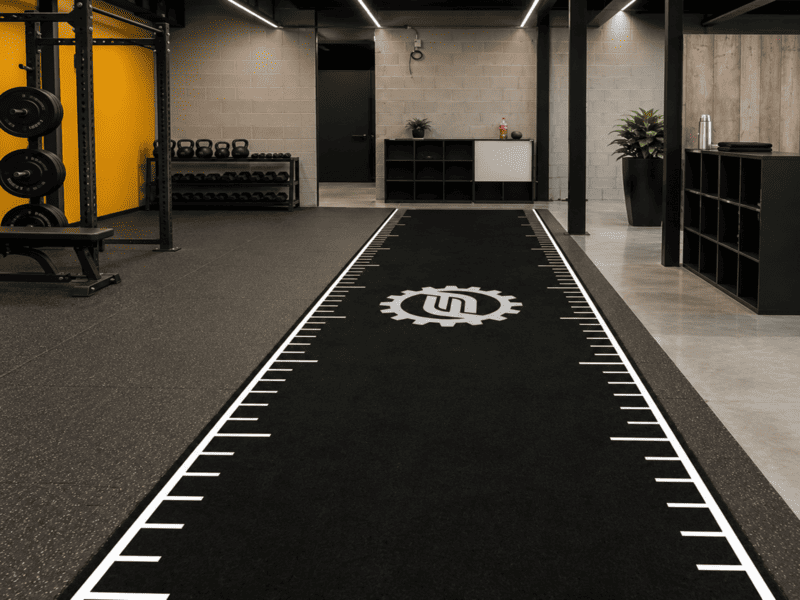
We need to look at the exact physics of a tight turn to choose the right materials. If you use the wrong product, you will have to replace your flooring in less than six months. Let us look at the specific technical requirements for these high-stress gym areas.
Why Do Tight Turnaround Corners Ruin Standard Gym Turf?
Tight turnaround corners ruin standard turf because rotational friction creates intense lateral torque that twists the yarn, separates weak seams, and breaks the adhesive bond between the backing and the subfloor.
| Friction Type | Direction of Force | Primary Damage Risk | Best Technical Prevention |
|---|---|---|---|
| Linear Friction | One-way / Straight line | Surface wear and pile flattening | High face weight, resilient fiber yarn |
| Rotational Torque | Multi-directional / Twisting | Delamination, seam tearing, bunching | Nylon material, polyurethane glue-down |
When a athlete turns a heavy sled in a tight space, the metal or plastic skis of the sled grip the turf fibers and twist them sideways. This action creates a massive pulling force at the base of the carpet. Standard turf will stretch or shift under this load. If the turf is not bonded perfectly to the ground, it will form wrinkles. These wrinkles are trip hazards for your members. Furthermore, if you place a seam directly in the middle of that turning zone, the twisting motion will tear the seam tape apart. I always tell my clients to analyze how the material handles these forces before they buy any flooring.
The Mechanics of Fiber Shedding and Base Failure
3. Core Turf Material Specifications for High-Torque Zones
We must look closely at the yarn polymer and backing engineering to solve this problem. Nylon is the best fiber choice for tight corners because it has a high melting point of around 220°C and excellent elastic recovery. When a sled pivots, the friction creates heat. Polyethylene turf can soften or melt under high heat, which causes the fibers to mat down permanently. Nylon stays upright and maintains its shape.
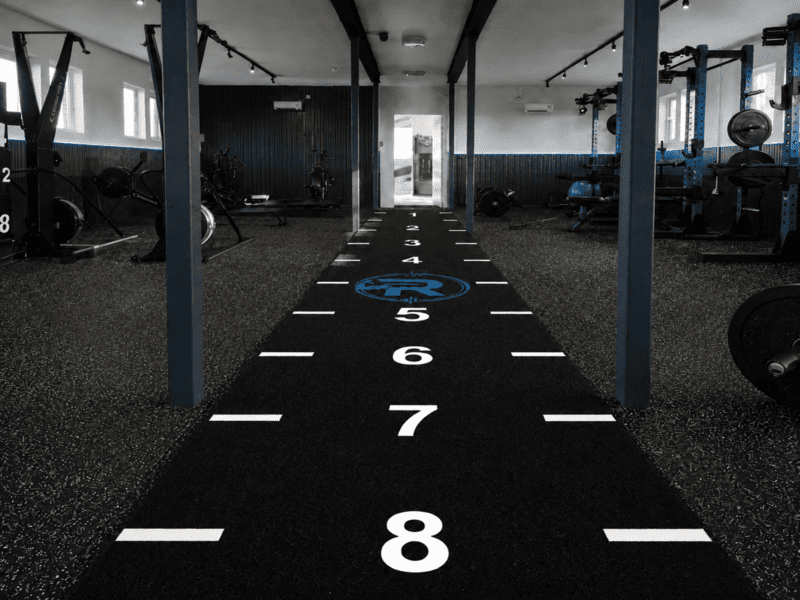
You also need a short pile height between 10mm and 15mm. Long fibers bend too much under lateral weight, which makes them easier to pull out. A short, dense pile with a face weight of 40 oz to 60 oz per square yard creates a compact surface. This high density leaves no room for the sled shoes to dig deep and pull the carpet apart. Finally, look at the backing. A premium dual-layer polyurethane backing offers superior tuft bind strength compared to cheap latex. This ensures that the individual yarn loops cannot be pulled out by the roots during sharp turns. For the best results, I recommend using turf that has a high-density vulcanized rubber shock pad bonded directly to the turf back during manufacturing. This eliminates any extra moving layers beneath the grass.
The layout of your track is just as important as the material you choose. Let us look at how smart design can reduce physical stress on the flooring.
How Should You Design the Layout for Sled Track Turnaround Zones?
You should design the layout by extending the turnaround zone to use a single continuous piece of turf, keeping seams away from pivot spots, and making the radius wide enough for smooth turns.
| Design Element | Standard Layout | Optimized High-Torque Layout | Longevity Benefit |
|---|---|---|---|
| Seam Placement | Seams every 2 meters | No seams in the turning zone | Prevents edges from rolling and lifting |
| Turning Radius | Tight 90-degree corner | Wide 180-degree continuous loop | Lowers peak lateral torque by 40% |
| Visual Indicators | Plain green surface | Inlaid contrast directional lines | Guides users along the safest path |
Many layout mistakes happen because people want to save money on carpet cuts. They place scraps or seam lines right where the sled turns. This is a bad idea because the edge of a turf roll is its weakest point. When a sled twists on a seam, it forces the two pieces apart. I always recommend the "Extended Corner" strategy. This means you buy a wider or longer single roll to cover the entire turnaround area without any joints.
Reducing Peak Torque with Smart Visual Paths
4. Design & Layout Strategies for Tight Corners
You also need to think about the turning radius itself. A standard gym sled is about 1 meter long and 0.8 meters wide. If your lane is only 1.5 meters wide, the user has to make a very sharp, aggressive pivot to go back down the lane. If you expand the turnaround zone to 3 meters wide, the athlete can push the sled in a smooth arc. This wider arc changes the sharp rotational torque into gentle linear friction.
I also advise embedding white or yellow turf lines directly into the layout during production. Do not use painted lines because paint wears off quickly under sled friction. These inlaid lines act as visual lanes to guide your gym members. They show people the best path to take when turning the sled. This spreads the wear across a larger surface area instead of burning out one exact spot on the floor.
Even the best turf will fail if it is not stuck to the ground correctly. Let us look at the only installation method that works for high-torque zones.
What Are the Critical Installation Methods to Prevent Turf Shifting?
The only reliable installation method to prevent turf shifting in corners is a 100% wet-bed bond using a premium, solvent-free polyurethane adhesive applied directly to a clean subfloor.
| Installation Component | Double-Sided Turf Tape | Full Polyurethane Glue-Down | Structural Result |
|---|---|---|---|
| Bond Strength | Low resistance to twisting | Permanent chemical bond | Stops carpet bunching |
| Moisture Resistance | Low / Can fail during cleaning | 100% Waterproof | Prevents edge curling |
| Labor Requirement | Fast and simple | Requires notched trowel work | Creates a flat surface |
Double-sided turf tape is fine for a light-duty home gym, but it will fail instantly in a commercial commercial facility. Sled training creates a strong shear force. This force easily pulls tape away from concrete or rubber underlayments. You must use a commercial-grade polyurethane adhesive. This glue creates a permanent chemical bond between the turf backing and the floor, so the carpet cannot shift even a millimeter.
Subfloor Preparation and Seam Engineering
5. Critical Installation Methods to Prevent Shifting
Before you spread any glue, your subfloor must be perfect. Concrete must be flat, dry, and free of dust, wax, or oil. If you install the turf over an existing rubber floor, you must test the glue first. Some adhesives react badly with rubber and cause the floor to bubble. Use a 3mm notched trowel to spread the glue evenly across the entire turnaround area to get a 100% wet-bed bond.
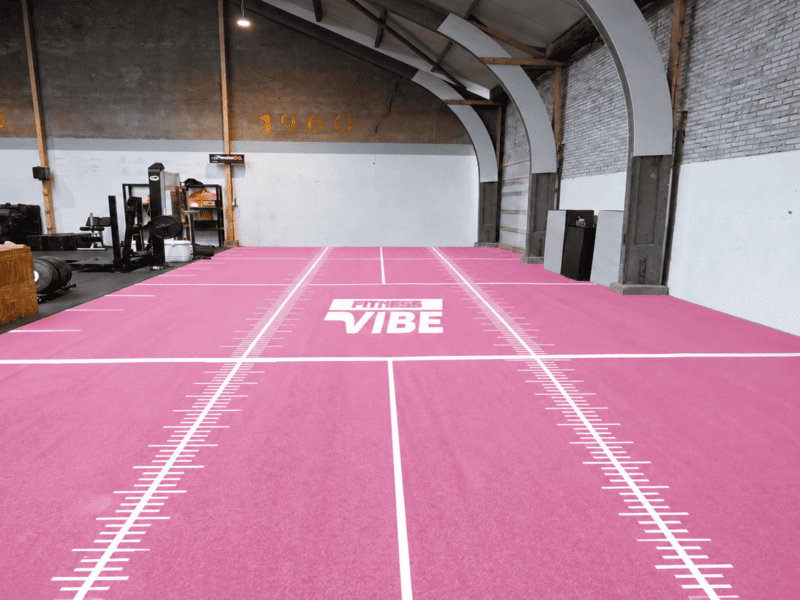
If your layout requires a seam near the corner, you must reinforce it. Use a heavy-duty, non-porous seaming cloth and premium glue. After joining the turf edges together, use a 35 kg or 50 kg metal lawn roller to press the turf firmly into the adhesive bed. Do not allow anyone to use the sled track for at least 24 to 48 hours to let the glue cure completely. This ensures that the seam becomes a single solid unit with the subfloor.
Use this simple specification checklist when you talk to suppliers to ensure you buy the right product.
Sled Lane Turf Buying Specification Checklist
- Material Composition: 100% Textured Nylon ( do not use polypropylene or standard polyethylene for corners).
- Pile Height Range: $10\text{ mm}$ to $15\text{ mm}$ maximum.
- Face Weight Target: Minimum $40\text{ oz}/\text{yd}^2$ to $60\text{ oz}/\text{yd}^2$.
- Backing Specification: Dual-layer Polyurethane or direct-bonded vulcanized rubber pad.
- Infill Strategy: 100% Non-Infill (infill sand will scatter everywhere when sleds turn).
How Can You Extend the Lifespan of Turf in Turnaround Zones?
You can extend the lifespan of your turf by enforcing alternating turning directions, checking sled shoes for metal burrs, and brushing the fibers weekly with a stiff nylon broom.
| Maintenance Action | Frequency | Required Tool | Target Prevention |
|---|---|---|---|
| Direction Rotation | Daily | Signage / Staff coaching | Stops one-way pile leaning |
| Sled Shoe Inspection | Monthly | Manual check | Prevents sharp cuts in yarn |
| Fiber Brushing | Weekly | Stiff nylon brush | Restores flattened pile |
Even the strongest nylon turf needs regular care to survive years of heavy use. The biggest issue is directional pile leaning. If every member turns the sled clockwise, the fibers will flatten in that exact direction. This makes the surface slick and reduces traction. You should train your staff to encourage members to turn both clockwise and counter-clockwise to keep the pile balanced.
Maintaining Sled Equipment and Brushing Routines
7. Maintenance & Longevity Tips for Turnaround Zones
You also need to inspect your sleds regularly. Steel sled feet can develop sharp burrs or rough edges from scraping across concrete floors outside or in other parts of your facility. These sharp metal edges act like knives that slice right through your turf yarns. Run your hand along the bottom of the sled shoes once a month. If you feel a rough spot, sand it smooth or replace the plastic protective ski shoe immediately.
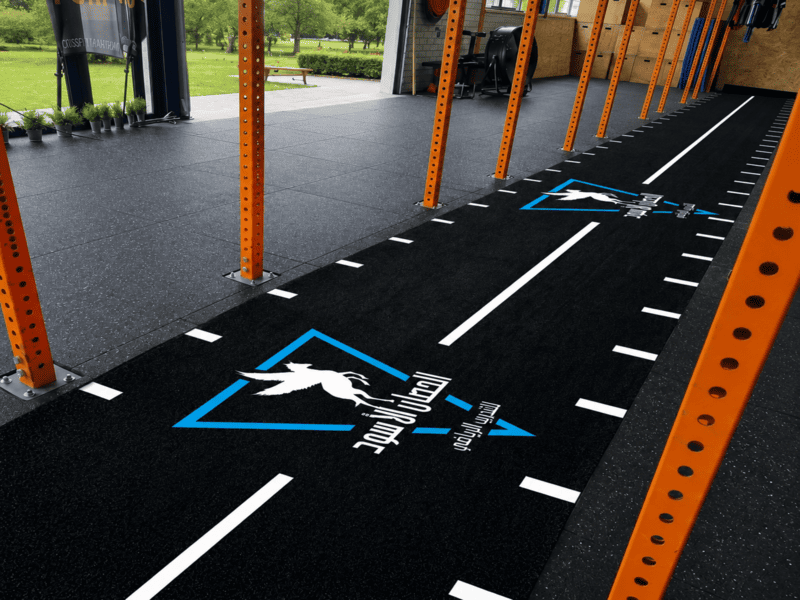
Finally, establish a weekly cleaning and brushing routine. Use a stiff nylon-bristled broom to sweep the turnaround zones against the grain. This lifting motion pulls the flattened fibers back into an upright position. It also loosens dirt and chalk dust that gets trapped deep in the pile. Keeping the fibers clean and upright helps them absorb the impacts of heavy sled training without breaking.
Conclusion
Choose short nylon turf with high face weight and glue it down fully.
If you are planning a new functional fitness area or need to replace a damaged sled track corner, let us help you get the technical specifications right. Send me a private message today with your floor measurements and sled weights, and I will help you customize a high-torque turf layout that will last for years.