


A reliable gym floor supplier is a manufacturing partner who secures your profit margin through 5 key pillars: verifiable raw material safety (low odor), engineered density consistency, OEM customization capability, transparent logistics, and a direct-factory warranty. They don’t just sell rubber; they engineer solutions that prevent client claims.
The 30-Second Summary: The "Reliability Checklist"
If you are scanning this page looking for immediate answers, here is the framework I use to evaluate any manufacturing partner. Understanding what makes a great gym floor supplier for wholesalers is critical, as a reliable partner must check all 5 of these boxes. If they miss one, you are exposing your business to risk.
| The 5 Core Pillars | What to Demand | Why It Matters to Your Profit |
|---|---|---|
| 1. Material Safety | MDI Binders (Low Odor) | Prevents "toxic smell" complaints from indoor gyms. |
| 2. Engineering | Full Vulcanization | Prevents crumbling and peeling after 6 months. |
| 3. Density | Uniform Core Density | Ensures the floor handles heavy drops without denting. |
| 4. Customization | In-Mold Markings/Logos | Allows you to sell high-margin, branded solutions. |
| 5. Logistics | 95%+ Loading Efficiency | Lowers your shipping cost per square meter. |
Introduction: The Hidden Risks of "Standard" Vendors
In my 15 years as a production process engineer, I have seen wholesalers win big contracts and I have seen them lose everything due to a single bad batch. The difference is rarely the price on the invoice—it is the engineering on the production line.
Most buyers focus on the FOB price. But the real cost of a supplier comes from the "invisible" factors: the smell that drives gym members away, the tiles that crumble under deadlifts, or the shipment that arrives with crushed corners.
You don’t need a salesperson telling you what you want to hear. You need a technical partner who can prove their quality. Below, I will break down exactly how to verify a supplier, from the chemistry of the glue to the loading of the container.
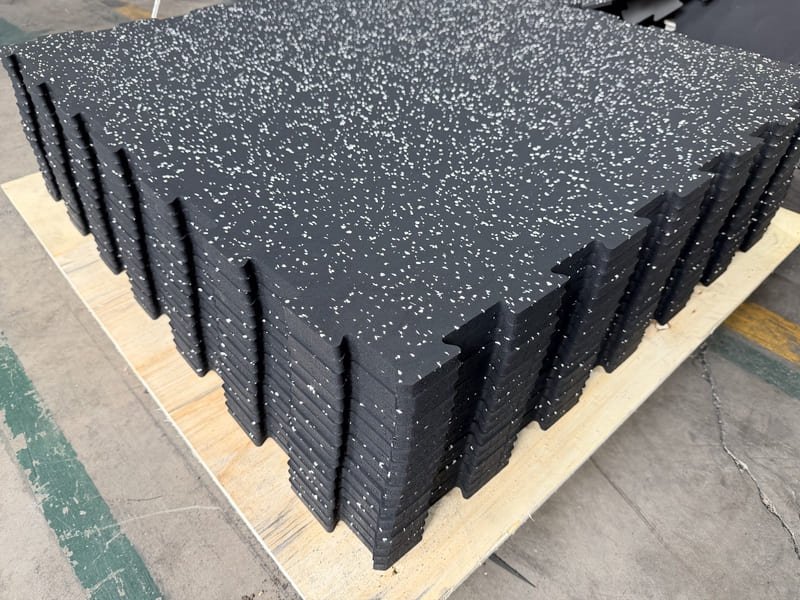
1. What "Quality" Actually Means (The Factory Perspective)
True quality is not about the thickness of the tile; it is about the purity of the chemistry. A reliable supplier uses high-grade MDI binders to eliminate odors and controls vulcanization pressure to ensure the mat is equally dense from top to bottom.
The "Smell Test" is a Chemical Indicator
The #1 complaint gym owners have is "the smell." If a supplier sends you a sample that smells like burnt tires or gasoline, that is a red flag. It means they are using cheap aromatic sulfur binders or low-quality recycled rubber full of oil and ash.
As an engineer, I insist on MDI (Methylene Diphenyl Diisocyanate) binders. They are more expensive to produce, but they are chemically stable, non-toxic, and virtually odorless. When you supply a gym with MDI-bonded flooring, you are selling air quality, not just rubber.
The Density Deception
Many factories cut costs by making the top 2mm of the tile dense (so it looks good) but leaving the bottom 8mm loose and porous. This saves them material, but it ruins your reputation. When a heavy weight drops, the porous bottom collapses, and the tile eventually tears.
How to check this:
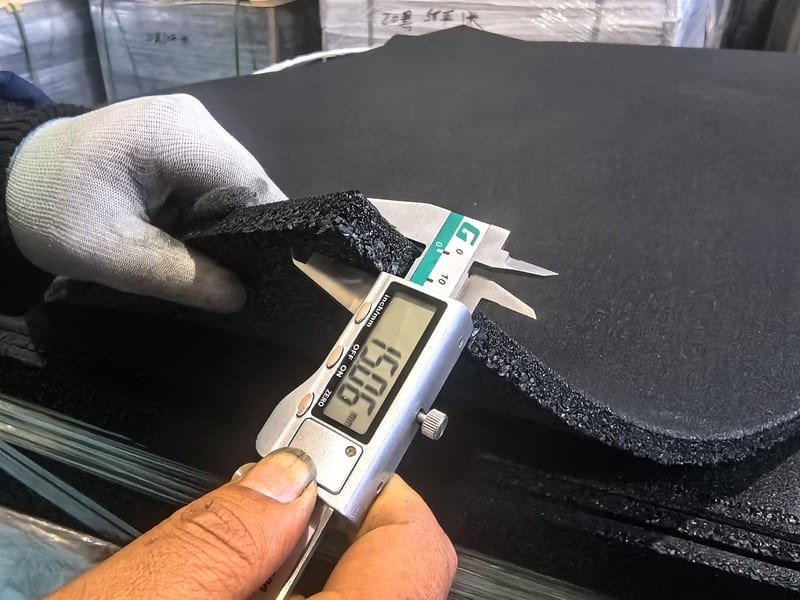
Don’t just look at the surface. Cut the sample in half. Look at the cross-section (the side view).
- Reliable Product: The density is uniform and tight from the top surface to the bottom base.
- Risky Product: You can see air gaps or loose crumbs in the middle or bottom layers.
2. Why Customization is Your Profit Multiplier
A strategic supplier does more than fill orders; they help you build a brand. By offering OEM/ODM services like custom logos and functional markings, they enable you to stop competing on price and start selling premium, bespoke solutions.
Escaping the "Black Roll" Trap
If you only sell standard black rubber rolls, you are selling a commodity. Your customers will always shop around for a cheaper price. A reliable manufacturing partner gives you the tools to be different.
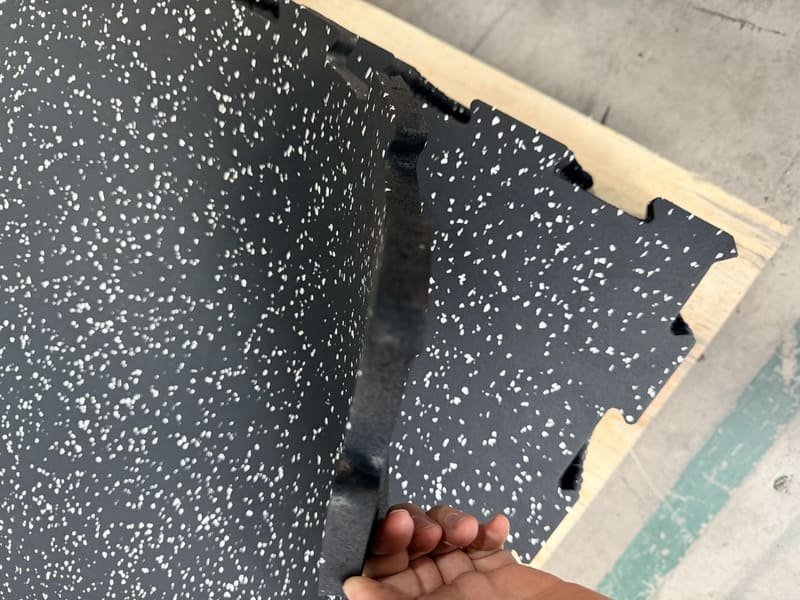
We optimize our production lines for Customization. This isn’t just painting a logo on top, and knowing how to choose the right gym turf supplier ensures you get high-quality fiber integration rather than just surface-level paint. We use specific molding technology to integrate colored EPDM granules into the tile.
- Functional Markings: We can produce tiles with start/finish lines, compass points, or ladder drills embedded in the floor.
- Branding: We can create custom logo tiles for your client’s reception area or lifting platforms.
By offering these "System Solutions," you become indispensable to your clients. You aren’t just selling a floor; you are helping them design their gym.
3. What Logistics Transparency Looks Like
Logistics excellence is about math, not just movement. A competent supplier uses calculated loading plans to maximize container space and heavy-duty packaging to ensure your goods arrive in pristine condition, reducing your landed cost.
Don’t Pay to Ship Air
I treat container loading as an engineering challenge. A lazy vendor throws pallets into a container and closes the door. A partner calculates. By optimizing the pallet size and stacking method for a 40HQ container, we can often fit 5-10% more material than a standard loading plan.
For a wholesaler, this is huge. It effectively lowers your shipping cost per square meter.
Packaging That Survives the Ocean
Gym flooring is heavy. If it isn’t packaged right, the bottom rolls get crushed into ovals, or the corners of tiles get chipped. We use:
- Custom-sized pallets that fit the rolls perfectly (no overhang).
- Hard corner guards on every pallet.
- Industrial stretch wrap to prevent moisture damage at sea.
We also provide a Loading Report before the ship sails, including photos of the empty container, the stacking process, and the final seal. You see what we see.

4. The 60-Second Vetting Script (For Non-Experts)
If you are not an engineer, you don’t need to know the chemical formulas. You just need to ask the right questions. Use this script to test any potential supplier.
Copy and paste these 5 questions in your next email to a supplier. Their answers will tell you if they are a factory partner or just a middleman.
1. "What specific binder do you use for your premium tiles?"
(Correct Answer: MDI or Aliphatic binder. If they just say "glue," be careful.)2. "Is your flooring press-cured (vulcanized) or cold-pressed?"
(Correct Answer: Vulcanized. It offers far superior tensile strength.)3. "Can you provide a cross-section photo of your tile showing the core density?"
(Correct Answer: They should send a clear photo showing tight, uniform granules throughout.)4. "Do you have the capability to create custom molds for specific functional markings?"
(Correct Answer: Yes, we have an in-house molding team/design team.)5. "Can you share a recent Packing List and Loading Plan to show your container efficiency?"
(Correct Answer: Yes, here is how we maximize a 40HQ container.)
Conclusion
Choosing a gym floor supplier is not a purchasing decision; it is a business strategy. By demanding verifiable quality, customization capability, and logistical transparency, you build a foundation for long-term profit.
You now have the framework to judge a supplier. The next step is to test the product yourself. Do not rely on photos alone.
Ready to put us to the test?
Contact my team today to request your "Quality Verification Kit." We will send you cut samples, binder comparisons, and custom print examples so you can see, smell, and feel the engineering difference.
[Contact Us for Your Free Sample Kit]