


TL;DR — The Quick Answer
For most homeowners, Modular Polypropylene Tiles are the best overall choice due to excellent shock absorption, drainage, and low maintenance.
- Best for Families & Safety: Modular Suspended Tiles
- Best for Pro Performance: Acrylic over Concrete
- Best for Low Budget: Polished Concrete (with sealer)
- Best for Rainy Climates: Modular Tiles (Open Grid)
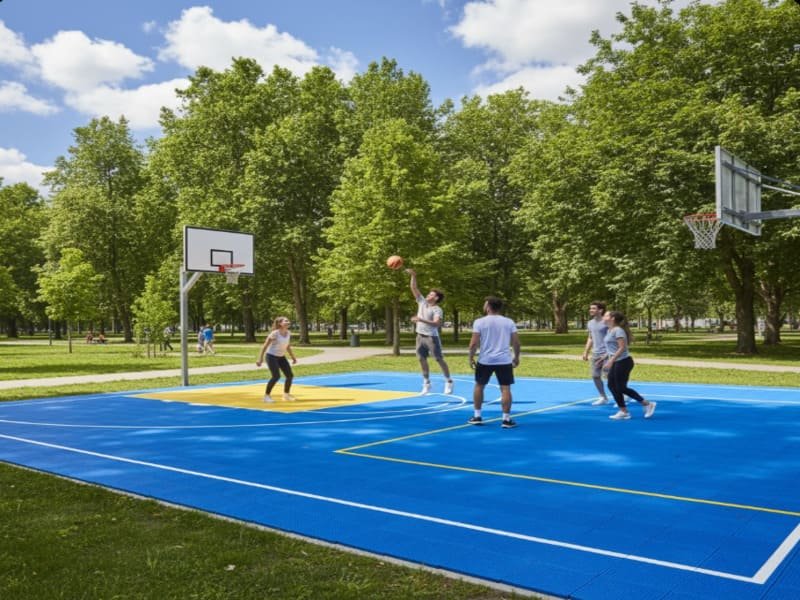
The best surface ultimately depends on your goals: Modular Polypropylene Tiles offer superior safety and durability for residential courts, while Acrylic Surfacing over Concrete delivers the professional-grade ball response used in competitive environments. To choose correctly, you must balance joint protection, local climate, and budget.
Based on my engineering experience in court materials, selecting a court surface is not about color—it’s about understanding what metrics define high-performance sports flooring, specifically physics, material resilience, and long-term performance. In manufacturing, we evaluate vertical deformation (shock absorption), ball rebound, and friction. A common homeowner mistake is focusing only on aesthetics while ignoring UV stability, thermal expansion, and drainage capability.
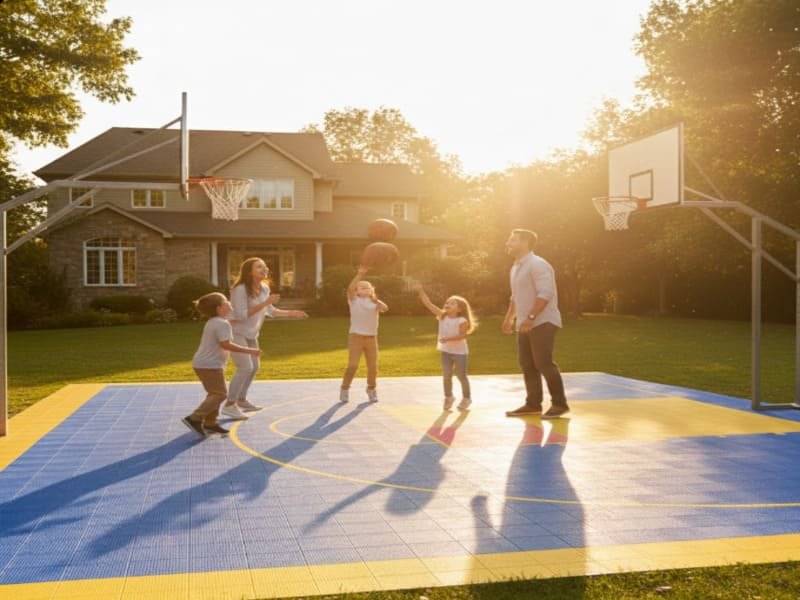
For backyard setups, I recommend modular tiles because they function as a floating system—they sit above the base, so even if concrete shifts or cracks, the tiles remain unaffected. For players who demand a true NBA feel, acrylic over a vapor-sealed concrete slab offers unmatched consistency, though it requires more maintenance.
Quick Guide: Best Surface by Scenario
| Scenario | Best Surface Recommendation | Why |
|---|---|---|
| Backyard Family Court | Modular Suspended Tiles | Best shock absorption; drains instantly after rain |
| Professional Training | Acrylic over Concrete | Consistent bounce & high traction |
| Tight Budget (<$5k) | Raw Concrete (Sealed) | Lowest cost; long lifespan |
| Rainy / Humid Climate | Modular Tiles (Open Grid) | No puddles; mold-resistant |
| Freeze/Thaw Zones | Modular Tiles | Handles expansion without cracking |
| Community Park | Asphalt | Cost-effective for large areas |

What Key Factors Must You Consider Before Choosing?
To select the optimal surface, focus on six engineering metrics:
1. Traction (Coefficient of Friction)
Surfaces must offer enough grip for quick stops—but not so much that they cause ankle injuries. High-quality surfaces maintain consistent grip even when dusty.
2. Shock Absorption (Force Reduction)
Concrete = 0% force reduction.
Quality modular tiles = 10–30%, which perfectly demonstrates what are the benefits of shock absorbing basketball flooring—meaning less impact traveling into knees and lower back—critical for kids and older players.
3. Climate Resilience
Materials expand and contract with temperature. Non-UV-stabilized surfaces become brittle or chalky. Freeze–thaw cycles can crack rigid coatings.
Top Contenders: In-Depth Engineering Review
A. Modular Suspended Tiles (The Engineer’s Choice for Homes)
Interlocking polypropylene (PP) tiles that snap together over a hard base.
Engineering Insight:
We use high-impact PP copolymers for the ideal balance of ball response and flexibility. Suspended legs create vertical cushioning and improve noise control.
Pros:
- Superior drainage
- Joint protection
- DIY installation
- Covers cracks in concrete
Cons:
- Slight hollow sound
- Higher upfront material cost

B. Acrylic Surfacing (The Professional Standard)
A multi-layer coating with silica sand applied over concrete.
Engineering Insight:
Sand mesh size controls traction and surface “speed.” Acrylic requires a flawless base because cracks telegraph through the coating.
Pros:
- Professional aesthetics
- Excellent ball bounce
- Custom colors
Cons:
- Minimal shock absorption
- Moisture can cause bubbles
- Requires professional installation
C. Concrete & Asphalt (The Basic Surfaces)
Concrete: rigid, durable, reliable ball bounce
Asphalt: flexible, cheaper, but oxidizes under UV and becomes brittle
Pros:
- Low initial cost
- Long lifespan
Cons:
- Hard on joints
- Slippery when wet (concrete)
- Cracks more easily (asphalt)
Head-to-Head Comparison Table
| Feature | Concrete | Asphalt | Modular Tiles | Acrylic System |
|---|---|---|---|---|
| Initial Cost | Low ($) | Low ($) | Medium ($$) | High ($$$) |
| Shock Absorption | 0% | ~5% | 20–30% | ~5–10% |
| Maintenance | Low | High | Low | Medium |
| Lifespan | 30+ Years | 10–15 Years | 15–20 Years | 5–8 Years |
| DIY Friendly | No | No | Yes | No |
| Ball Bounce | Excellent | Good | Good | Excellent |
What Is the Real Cost Breakdown Per Square Foot?
Approximate cost ranges (varies by region):
- Concrete slab: $4–$8 / sq ft
- Asphalt: $3–$6 / sq ft
- Modular tiles: $3.50–$5.50 / sq ft
- Acrylic system: +$4–$8 / sq ft (on top of base)
Cost Tiers
- Entry Level: Raw Concrete
- Mid-Range: Asphalt + Seal Coat
- Upper-Mid: Concrete Base + Modular Tiles
- Premium: Post-Tensioned Concrete + Cushioned Acrylic
Modular tiles often save money long-term because they’re a finished product requiring almost no maintenance.
Frequently Asked Questions (FAQ)
Can I install a court on grass or dirt?
No. Soil is unstable and shifts under load. You need concrete, asphalt, or compacted crushed stone as a rigid sub-base.
How thick should the concrete slab be?
4 inches, reinforced with rebar or mesh. Use 4000 psi concrete to prevent cracking.
Are modular tiles slippery when wet?
Quality tiles have textured patterns to increase traction. Their open-grid design drains water instantly.
How long does each surface last?
- Concrete: 30+ years
- Asphalt: 12–15 years
- Modular Tiles: 15–20 years
- Acrylic: 5–8 years
Conclusion & Final Verdict
There is no universally perfect surface—only the perfect surface for your needs.
Choose Modular Tiles if:
- You want a family-friendly backyard court
- You care about joint safety
- You need excellent drainage and low maintenance
Choose Acrylic if:
- You are a competitive player
- You need precise ball response and high traction
- You can maintain the surface every 5–7 years
Choose Concrete if:
- Budget is the top priority
- You are willing to sacrifice comfort for durability
Ready to Build Your Dream Court?
Don’t guess—use engineering-backed specifications.
👉 [Contact Us for a Free Quote & Sample Kit]
Experience the quality of our high-impact flooring tiles firsthand.
About the Author
I am a Production Process Engineer with over 10 years of experience in manufacturing sports flooring systems. I specialize in polymer material formulation and injection molding for outdoor applications, optimizing the balance between athletic performance, safety, and durability.