


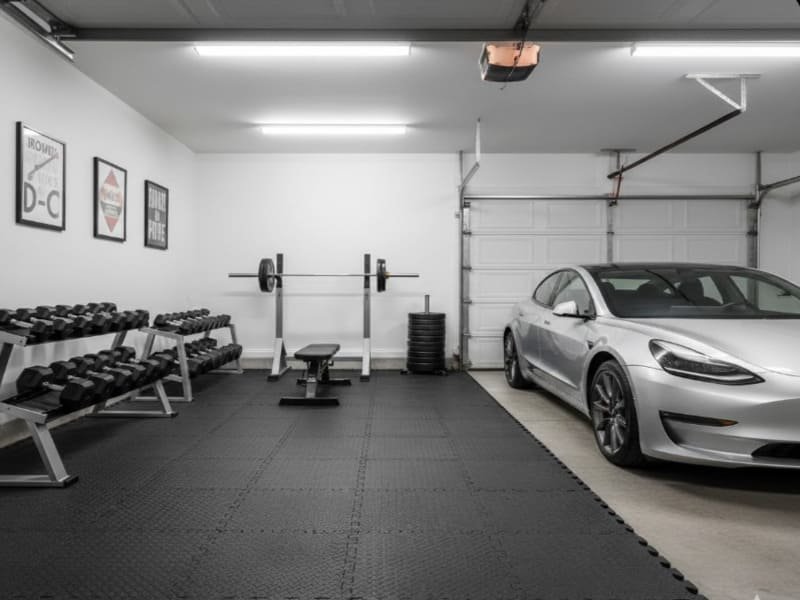
The best flooring for CrossFit depends entirely on your specific environment: for garage gyms, 3/4-inch vulcanized horse stall mats (density >950 kg/m³) are the gold standard; for commercial boxes, high-density rolled rubber combined with turf lanes offers the best balance of aesthetics, hygiene, and performance.
As an engineer who tests material resilience under dynamic loads, I treat the "clang" of a dropped barbell as a stress test, not just a sound. Unlike static commercial gyms, a CrossFit box is a high-impact zone. You are dealing with the kinetic energy of 225lb+ drops, repetitive friction from burpees, and heavy sled drags.
The goal is simple: Protection. You must protect the athlete’s joints, the bumper plates, and the concrete foundation. I have seen garage floors fracture because the owner chose aesthetics over physics. While branding matters, performance data must dictate your choice. You need a material that balances energy restitution with stability.

To make the right choice, ignore the marketing fluff and focus on the engineering specifications that actually define performance.
Critical Buying Factors: The Engineering Specs You Need?
When selecting flooring, look for three key metrics: Density (>950 kg/m³ for mats), Tensile Strength (2–3 MPa), and Shore Hardness (65–75A). These metrics are not arbitrary—force reduction, deformation control, and material recovery are standardized performance indicators used across professional sports flooring systems, which are defined and tested according to recognized performance benchmarks outlined in what metrics define high-performance sports flooring.
In my R&D lab, we verify these specs to ensure longevity. If the rubber doesn’t meet these baselines, it will fail under CrossFit conditions.
-
Density (Durability):
- Stall Mats: Must be >950 kg/m³. This ultra-high density (achieved via vulcanization) makes the mat waterproof and crush-proof.
- Rolled Rubber: Must be 840–900 kg/m³. Anything lower acts like a sponge, absorbing sweat and destabilizing heavy lifts.
-
Tensile Strength (Tear Resistance):
- Target 2–3 MPa. This prevents the floor from shredding during sled pushes or pivots.
-
Shore Hardness (Grip/Stability):
- Target 65–75 Shore A. Too soft (<60A) kills your lift energy; too hard (>80A) is slippery and dangerous.
Technical Specification Benchmark
| Spec | Stall Mats (Vulcanized) | Rolled Rubber (Commercial) | Cheap Gym Tiles (Avoid) |
|---|---|---|---|
| Density | >950 kg/m³ | 840–900 kg/m³ | <700 kg/m³ |
| Tensile Strength | 2.5 – 3 MPa | 1.5 – 2 MPa | <1 MPa |
| Shore Hardness | 65-75A | 60-65A | 45-55A (Too Soft) |

Now, let’s apply these specs to the two most common user scenarios.
Scenario Analysis: Garage Gym vs. Commercial Box?
For Garage Gyms, prioritize utility and cost-efficiency with 4’x6′ Stall Mats; for Commercial Boxes, prioritize cleanability and zoning by using Rolled Rubber and Turf.
The "best" floor is relative to your constraints.
Scenario A: The Garage Gym Owner
- The Constraint: Low budget, multi-use space (parking cars).
- The Solution: 3/4" Vulcanized Stall Mats.
- Why: With a density >950 kg/m³, they withstand the point load of a 4,000lb vehicle without deforming. They are heavy enough (100lbs/mat) to stay in place without glue, allowing you to remove them if needed.
Scenario B: The Commercial Box Owner
- The Constraint: Large surface area, high foot traffic, need for hygiene.
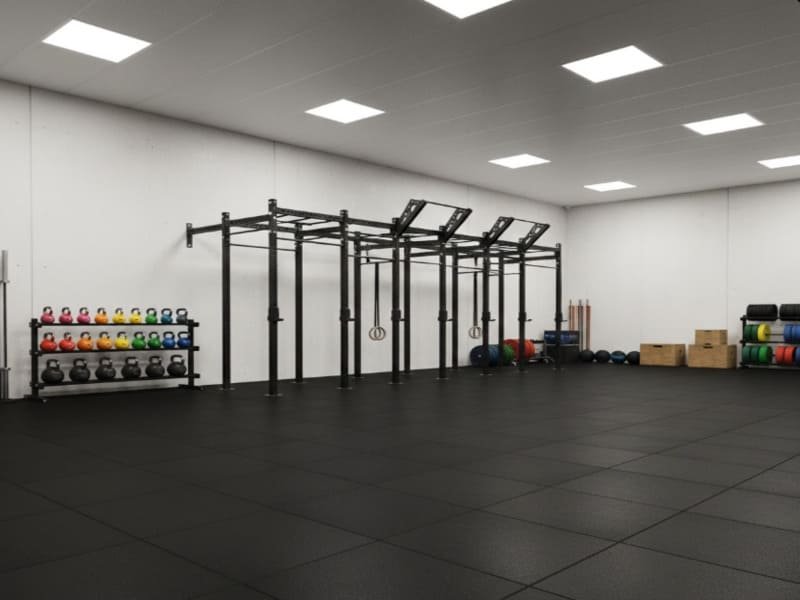
- The Solution: High-Density Rolls + Turf Zone.
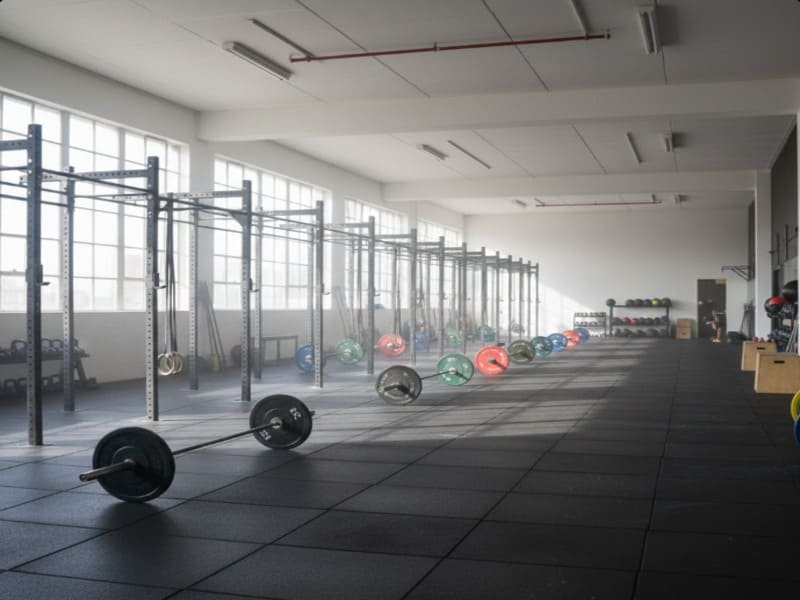
- Why: Rolls reduce seams by 80%, making cleaning significantly faster. We integrate Turf Strips for sleds to prevent rubber burn (thermal degradation) and Wooden Platforms for dedicated Oly lifting stations.
Here is how the specific products rank based on performance metrics.
Top Contenders: The Best Flooring Options Ranked?
The top contenders are Horse Stall Mats (Best Value), Rolled Rubber (Best Aesthetics), and Artificial Turf (Essential for Sleds). Avoid EVA foam and bare concrete at all costs.
- Horse Stall Mats (4’x6′): The industry benchmark. Max density equals max protection. The trade-off is the industrial smell and look.
- Rolled Rubber: The professional choice. Provides a seamless, flat surface. Ensure you buy "re-vulcanized" or high-binder content rolls to avoid crumbling.
- Artificial Turf: Critical for a 10-yard sled strip. Dragging heavy sleds on rubber creates shear stress and heat; turf eliminates this.
- AVOID:
- EVA Foam: Density <150 kg/m³. Compresses to zero under load. Dangerous for ankles.
- Bare Concrete: High compressive strength but low tensile strength. It will crack under impact.
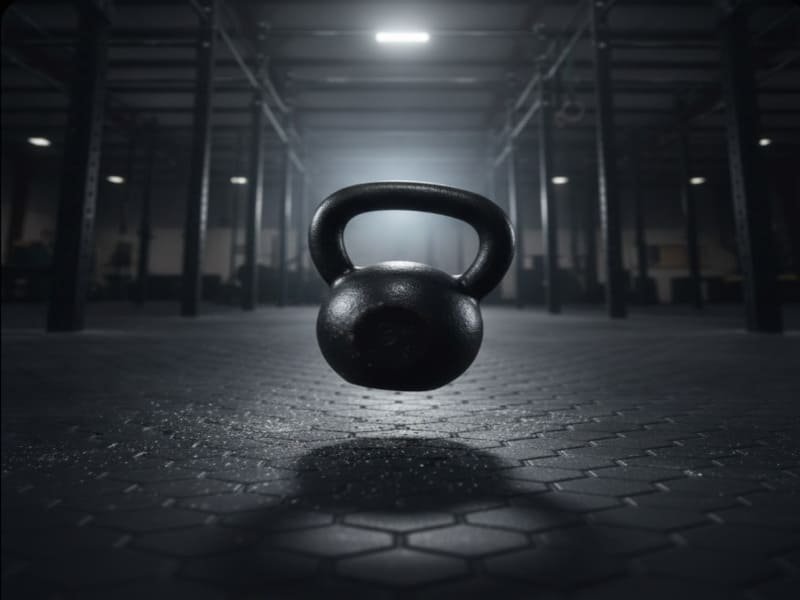
Proper installation is just as important as the material choice. The performance difference between stall mats, interlocking tiles, and rolled rubber often comes down to acclimation, cutting accuracy, and adhesion method, which is why installation workflows differ significantly between tiles and rolls when applying rubber gym flooring in real-world conditions: How to Apply Rubber Tiles vs. Rolls in Gym Flooring.
Installation: DIY vs. Professional?
Installation requires acclimation (24-48 hours), precise cutting with fresh blades, and choosing between loose-lay (mats) or full glue-down (rolls).
- Acclimation: Rubber expands with heat. Unroll flooring for 24 hours before cutting, or gaps will appear later.
- Cutting: Use a straight edge and a fresh utility blade. Pro Tip: Place a 2×4 under the cut line to bend the rubber—this opens the seam and reduces friction on the blade.
- Adhesive: Garage mats can be "loose laid" (gravity holds them). Commercial rolls must be taped or glued to prevent rippling under traffic.
Let’s break down the investment required for these configurations.
Budget Breakdown & Recommended Configurations?
For budgets under $500, stick to Stall Mats; for mid-range budgets, add a Turf strip; for commercial facilities, invest in Rolls, Sled Lanes, and Platforms.
Don’t just spend money; allocate it where it impacts performance.
Recommended Budget Matrix
| Budget Tier | Configuration | Est. Cost | Key Advantage |
|---|---|---|---|
| < $500 (Home) | Stall Mats Only | ~$1.80/sq.ft | Best ROI / Indestructible |
| $800-$1500 | Mats + Turf Strip | Turf: ~$3.50/sq.ft | Adds Sled Work Capability |
| Commercial | Rolls + Turf + Platforms | Rolls: ~$2.50/sq.ft | Aesthetics + Cleanability |
Note: Always factor in shipping costs, as rubber is extremely heavy.

Finally, I’ll answer the most frequent technical questions I receive.
Frequently Asked Questions (FAQ)?
Common questions cover parking, odor, thickness, and long-term maintenance. Below are the answers I give most often in my R&D consultations.
1. Can I park my car on stall mats in a garage gym?
Yes.
Vulcanized stall mats (>950 kg/m³ density) are engineered to withstand extreme point loads. A passenger vehicle exerts far less pressure than a loaded barbell dropped from overhead.
Reminder: Avoid prolonged exposure to oil leaks, as petroleum products can soften rubber over time.
2. Why do cheap rubber mats smell so bad?
Odor comes from low-grade SBR, high sulfur content, and low binder ratio.
Premium mats (vulcanized or high-binder commercial rolls) emit far fewer VOCs.
To reduce initial odor:
- Unbox outdoors for 24–48 hrs
- Clean with diluted vinegar
- Improve airflow during the first week
3. What thickness should I choose for CrossFit?
- Garage Gyms: 3/4 inch (19mm) stall mats are the gold standard
- Commercial Boxes: 8mm–12mm rolled rubber + platforms
- Dedicated lifting zones: Add 2–3 layers or use built platforms
Anything thinner than 8mm will fail under barbell drops.
4. Do I need adhesive for installation?
- Stall Mats: No. Loose-lay works because of weight + density
- Rolled Rubber: Yes. Full glue-down or seam tape prevents ripples
- Turf: Always glued or seamed for sled work
5. Will heavy deadlifts crack my concrete?
Yes—if unprotected.
Concrete has high compressive strength but low tensile strength, making it vulnerable to shock waves from drops above 200–300 lb.
High-density mats + platforms eliminate this risk.
6. How do I clean and maintain rubber flooring?
- Daily: Dry sweep
- Weekly: Wet mop with neutral pH cleaner
- Monthly: Deep scrub (commercial boxes)
- Avoid: Bleach, petroleum, acetone—these degrade polymer chains
Proper care extends lifespan from 7 years → 12+ years.
7. Is turf necessary for a CrossFit box?
If your programming includes sled drags: Yes.
Dragging on rubber causes:
- Shear stress
- Heat buildup
- Surface burn
Turf provides a low-friction, high-wear channel for sleds and sprints.
Conclusion
Stall Mats dominate garage gyms for one reason: unmatched density and value.
Rolled Rubber elevates commercial boxes with cleanability, aesthetics, and seamless surfaces.
Turf is the non-negotiable addition for any facility running sled programming.
Your final choice should be based on environment, training intensity, and budget—but always anchored in engineering specifications, not marketing.
Rubber flooring is not just a surface; it is a performance system that protects athletes, equipment, and your foundation.
Call to Action (CTA)
If you want:
- A full customized floor plan for your garage or CrossFit box
- Material specs validated by my lab
- Or a comparison of suppliers based on durability + density
Tell me your room size, budget, and training style—I’ll design the optimal configuration for you.