


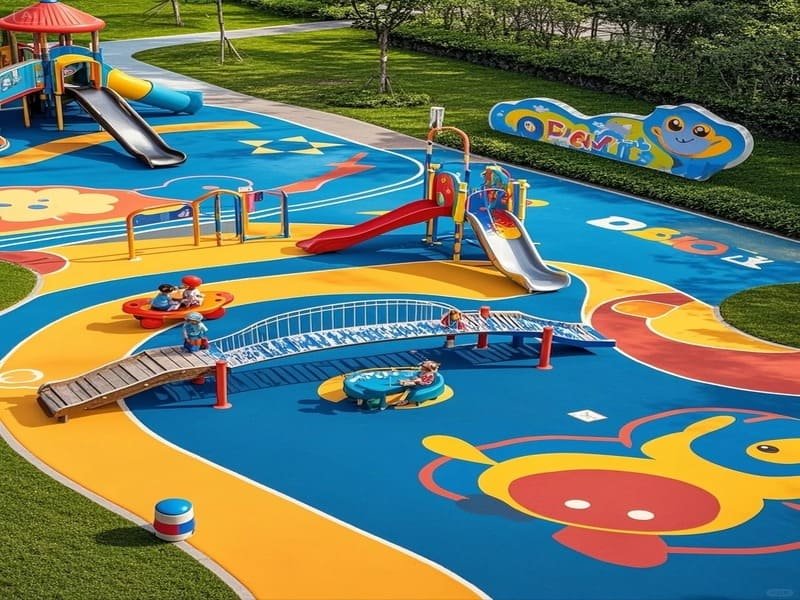
Choosing the right playground flooring isn’t about picking the prettiest color; it is an engineering decision based on three non-negotiable factors: Critical Fall Height (CFH) compliance, Total Cost of Ownership (TCO), and ADA accessibility. Neglecting these for a lower upfront price increases liability risks and long-term maintenance costs.
In my years as a production engineer designing rubber compounding processes, I have seen safe-looking playgrounds fail catastrophic safety audits because the surfacing was chosen based on aesthetics rather than physics. The reality is harsh: 70% of playground injuries occur due to falls. The ground beneath a child’s feet is their primary safety device.
Many buyers view flooring as a design element, similar to picking wallpaper. However, I approach it as a shock-absorption system. A "cheap" installation that fails to meet ASTM F1292 standards isn’t just a bad investment; it is a lawsuit waiting to happen. The cost of a single liability claim often dwarfs the price difference between mulch and high-quality engineered rubber tiles. Furthermore, maintenance plays a huge role. I often see facility managers blowing their budgets on labor to rake wood chips back into place, wishing they had invested in a unitary system from day one.
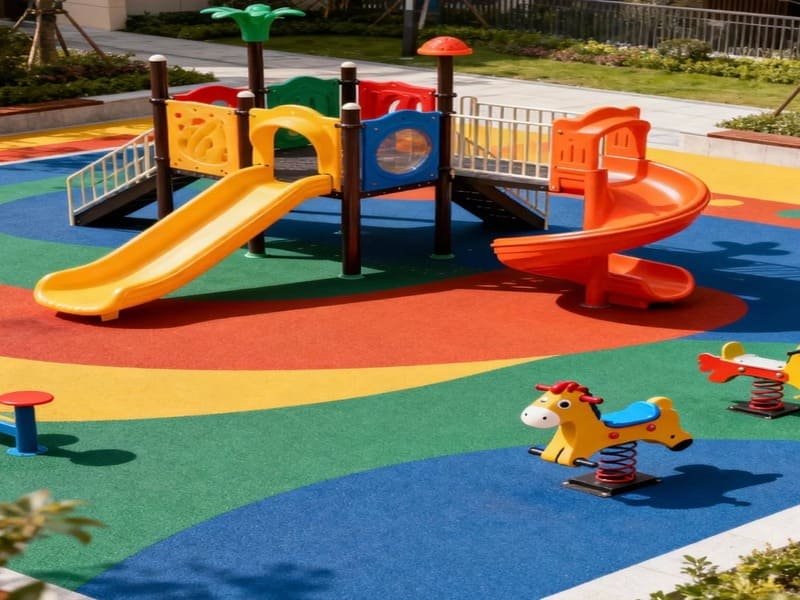
Now that we understand the gravity of the decision, let’s look at the science that dictates how thick and soft your floor actually needs to be.
The Science of Safety: Understanding HIC & Fall Height?
Safety is calculated using the Head Injury Criteria (HIC) and Critical Fall Height (CFH). To prevent life-threatening injuries, the flooring’s shock absorption capability must match or exceed the highest accessible point of your play equipment, certified by ASTM F1292 lab tests.
The Physics of Falling
As an engineer, I live by data. In playground surfacing, the only number that matters is the HIC score (Head Injury Criteria). A score of 1000 is the limit where a life-threatening brain injury is unlikely.
However, thicker isn’t always better. We call this the "Marshmallow Effect." If a surface is too soft (like a deep, uncompacted pit of foam), it provides no stability. A child running across it will roll their ankle because the ground absorbs too much energy, offering no reaction force. Conversely, if it is too hard, it fails the HIC test.
Accessibility vs. Technical Compliance
Many loose-fill materials claim to be "ADA Compliant." In a lab, they might pass. But in the real world? Try pushing a wheelchair through 12 inches of wood chips after a rainstorm. It is impossible. True accessibility requires a stable, firm surface that doesn’t displace under load.
Understanding the required thickness is step one; step two is selecting the material system that fits your operational budget and maintenance capabilities.
The Great Showdown: Loose-Fill vs. Unitary Systems?
Loose-fill systems (wood chips, sand) offer the lowest initial purchase price but require daily maintenance and often fail accessibility tests over time. Unitary systems (rubber tiles, PIP, turf) require a higher upfront investment but provide superior safety, zero displacement, and full ADA compliance with minimal upkeep.
The Engineering Trade-off
In manufacturing, we talk about CAPEX (Capital Expenditure) vs. OPEX (Operating Expenditure). This exact concept applies here.
Option A: Loose-Fill (The OPEX Nightmare)
Materials like sand, wood chips, and Engineered Wood Fiber (EWF) are cheap to buy. However, physics works against them. Kids kick them out of the play zone (displacement), and rain compacts them.
- The Hidden Danger: I have found broken glass, used needles, and animal waste buried in sandboxes. You cannot "clean" loose fill; you can only rake it or replace it.
- The Verdict: Only suitable for public parks with dedicated daily maintenance crews.
Option B: Unitary Systems (The CAPEX Investment)
Rubber tiles, Pour-in-Place (PIP) rubber, and artificial turf create a seamless or locked surface.
- The Engineering Edge: We engineer these materials with dual-density layers—a soft bottom for shock absorption and a dense top for durability.
- The Verdict: Essential for schools, daycares, and commercial centers where safety and low maintenance are paramount.
System Comparison Matrix
| Feature | Loose-Fill (Wood/Sand) | Unitary (Rubber Tiles/PIP) |
|---|---|---|
| Initial Cost | Low ($) | Moderate to High ($$-$$$) |
| Maintenance | Daily Raking & Top-ups | Occasional Cleaning |
| ADA Accessibility | Poor (Degrades quickly) | Excellent (Stable & Firm) |
| Hygiene | Low (Hides hazards) | High (Easy to sanitize) |
| Lifespan | 1-2 Years (Needs refill) | 8-15 Years |
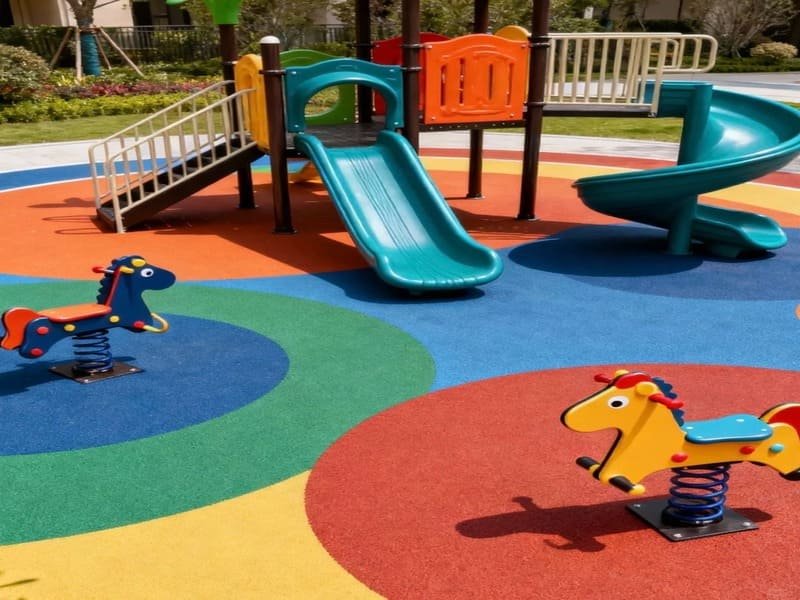
Even if you choose the high-end rubber option, there are manufacturing details that dishonest suppliers hide. Here is what you need to know to avoid failure.
Manufacturer’s Secrets: 3 Factors Competitors Won’t Tell You?
The longevity of your playground flooring depends less on the rubber itself and more on the sub-base preparation, the type of polyurethane binder used (Aliphatic vs. Aromatic), and the thermal management of the surface color.
1. The Sub-Base is King
You cannot install high-performance rubber tiles directly over grass or dirt. I see this mistake constantly. Organic matter decays, causing the ground to shift and sink.
The Fix: You need a solid sub-base. Ideally, concrete or asphalt. If that is too expensive, a properly compacted crushed stone base with a geotextile weed barrier is the minimum engineering requirement for drainage and stability. For detailed sub-floor preparation technical standards, see our A Comprehensive Guide to Commercial Gym Flooring Installation.
2. Heat Build-Up: The "Hot Tire" Effect
Recycled SBR rubber is black. In direct summer sun, black rubber can reach temperatures of over 160°F (71°C). This can burn a child’s skin in seconds.
The Fix: If your playground is unshaded, do not use plain black tiles. You must specify an EPDM top layer in a lighter color (beige, grey, or green) or install shade sails. (Note: Since EPDM requires specific bonding techniques, you can refer to our How to Install EPDM Rubber Flooring: The Ultimate Guide for professional execution.)
3. UV Stability: The Glue Matters
This is the biggest secret in the industry. Rubber granules are held together by polyurethane binder.
- Aromatic Binder: Cheap, turns yellow/amber when exposed to sunlight (UV). If you buy blue flooring with aromatic binder, it will look green in three months. eventually, it becomes brittle and cracks.
- Aliphatic Binder: Expensive, UV-stable, stays clear. It keeps colors vibrant and maintains flexibility for years. Always ask your supplier which binder they use.
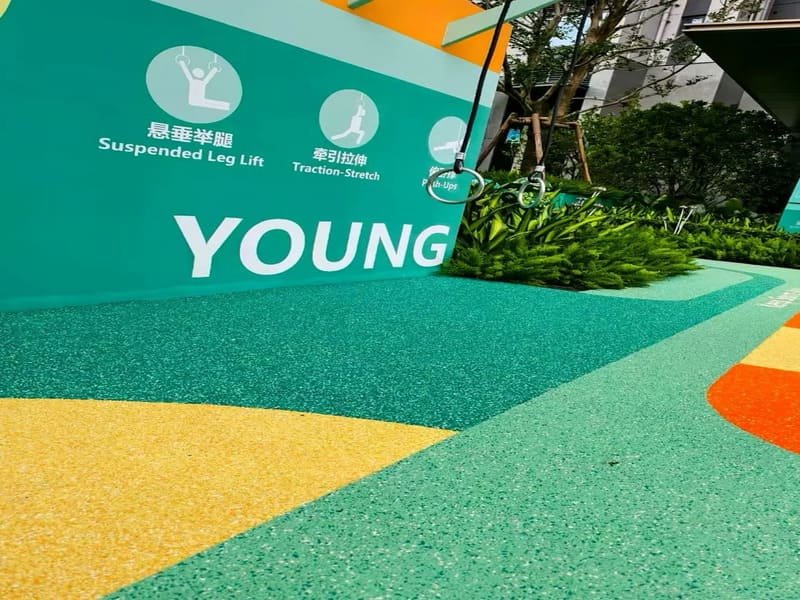
Knowing these secrets helps you assess quality, but how does this impact your wallet in the long run? Let’s run the numbers.
Cost Analysis: Upfront Price vs. Total Cost of Ownership (TCO)?
While wood mulch may cost 60% less initially, the cumulative costs of topping up material, daily labor for raking, and potential liability claims make it more expensive than rubber tiles over a standard 5-year lifecycle.
The "Cheap" Trap Calculation
Let’s analyze a hypothetical 1,000 sq. ft. playground.
Scenario A: Engineered Wood Fiber (EWF)
- Year 1: Install cost is low.
- Years 2-5: Every year, you lose 10-20% of volume to decomposition and displacement. You must buy new mulch and pay for shipping. Plus, you pay a staff member 30 minutes daily to rake it level under the swings.
- Result: By Year 5, your OPEX has exceeded your initial CAPEX.
Scenario B: Interlocking Rubber Tiles
- Year 1: Higher material cost.
- Years 2-5: Zero top-up costs. Maintenance involves a leaf blower or a hose down once a week.
- Result: The Break-Even Point usually hits around Year 3. After that, you are saving money every single day.
Longevity Expectations
- Mulch/Sand: Functional lifespan is 6-12 months before maintenance is critical.
- Rubber Tiles: 10+ years (if chemically bonded correctly).
- PIP Rubber: 8-12 years (heavily dependent on the installer’s skill).
Now that the financial case is clear, here is your step-by-step protocol to ensure you order the exact right product for your site.
5-Step Checklist: How to Buy the Right Flooring?
To purchase correctly, you must measure the maximum fall height, define your user group’s age, assess local climate drainage needs, separate your construction vs. maintenance budgets, and strictly demand ASTM F1292 test reports.
Step 1: Measure Fall Height
Identify the highest platform or climbable point. If the highest deck is 6 feet, buy flooring rated for 7 or 8 feet. Never buy exactly at the limit; always build in a safety margin.
Step 2: Define the Users
- Toddlers (0-2 years): Avoid mulch/gravel. They put everything in their mouths (choking hazard). You need smooth, unitary surfaces like tiles or turf.
- Older Kids (5-12 years): High impact. Focus on maximum HIC ratings under swings and slides.
Step 3: Check the Climate
- Heavy Rain Areas: You need tiles with a "waffle" or "footed" bottom design that allows water to flow underneath.
- High Sun Areas: Invest in Aliphatic binders and EPDM color caps to resist UV degradation.
Step 4: Set the Budget (CapEx vs OpEx)
If you have a grant for construction but no budget for a groundskeeper, do not buy loose fill. Spend the grant money on rubber now to save your operating budget later.
Step 5: Request Samples & Certifications
Never rely on a brochure. Ask for:
- A physical sample: Cut it open. Check the density.
- The ASTM F1292 Report: Ensure it is recent and specific to the thickness you are buying.
Conclusion
The best playground flooring is the one you don’t have to worry about. It protects children from falls, withstands the elements, and doesn’t drain your bank account with endless repairs.
Don’t guess when it comes to safety compliance.
If you are unsure about the Critical Fall Height of your equipment or need a material sample to test the density yourself, contact our engineering team today. We can provide a free safety assessment and send you a sample kit to compare the quality firsthand.