


Horses stand most of the day, and hard, unforgiving surfaces stress their joints, legs, and hooves. Horse mats absorb impact, provide cushioning, and create a safer, more hygienic environment.
As a Quality Control Engineer in the $Horse \ Mats$ industry, I see the direct link between a stall’s flooring and an animal’s long-term health. Without good flooring, stalls become slippery, dirty, and a constant source of discomfort. Using quality $stall \ mats$ is not a luxury; it is a required investment for equine welfare and efficient stable management. We must ensure every mat delivers on key performance metrics like shock absorption and hygiene.
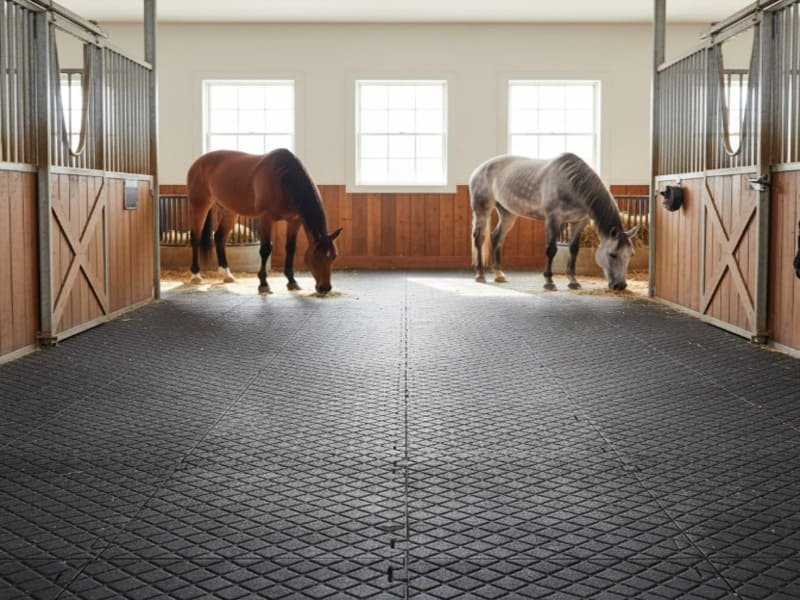
I work with stable owners and product developers who want the best for their horses. They need to know what floor solution works, what lasts, and why. The right matting system protects against cold, damp conditions, reduces the risk of injury, and greatly simplifies cleaning. The focus is always on five main benefits: hoof protection, joint comfort, superior hygiene, thermal insulation, and anti-slip safety. Let me explain why these mats are vital for every stable.
Do Horse Mats Really Make a Difference in Equine Health?
Yes, $horse \ mats$ make a critical difference. They provide necessary shock absorption, reduce stress on joints and tendons, and minimize the risk of hoof trauma caused by standing on hard, abrasive concrete floors.
Experience shows me that $equine \ health$ depends heavily on the surface below the hooves. When a horse stands or lies down on a firm surface, the impact and constant pressure can lead to chronic joint issues over time. Mats distribute the horse’s weight more evenly. This means less localized stress on the knees, hocks, and fetlocks. I have seen stables report fewer cases of stocking up (fluid accumulation in lower legs) after installing high-density rubber mats. This material acts like a controlled spring, dampening the energy of movement, which reduces fatigue and encourages deeper rest.
Why Mats Reduce Joint Strain
Mats provide engineered support. They move with the horse but do not give too much. This balance is key.
| Benefit Area | Mechanism of Action | Engineering Detail |
|---|---|---|
| Joint Protection | Absorbs impact force when the horse lies down or gets up. | High material density (e.g., $1.4 \ g/cm^3$ for rubber) ensures sustained rebound. |
| Tendon Health | Reduces concussive forces from pawing or shifting weight. | $30 \ mm$ minimum thickness provides the necessary cushioning depth. |
| Muscle Fatigue | Offers a comfortable, stable standing surface. | Textured surface prevents minor slips, reducing muscle effort to maintain balance. |
I once worked with a developer needing mats for an older horse rehabilitation center. The requirement was maximum softness, while still being firm enough to prevent slippage when the horse stood up. We specified a $40 \ mm$ EVA foam mat overlaid with a thin, durable rubber mat for grip. This combination delivered the required comfort and safety, something impossible with just bedding. This practical approach is the core of our engineering optimization. We use technical knowledge to solve real-world design challenges.
This is why we engineer mats with specific densities. Density is a measure of how much material is in a space. The right density means the mat does not flatten out quickly, maintaining its protective function for years. Poor quality mats feel soft but lack the necessary structural integrity to support heavy weight over time. The material’s ability to resist "compression set" is what guarantees long-term performance. We always recommend consulting on the specific density required for the horse’s weight and the application.
How Do Quality Mats Improve Stable Hygiene and Reduce Costs?
In my experience, hygiene is often the biggest cost and labor saver. Stall mats act as a waterproof barrier between the horse and the subfloor. Urine runs off the surface instead of soaking into the bedding and the concrete below. This prevents the constant presence of ammonia gas and bacteria. Ammonia can cause respiratory issues and thrush in hooves. We design our mats with integrated drainage channels or grooves on the underside. These features allow moisture to travel away quickly when the mat is lifted, or to drain away if the stall has a slight slope.
Traditional Bedding Versus Rubber Mats
| Feature | Traditional Bedding (e.g., Shavings) | High-Density Rubber Matting |
|---|---|---|
| Urine Absorption | High absorption; becomes saturated quickly. | Non-porous; urine drains away or sits on the surface. |
| Bacteria/Mold | Grows quickly in damp, organic material. | Resistant to bacterial growth; easy to disinfect. |
| Cleaning Labor | Requires full muck-out and disposal of large material volume. | Requires simple surface scraping and minimal bedding removal. |
| Material Cost | High recurring monthly cost for resupply. | High initial cost, but minimal ongoing cost for up to $15$ years. |
| Ammonia Level | High potential for high ammonia levels. | Low potential; easy to eliminate moisture that creates ammonia. |
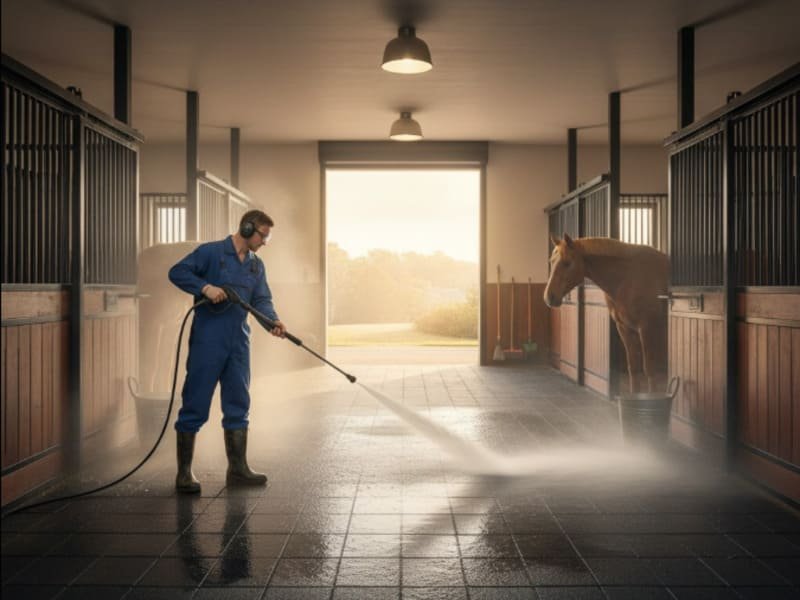
I often advise new clients to look at the numbers. Installing a quality $30 \ mm$ rubber mat system can reduce bedding consumption by up to $60\%$. This means less time mucking stalls, lower labor costs, and a much lower bill for buying and disposing of shavings or straw. This change improves the air quality in the barn, which benefits both the horses and the stable staff. Furthermore, mats are easy to clean with a simple hose or mild detergent. This consistent, deep cleaning is impossible with a dirt or plain concrete floor. We use materials certified to standards like REACH and RoHS to ensure no harmful chemicals are in the rubber. This commitment ensures safety and quality.

Mats also help with thermal insulation. Concrete floors stay very cold in winter. This cold transfers directly to the horse’s legs and body when they lie down. The thick rubber or EVA foam provides an insulating layer. This layer protects the horse from the cold and damp, which is very important for circulation and muscle health. The mat keeps the horse warm and dry, improving comfort and reducing illness risk. Our manufacturing knowledge helps us recommend material compounds that maximize insulation without compromising durability.
Which Mat Material is Best for Heavy-Duty Use and Durability?
For $heavy-duty$ use and maximum durability in a stall, $high-density \ rubber \ mats$ are the best choice. They offer superior wear resistance, stability, and a long lifespan of $10$ to $15$ years.
| Material | Durability | Cushioning | Maintenance | Ideal Use |
|---|---|---|---|---|
| Rubber | ★★★★★ | ★★★★☆ | Easy to clean | Heavy-duty stalls, wash bays |
| EVA Foam | ★★★☆☆ | ★★★★★ | Requires care | Temporary use, light-weight animals |
| PVC | ★★★★☆ | ★★★☆☆ | Waterproof | Outdoor areas, feeders |
When we talk about the best material, we must consider the usage. Rubber mats are heavier. The weight makes them stay flat and stable against constant shifting and movement from a thousand-pound animal. The composition of vulcanized rubber gives it excellent tear strength and compression set resistance. Compression set means the mat resists permanent deformation even under long-term pressure. This material choice is what ensures the longevity of the mat’s shock absorption capability.
Material Choice for Specific Stable Areas
We tailor the material to the specific application.
Rubber for Stalls and Wash Bays
For stalls, I always recommend a minimum $30 \ mm$ thick, high-density rubber mat. This thickness provides enough material to absorb impact effectively and withstand the constant wear of hooves and stable tools. For wash bays, the requirement shifts slightly. The mat must be fully waterproof and have excellent drainage. We often specify a mat with a highly aggressive surface texture or a porous structure to ensure water runs off fast and the surface remains anti-slip, even when soapy.
EVA Foam for Temporary or Lightweight Use
EVA foam mats are much lighter. This makes them easy to move and install. They offer fantastic cushioning, often more than rubber, which is great for specialized medical or recovery stalls. However, they are less resistant to tearing and concentrated pressure. They work well for temporary event stalls or for smaller ponies.
I remember a client who tried to use thin, low-density rubber mats to save money. After six months, the mats had stretched, buckled, and developed permanent indentations where the horse stood. This created trip hazards and ruined the drainage. The lesson is clear: buy the right density and thickness once. The industry standard $30 \ mm$ mat is the cost-effective long-term choice. Our role is to provide technical guidance and help our clients avoid these common, costly design mistakes.
Conclusion
The use of high-quality $horse \ stall \ mats$ is the best investment for a horse’s health, safety, and a stable’s operating budget.
My Role
As a Quality Control Engineer in the $Horse \ Mats$ manufacturing sector, I specialize in the technical specifications, material science (rubber, EVA, PVC), and engineering design required to produce flooring that meets stringent equine safety and performance standards. I advise clients on optimal mat thickness, density, and drainage features for long-term health and cost-efficiency.
Ready to give your horse a safer, cleaner, and more comfortable space? We offer a range of high-density rubber mats with integrated drainage design and anti-slip surfaces. Contact my team today for a custom quote or to request a free material sample. We are ready to partner with you to engineer the perfect flooring solution for your stable.