



The hidden factor affecting your race time is the floor’s friction coefficient, which dramatically changes the biomechanics and metabolic effort required for sled work and burpee broad jumps. Understanding this variable is the key to translating your gym training effort into actual race-day performance, optimizing your pacing and maximizing energy conservation.
The Technical Imperative: Why Floor Friction is Your Hidden Variable?
You train hard, track your heart rate zones, but still feel inconsistent when race day arrives. Why? As a production process engineer, I confirm the hidden variable is friction. The standard Hyrox setup—specifically the contrast between high-friction turf/carpet and lower-friction rubber mats—dramatically changes the effort required for key stations. This mechanical change skews your expected calorie expenditure and heart rate response, turning a predictable workout into a metabolic guessing game.
Analyzing the Biomechanical and Metabolic Differences
My core thesis is this: you must analyze the biomechanical and metabolic differences of performing Sled Work and Burpee Broad Jumps on high-friction versus low-friction surfaces. This knowledge is essential for effective training intensity and a successful race-day strategy.
| Movement & Surface | Primary Energy System Shift | Biomechanical Adjustment Required |
|---|---|---|
| Sled Push (High-Friction Turf) | Massive shift to Anaerobic (lactic) due to high static friction. | Lower body angle, shorter, choppy steps, focus on constant tension. |
| Sled Push (Low-Friction Rubber) | Focus remains on Aerobic/Power to maintain momentum. | Higher body angle, longer strides, focus on powerful hip extension. |
| Burpee Broad Jump (Hard Rubber) | Efficient use of Elastic Energy (plyometric focus). | Minimal ground contact time, focus on distance per jump. |
| Burpee Broad Jump (Softer Turf) | Higher reliance on Muscular Force (less elastic return). | Focus on rhythm to manage higher muscular effort and impact absorption. |
The takeaway for readers is how to translate their gym-based efforts to this race-day reality. You must not just train the movements; you must train the friction.
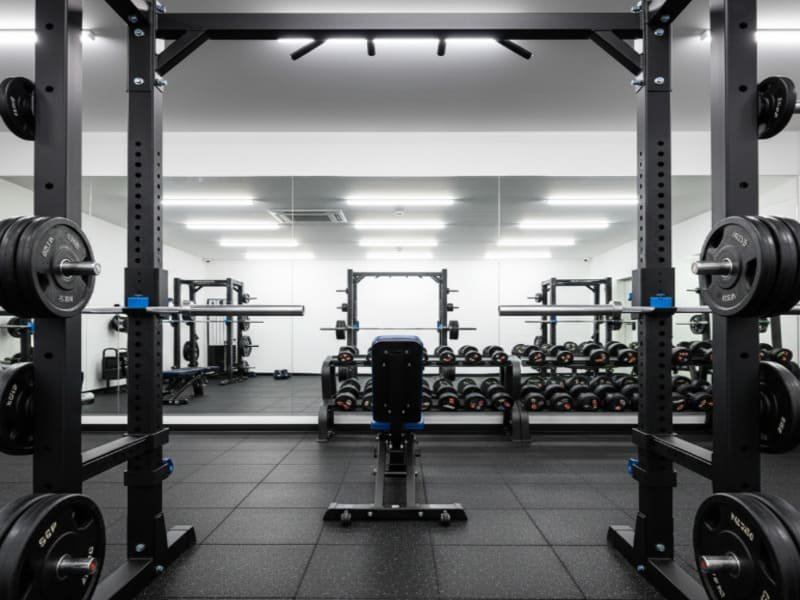
The long-term success of your training relies on accurately matching the high metabolic demand of the race floor, even if your gym floor is different.
The Sled Stations: A Battle Against Friction
The Sled Stations are often where races are won or lost because they force an immediate, massive spike in effort. This is a direct battle against the floor’s friction coefficient, which governs the required Rate of Perceived Exertion (RPE).
Sled Push & Pull: Biomechanics of Different Surfaces
High-Friction (Carpet/Hyrox Turf)
The challenge here is the massive initial burst of static friction needed to start the sled moving, followed by a sustained output against high kinetic friction.
- Biomechanical Shift: The athlete must adopt a lower, more powerful body angle, relying heavily on the quads, glutes, and core stability. Shorter, choppy steps are often necessary to maintain continuous tension and prevent the sled from stalling.
- Result: This high resistance leads to a higher Metabolic Demand (Calorie Burn) per meter and a much faster build-up of Lactate. The athlete is forced immediately into a high Heart Rate Zone (Zone 4/5) upon starting.
Low-Friction (Smooth Rubber/Gym Floor)
This surface is easier to start, meaning momentum is key. The main risk is the athlete slipping or failing to utilize the full force capacity of their leg drive, leading to an artificially lower training stimulus.
- Biomechanical Shift: The surface allows for longer strides, a more forward lean, and a greater focus on powerful hip extension.
- Result: Lower effort is needed to maintain speed. This is potentially more efficient but risks under-training the specific metabolic demands of the race if the load is not properly adjusted.
Heart Rate Zone & Calorie Comparison (The Numbers)
My advice for training application is simple: You must load the sled heavier on a smooth floor or use a drag chain to match the RPE of a lighter sled on turf. For illustrative purposes: a sled push that causes a peak heart rate of 175 bpm within 30 seconds on high-friction turf might require you to increase the gym load by an estimated 20% to 30% on a smooth rubber floor to achieve the same metabolic spike and RPE. These are experienced-based ranges, not standardized test data. The massive Heart Rate Spike during the turf sled work can immediately affect the subsequent 1km run, potentially causing an immediate jump into Zone 5 if pacing is not perfect.

You need to train your body to recover from that metabolic spike while running, which means integrating sled work with running intervals that simulate race conditions.
The Burpee Broad Jump: Plyometrics & Landing Mechanics
The floor surface also fundamentally changes the dynamics of the Burpee Broad Jump, affecting both power output and joint impact management over the 80-meter distance.
Surface Impact on Power and Exercise Efficiency
Hard Rubber/Solid Floor
- Advantage: Provides a firm base for the explosive jump, allowing for more efficient force transfer from the ground. This often encourages maximal jump effort.
- Disadvantage: Results in higher impact forces on landing, potentially leading to faster fatigue in the ankles, knees, and lower back over 80 meters.
- Effect on Biomechanics: Encourages maximal jump effort (longer distance per rep) but taxes stabilizing muscles upon landing. Athletes can use stored elastic energy more effectively.
Turf/Carpet/Softer Surface
- Advantage: Offers a more forgiving landing, which translates to less impact on joints and a lower risk of acute pain.
- Disadvantage: The surface absorbs some of the elastic energy during the jump, requiring more pure muscular effort for the same distance (lower exercise efficiency). There is also potential for feet to catch on the material during the broad jump.
- Effect on Metabolic Rate: The reduced elastic efficiency means more muscular work is required to cover the same distance. This leads to a higher sustained Calorie Burn over the 80m distance for the same overall pace.

Pacing and Heart Rate Zones
The Burpee Broad Jump is an immediate, high-volume plyometric effort. The surface influences the duration spent in the Anaerobic (Zone 4/5) threshold. I advise athletes to look at the "Step-Up" vs. "Jump-Up" Burpee technique. A softer surface might reward a controlled stepping technique to save impact and manage muscular fatigue, while a harder surface demands a rhythmic, powerful sequence that minimizes ground contact time to maximize distance efficiency. Pacing is not about speed; it’s about minimizing the impact rate and maintaining a consistent rhythm that prevents an uncontrolled spike in heart rate.

Managing the jump rhythm on a forgiving surface is key to avoiding over-exertion early in the 80-meter stretch.
Training Prescription: Translating Friction to Performance
As your technical partner, my goal is to provide actionable advice so you can perfectly match your training effort to race-day demands.
Training for Metabolic Demand (Calorie/Energy Systems)
- Sled Drag Intervals: Structure your training intervals to match the metabolic effort of the high-friction race surface, even if your gym floor is smoother. If the Hyrox sled takes 90 seconds to push, structure your gym interval to last 90 seconds, even if it requires a much heavier load to maintain that effort duration and high heart rate.
- Heart Rate Monitoring: Use the Rate of Perceived Exertion (RPE) as a primary tool. If the sled push should feel like an 8/10 RPE in the race, adjust your load in the gym until you hit that 8/10 feeling, regardless of the weight on the sled.
Key Takeaways for Athletes
- Sleds: The goal is to move the Hyrox sled/carpet at a sustainable pace (Zone 3/4 effort) by using the correct body angle, not max power. Use the first 10 meters to establish a low, powerful rhythm.
- Burpee Broad Jumps: Prioritize rhythm and managing the rate of impact/fatigue over maximum single-jump distance. Maintain a pace that allows you to recover quickly once the 80 meters are complete.
Conclusion
Different ground materials are not just a nuisance; they are a fundamental change in the biomechanics of the movement, directly affecting metabolic demands (calorie burn) and forcing a rapid spike into high Heart Rate Zones. By understanding this technical variable, you can perfect your pacing, conserve energy, and push beyond the friction to a new personal best.
Ready to Engineer Your Training Facility for Peak Performance?
If you are developing a new functional training space or upgrading your Hyrox area, the right floor materials are non-negotiable. My team and I specialize in custom-engineered flooring, including high-density rubber underlayment and specialized turf, that precisely replicates race-day conditions.
Contact us today for a free technical consultation and a quote on our performance-optimized Hyrox floor samples.