


Shock absorption is not just about comfort; it is the critical barrier between an athlete’s joints and the concrete subfloor. True shock absorption dissipates impact energy to prevent long-term injury while providing enough stability for safe movement. Ignoring this leads to joint pain and a significant decrease in your training longevity, much like how poor material quality negatively affects the overall lifespan of rubber gym flooring over time.
In my years managing the production line, I have seen thousands of gym owners make the same mistake: they buy flooring based on how it looks, not how it performs. They see a sleek black roll and assume it is safe. But under a microscope, the difference is massive. We engineer gym floors to act as a suspension system for the human body. When you land a box jump, your body generates force up to seven times your body weight. If the floor does not absorb that energy, your cartilage does. In our manufacturing process, we manipulate the density of the rubber and the binding agents to create a matrix that handles this load. It is about "Force Reduction." If a floor is too hard, like concrete, the force reduction is near zero. If we engineer it correctly, utilizing the right EPDM or SBR rubber granules, we can reduce that impact significantly. This is the difference between a workout that builds you up and one that breaks you down.

The 30-Second Cheat Sheet: What Do You Need?
If you are looking for a quick answer on what to install without diving into the physics right away, here is the breakdown based on how you will use the space. This is the exact advice I give to facility managers who need a safe, durable solution fast.
| Your Activity | Recommended Material | Ideal Thickness | Why? |
|---|---|---|---|
| Heavy Lifting / CrossFit | High-Density Rubber Rolls/Tiles | 8mm – 15mm | You need stability. Too soft = rolled ankles. You need density to protect the subfloor from dropped weights. |
| HIIT / Plyometrics | Artificial Turf with Shock Pad | 15mm – 25mm | You need maximum impact absorption. The shock pad reduces stress on shins and knees during jumps. |
| Home / Garage Gym | Rubber Tiles or Rolls | 8mm – 10mm | The "Goldilocks" zone. Thin enough for stability, thick enough to protect your concrete and reduce noise. |
| Yoga / Pilates | EVA Foam / High-Density Foam | 20mm+ | Focus is 100% on comfort. Not suitable for heavy weights (it will compress permanently). |
| Basketball / Dance | Sprung Wood or PVC w/ Foam Backing | System Dependent | Needs "Energy Return" (bounce) for ball response and movement flow. |
Now that you know what to get, let’s explain why these differences exist and how we engineer them.
What is "True" Cushioning? (The Science)
True cushioning is a balance between Force Reduction (absorbing energy) and Energy Restitution (giving energy back). It prevents injury by dampening impact but avoids the "quicksand effect" that causes fatigue. We tune these metrics during manufacturing to suit specific athletic movements.
When we design a new batch of flooring, we are constantly fighting a battle between two opposing forces: softness and stability. Many people think "more cushion is better," but that is scientifically wrong for gym environments. If I make a floor with 100% absorption, like a soft foam pit, you lose all stability. Your ankles will roll, and your muscles have to work overtime just to keep you upright. This is where Energy Restitution comes in. It is the ability of the flooring material to spring back after impact.
- Force Reduction (FR): The percentage of impact force absorbed by the floor. High FR prevents acute injuries like stress fractures.
- Energy Restitution: The energy returned to the athlete. High restitution helps with plyometrics and sprinting.
- Vertical Deformation: How much the floor sinks under load. Too much sink creates instability for weightlifting.
We use vulcanization processes and specific binder ratios to hit the "sweet spot"—enough absorption to save your knees, but enough return to keep you moving efficiently.
The Hidden Dangers of Poor Flooring
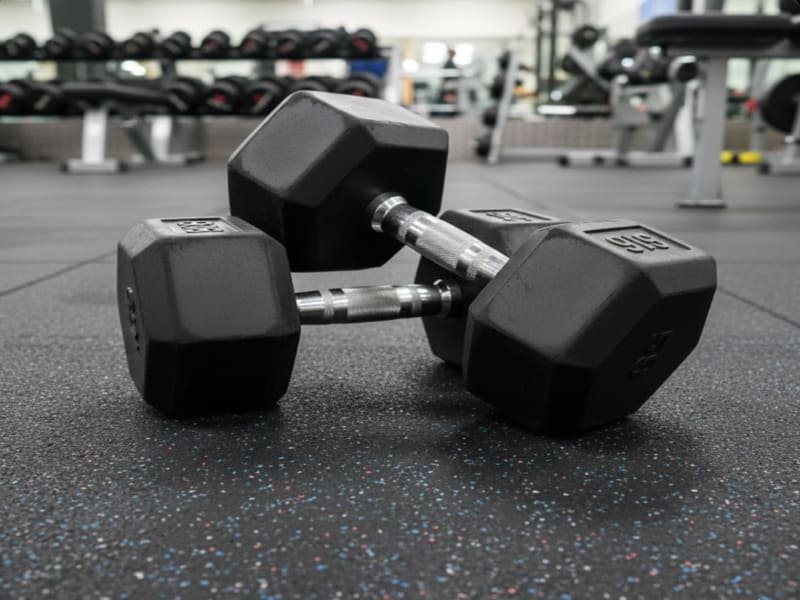
Poor flooring lacks the density to stop "bottoming out," meaning impact force travels directly through the mat to the subfloor and your joints. This leads to chronic pain, "energy leaks" that ruin performance, and a higher risk of slip-and-fall accidents due to unstable surfaces.
I often inspect worn-out gyms, and the most dangerous thing I see is the "Bottoming Out" effect. This happens when a floor looks thick but has low density. Imagine a 10mm foam mat. It feels soft to the touch. But if you drop a 100lb dumbbell on it, or a 200lb athlete lands on one foot, that foam compresses to 0mm instantly. At that millisecond of maximum impact, the athlete is effectively landing on concrete. In the factory, we test for this by applying heavy static loads. If the material structure collapses, it fails our quality control. This is also where "Energy Leaks" occur. A floor that is too soft absorbs the energy you meant to put into your lift. Instead of your force propelling the barbell up, it is wasted compressing the mushy floor. This fatigues athletes faster and ruins their mechanics.
How Pros Measure Quality (Beyond the Eye Test)
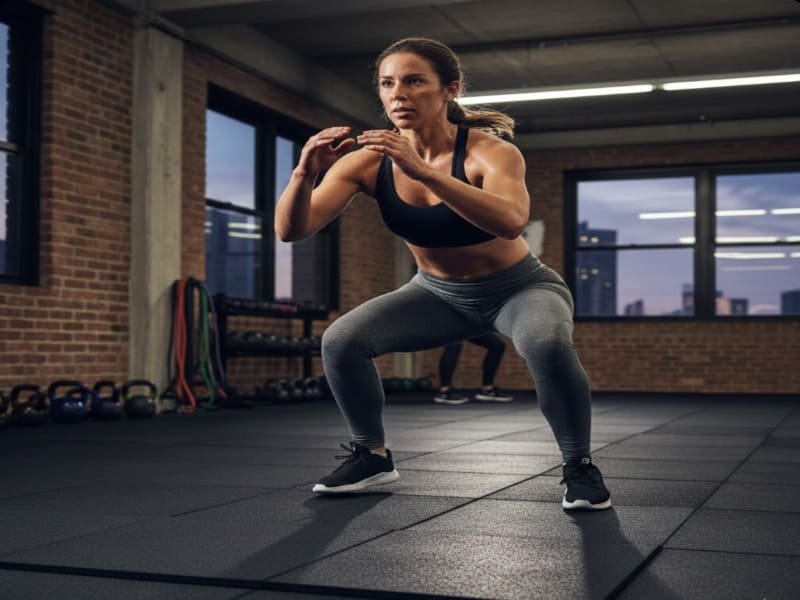
We rely on ASTM F2772 standards to quantify safety, specifically looking at G-Max scores and Vertical Deformation. These tests use an "Artificial Athlete" machine to impact the floor, providing data that proves whether a surface is safe for sports or just a decorative sheet.
In our R&D lab, we do not trust our thumbs to check quality. We use the ASTM F2772 standard, which is the bible for indoor sports flooring systems. The most critical test involves a machine that drops a specific weight to measure the G-Max Score. This score tells us exactly how much impact is transmitted back to the athlete’s body. A lower number is generally safer, but if it is too low, the floor is too soft.
- G-Max Impact: Measures shock attenuation. We aim for specific ranges (< 200) to prevent head and joint trauma.
- Vertical Deformation: Measures how deep the floor bends. We want minimal bend for lifting, but moderate bend for ball sports.
- Ball Rebound: Checks surface uniformity. It must provide a consistent bounce (90%+) compared to concrete.
If a batch of rubber tiles leaves my production line with high variance in these numbers, we scrap it. You cannot see G-Max with your eyes, but your joints will feel it after 100 reps.
Material Comparison: Which One Fits You?
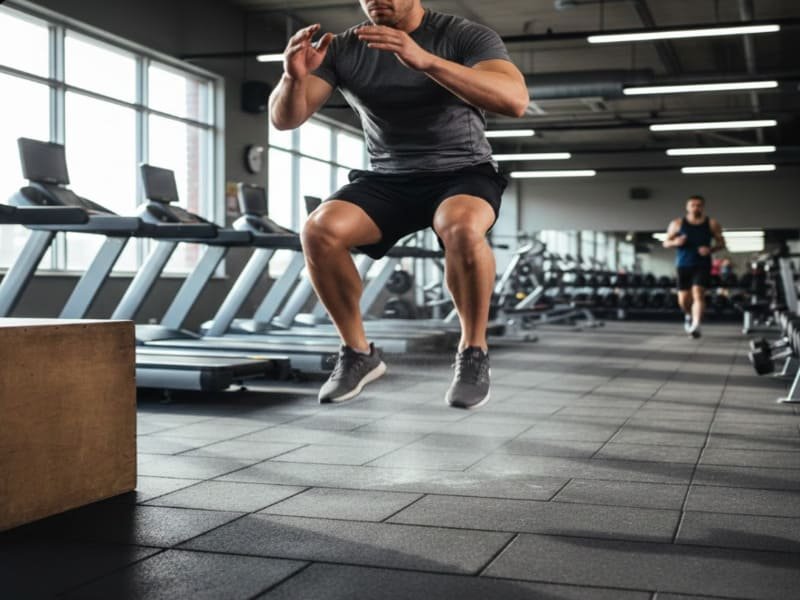
Rubber tiles offer the best stability for heavy lifting, while artificial turf with shock pads is superior for sled work and agility. PVC is ideal for court sports, and foam is strictly for low-impact bodyweight exercises. The right choice depends on density and intended use.
Not all rubber is created equal, and comparing materials is a huge part of my job when consulting with facility managers. We see distinct performance characteristics in the raw materials we process.
1. High-Density Rubber (The Heavy Lifter)
- Best for: Weightlifting, Powerlifting, Commercial Gyms.
- Production Insight: We use vulcanized rubber or high-pressure compression to prevent compression under heavy loads. It provides a stable base so you don’t wobble during a squat.
2. Turf with Shock Pad (The Agility Master)
- Best for: Sled Pushes, Sprints, Functional Training.
- Production Insight: The turf itself offers almost no shock absorption. The magic is in the underlayment. Understanding why to install shock pads under artificial grass is critical, as we engineer these pads to absorb high impact (running/jumping) specifically to save your shins.
3. PVC / Vinyl (The Court King)
- Best for: Basketball, Group Class, Aerobics.
- Production Insight: Engineered for ball rebound and easy cleaning. It is not designed for dropping weights, as the surface can tear or dent.
4. EVA Foam (The Comfort Zone)
- Best for: Yoga, Pilates, Kids Areas.
- Production Insight: High air content makes it soft but destroys durability. Never put heavy equipment on foam; it will leave permanent indentations.
How to Choose Based on Your Activity
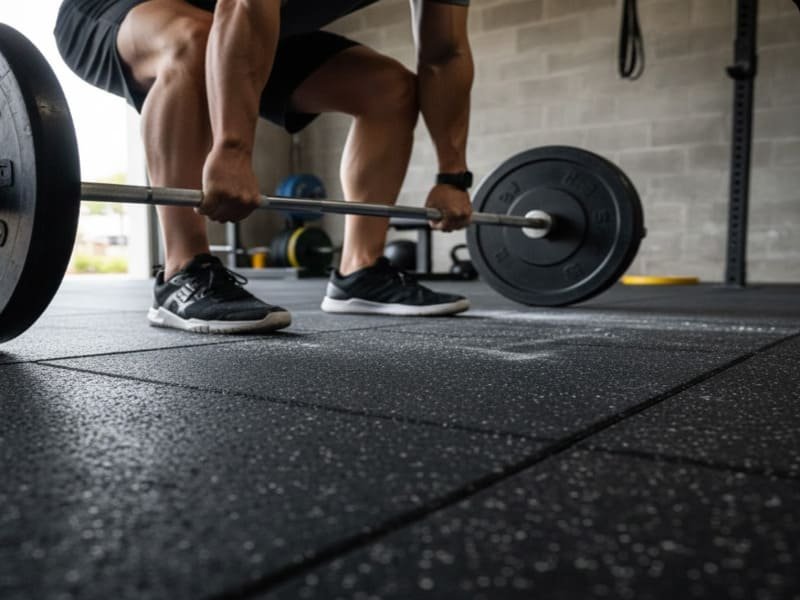
For heavy lifting, prioritize stability and density to ensure safe force transfer. For HIIT and plyometrics, prioritize Force Reduction to protect joints during repetitive impact. For multi-use garage gyms, choose a balanced thickness (8mm-15mm) that offers moderate protection and firmness.
When clients ask me what to buy, I ask them what they do. The engineering requirements for a deadlift are the opposite of a box jump.
- Scenario A: Heavy Lifting. You need a floor with low Vertical Deformation. If your feet sink while squatting 400lbs, you risk knee injury. We recommend high-density rolled rubber or tiles that allow for a solid stance.
- Scenario B: HIIT & Plyometrics. Here, Force Reduction is king. You are jumping hundreds of times. You need a floor that absorbs that shock so your shins do not develop splints. A turf system with an underlayment is often the best engineering choice here.
- Scenario C: The Garage Gym. This is the hardest to spec because you do everything here. We usually suggest a "middle-ground" density. It is firm enough to park a bench on without wobbling, but has enough give that doing pushups does not hurt your wrists.
Conclusion
Invest in flooring that meets ASTM standards to protect your joints and improve performance. Don’t guess on safety—rely on data and proven material science.
About the Author
Production Manager at YMJ Tile
With over a decade of experience in rubber and flooring manufacturing, I oversee the production of high-performance surfaces for gyms, playgrounds, and athletic facilities. My expertise lies in polymer formulation, ASTM quality testing, and optimizing production lines to create safer, more durable flooring solutions.
Not sure which ASTM standard applies to your facility? Contact us today for a free consultation and a sample kit to feel the difference yourself.