


The true difference lies in their core structure: PVC uses a layered, synthetic design for customized grip and low-impact sport, while rubber is a dense, single-material compound built for superior shock absorption and heavy weight use.
Choosing the right floor is not just about color; it is about performance, safety, and budget. When facility owners ask me about flooring, they want to know which material will last longest and best support their specific activities. I help them move past the marketing hype. This guide gives a clear comparison. We need to match the material to the job. PVC is a layered sheet or tile product. Rubber is a dense material, often recycled.

To make the best choice, we must look at what each material is made of. The composition dictates the performance. This knowledge is key to making a long-term investment.
II. Material Composition and Construction: Understanding the "Why"
What Is PVC Flooring Made Of, and How Does It Work?
PVC flooring is a synthetic polymer, specifically Polyvinyl Chloride, and works through a layered structure to balance cushion and wear resistance.
PVC Flooring: The Layered Approach
| Layer | Composition & Function | Key Performance Insight |
|---|---|---|
| Wear Layer | Clear, thick Polyurethane coating. | Provides stain resistance and customizable friction (grip). |
| Design Layer | Printed film (often wood look). | Allows for superior visual customization and branding. |
| Cushion/Backing | Foam or fiberglass layer. | Adds comfort, moderate force reduction, and dimensional stability. |
PVC Construction
I see PVC as an engineered solution. It is made of several layers fused together. The top layer is a clear, durable wear layer. This clear layer ensures floor longevity and controls the grip profile. Under this is the design layer, which gives the floor its look. The bottom layer is a foam or fiberglass backing. This backing adds moderate cushioning. This layered design allows for very specific surface properties. We precisely control the friction required for specific ball sports. The main strength of PVC is its customizable surface and superior hygiene due to sealed seams. However, this layered structure is susceptible to penetration damage or permanent indentation from high-point loads, a key engineering limitation. When you choose PVC, you choose controlled grip and a low-maintenance, sealed surface.

This design is highly technical. It offers a sealed surface. This is good for hygiene. But what about the material designed for brute strength?
What Is Rubber Flooring Made Of, and How Does It Work?
Rubber flooring is made from a dense compound, often recycled tire granules (SBR) or virgin rubber, and works by using its mass and elasticity for unmatched shock absorption.
Rubber Flooring: Density and Resilience
| Material Type | Composition & Source | Core Advantage |
|---|---|---|
| Recycled Rubber (SBR) | Shredded and rebonded tires. | Superior density, cost-efficiency, and high impact tolerance. |
| Virgin/Natural Rubber | Directly processed rubber polymers. | Minimal volatile organic compounds (VOCs), high purity, and vibrant color options. |
Rubber Construction
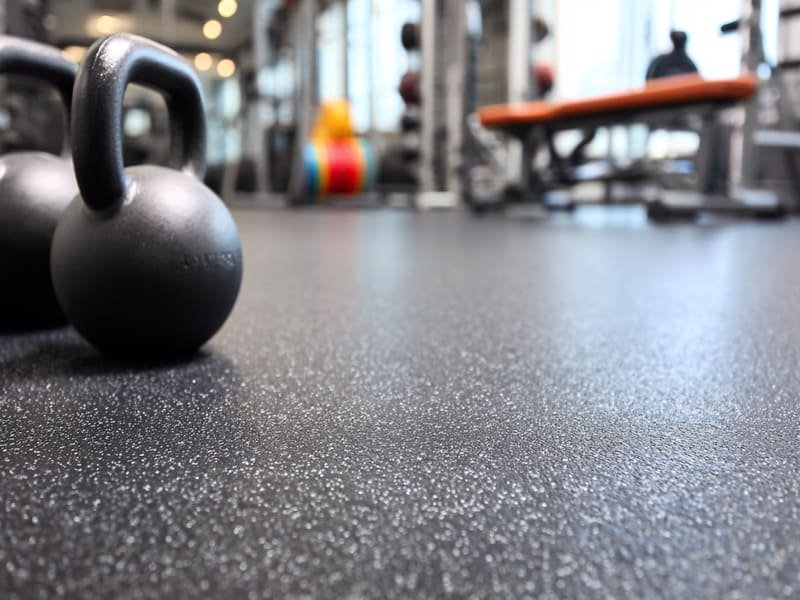
Rubber flooring is simple in its makeup, but complex in its performance. It is a single, dense material. It is either made from recycled tires (SBR) or new, virgin rubber. These rubber materials are compressed into thick rolls or tiles. The strength of rubber comes from its high-volume elasticity and mass. It has an inherent, natural ability to absorb force. When a heavy weight drops, the dense rubber floor effectively dissipates kinetic energy. This action protects the concrete subfloor from stress fractures. It also protects the athlete’s joints. My experience with heavy lifting environments confirms that rubber’s density is non-negotiable for force reduction. Its main feature is its mass. This mass is what makes it so good at absorbing vibration and sound. When you choose rubber, you choose maximum protection and acoustic dampening.
Understanding their structure helps. Now, let us look at how they perform under a load.
III. Direct Performance Comparison: Matching Floor to Sport
A. Impact and Shock Absorption: The Safety Factor
Which material is better for shock absorption, PVC or rubber?
Rubber is superior for high-impact zones because its high density offers greater force reduction (Force Reduction typically $>35\%$ for 10-12mm thick rubber), protecting joints and the subfloor from heavy, repeated impacts like dropped weights.
Impact Performance
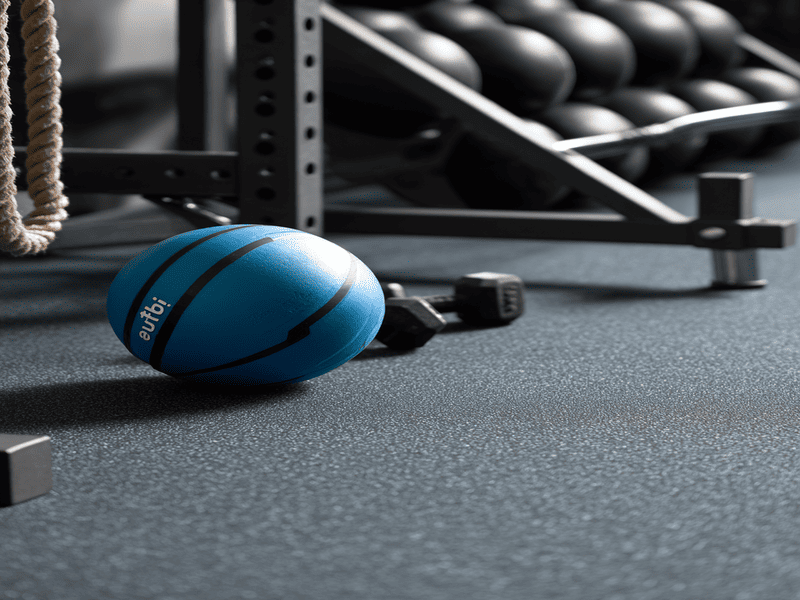
Rubber has a clear advantage in areas with heavy impact. In a functional fitness gym, I always specify rubber. When a barbell drops, the high density of the rubber absorbs the shock better than PVC’s foam layer can. This absorption reduces the peak force transmitted to the subfloor. It also reduces the strain on the athlete’s joints. PVC, while offering cushion, is not structurally designed for direct, repeated heavy point-load impacts. If you use PVC in a free weight area, you risk permanent compression set. For free weight areas, the required Shore Hardness (Type A) for the rubber compound should be in the 55 to 75 range to ensure durability without excessive softness that could compromise athlete stability.
Safety is one thing. Performance for the sport is another.
B. Traction, Grip, and Ball Bounce: The Sport Factor
Which material provides better grip and ball bounce for court sports?
PVC offers excellent, predictable grip and high energy return, which is essential for consistent ball bounce in court sports, with typical official specifications demanding a Ball Rebound of $>90\%$ (EN 14904 standard).
Surface Dynamics
PVC is highly engineered for specific court sports. The surface of a good PVC sports floor has a specific texture. This texture is designed to give the predictable grip needed for fast starts and stops. More importantly, its elastic structure provides high energy return. This means when a basketball hits the surface, the bounce height is consistent, which is crucial for competitive play. Rubber provides high general friction, making it effective for anti-slip human movement. However, the density that makes rubber excellent for shock absorption causes it to absorb too much energy. The resulting ball rebound is low. For a multi-sport hall where ball games happen often, PVC with a surface sliding coefficient of friction (COF) between 0.4 and 0.7 is the industry standard balance for quick movement and injury prevention.

The difference in bounce also means a difference in sound.
C. Acoustics and Noise Reduction: The Facility Comfort Pain Point
Which floor is better at reducing noise from equipment and activity?
Rubber is superior at noise reduction because its dense mass excels at absorbing and dampening vibrational energy, offering a typical noise reduction of 15 to 25 dB in high-impact settings.
Sound Dampening
Noise is a major issue in commercial gyms, especially those above other businesses. The dense mass of rubber is highly effective at absorbing structural borne sound energy. When a weight hits the floor, the rubber converts much of that impact energy into heat, preventing it from propagating as loud sound waves. This is a critical factor in a high-traffic or multi-level facility. PVC offers moderate noise reduction through its foam backing. However, it cannot match the sound absorption coefficient (NRC) of thick rubber. For any facility where weights drop or machines vibrate loudly, rubber is necessary to meet facility acoustic requirements. The minimum rubber thickness I recommend for significant noise reduction under free weights is 8mm to 10mm.

Now, let us talk about the practical side of owning this flooring.
IV. Practical Logistics: Durability, Maintenance, and Installation
A. Durability and Lifespan
Which floor lasts longer under general wear and tear?
Rubber offers unmatched resistance to indentation, tears, and heavy compression, with a typical life expectancy of 15-20+ years, making it better for extreme use.
Wear Characteristics
PVC’s strength is its wear layer. This layer ensures high resistance to staining and scuff marks from shoes. Liquids do not easily penetrate it. Its weakness remains heavy, repeated impacts that can permanently dent or pierce the surface. Rubber, on the other hand, is extremely resistant to structural failure from compression or tearing in standard gym use. Its long-term concerns are different. Recycled rubber can have an initial, temporary odor that requires proper ventilation. Also, exposed rubber compounds can be susceptible to some oil-based chemical degradation. Both are long-lasting, but rubber wins in structural integrity under sustained, high compressive loads.
| Feature | PVC Advantage | Rubber Advantage |
|---|---|---|
| Stain Resistance | High (Sealed wear layer) | Moderate (Porous if not sealed) |
| Compression/Indent | Moderate (Permanent set risk) | Excellent (Extreme resistance to force) |
| Lifespan | 10-15 Years (In proper use) | 15-20+ Years (Heavy-duty use) |

Durability is nothing if the floor is hard to install or clean.
B. Installation Process
Installation Differences
I have managed many installation projects. PVC is lighter and easier to handle in rolls or sheets. We often glue it down or use seam-welding for a fluid-proof finish. Rubber, especially in thick rolls (over 10mm), is very heavy. It requires more labor for handling and positioning. For functional fitness areas, interlocking rubber tiles offer the most flexible and popular DIY option. These tiles rely on their weight and interlocking pattern for stability, often requiring no adhesive. This makes rubber tiles a very cost-effective temporary or flexible solution for gym areas.
C. Cleaning and Hygiene
Maintenance Needs
Both floors are excellent because they are highly water-resistant and easy to clean with simple sweeping and mopping. This is key for hygiene. For PVC, you must always use pH-neutral cleaners to prevent damage to the clear polyurethane wear layer. Harsh, high-alkaline chemicals can degrade this layer, reducing the floor’s lifespan and grip. Rubber is generally more tolerant of most standard cleaning agents. However, with recycled rubber, a specific sealant may be needed to prevent sweat and moisture from absorbing into the material’s pores, ensuring full sanitation.
Now, let us look at the money side of the decision.
V. Cost Analysis and Value Proposition
What is the cost difference, and which floor is the better value?
PVC often has a lower initial material cost at thinner specifications, making it the budget option, but rubber’s extreme longevity under heavy loads gives it a lower lifetime cost in dedicated weight rooms due to superior subfloor protection.
Cost vs. Value
When budgeting, the initial material price is important. Thinner PVC is usually less expensive per square foot. This makes it a good option for large, multi-sport facilities needing to cover vast areas. However, I always advise clients to focus on long-term investment (lifetime cost). Rubber often has a higher initial cost, especially thick or virgin rubber. But, because it lasts so long and provides superior protection to the costly concrete subfloor, it drastically reduces long-term capital expenditure. Replacing a cracked concrete slab due to insufficient flooring protection is far more expensive than any flooring material. Therefore, the rubber acts as necessary insurance. A high-density 1/2-inch (12mm) rubber tile for a weight room represents superior long-term value compared to thinner PVC.
| Cost Factor | PVC (Low/Mid Impact) | Rubber (High Impact) |
|---|---|---|
| Initial Material Cost | Generally Lower (Good for large spaces) | Generally Higher (Due to material density and thickness) |
| Subfloor Protection | Moderate (Risk of high-impact transfer) | Excellent (High force reduction is key protection) |
| Best Value For | Multi-sport halls, aerobic studios, classrooms | Free weight rooms, functional fitness, high-traffic commercial gyms |

Choosing the right floor must align with the facility’s main purpose.
VI. Conclusion: Making the Final Match
Choose PVC if you require a surface for competitive court sports, want a high degree of custom visual design, or are building a low-impact studio with a strict budget where impact is controlled.
Choose Rubber if your facility is a heavy weightlifting, cross-training, or functional fitness gym where superior shock absorption, extreme durability against equipment, and maximum acoustic control are non-negotiable engineering requirements.
The best sports floor is the one that directly matches the specific demands of your activity.
As a Quality Control Manager/Engineer in PVC and Rubber Sports Flooring manufacturing, I specialize in material science, engineered performance specifications, and manufacturing process optimization. My expertise lies in translating facility needs into the precise technical specifications for an optimal, long-lasting floor solution. I guide clients in selecting the right material compound, density, and wear layer thickness to ensure safety, performance, and compliance with industry standards.
Next Step: Get the Right Specs for Your Project.
Ready to finalize your floor plan? My team provides technical consultation and manufacturing expertise to ensure your chosen floor meets its performance goals. We offer in-depth engineering advice on material suitability for load-bearing requirements and safety specifications.
Contact us today to request a custom quote or free performance sample of PVC or Rubber flooring tailored to your exact application.