


A top-tier manufacturer is defined by three non-negotiable pillars: material purity (authentic density), process consistency (QC systems), and value-added capabilities (OEM/Logistics). This guide provides the engineering criteria to validate a partner, not just a product.
Introduction: Moving Beyond the Datasheet
In the rubber flooring industry, a Technical Data Sheet (TDS) is a promise, but it is not proof. Many wholesale buyers mistakenly equate a “passable” spec sheet with a reliable supplier. However, understanding the inherent disadvantages of rubber flooring—such as potential odors or sensitivity to binders—is the first step in recognizing why a top-tier partner is required to mitigate these technical risks. As an R&D engineer, I view the manufacturing process as a system. A top-tier manufacturer doesn’t just mix rubber and glue; they control a precise chemical engineering process that guarantees performance stability. To help you distinguish a true manufacturing partner from a commodity trader, I have codified the standards into a verifiable framework.
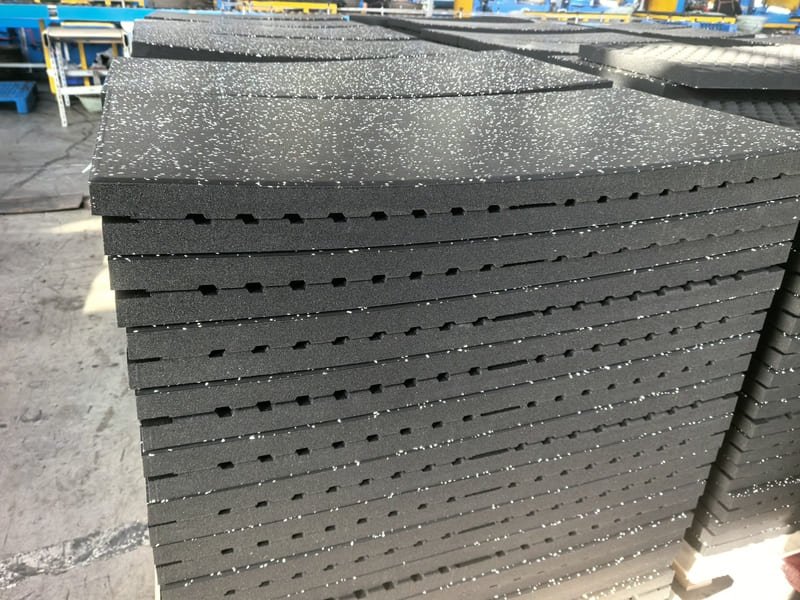
Before diving into the technical details, use this quick reference framework to assess your current or potential suppliers.
The Top-Tier Audit Checklist
Use this decision matrix to quickly categorize a supplier. A top-tier manufacturer should meet the criteria in the left column, offering transparency and systemized quality control.
The "Go/No-Go" Framework
When sourcing globally, efficiency is key. This checklist allows you to assess a supplier’s maturity level in minutes.
| Evaluation Criteria | Top-Tier Manufacturer Standard | Commodity/Low-Tier Warning Signs |
|---|---|---|
| Material Purity | Pure SBR/EPDM: Elastic, authentic density. | High Filler Content: Mixed with calcium/sand; brittle & heavy. |
| Binder Chemistry | MDI-Based PU: Low odor, high bond strength. | Acidic/Cheap Glue: Strong smell, shedding granules. |
| Batch Consistency | <1% Variance: Automated dosing ensures uniformity. | Visible Variance: Color/thickness shifts between rolls. |
| Testing Protocol | Destructive Testing: Openly shares stress-test results. | Paper Only: Relies solely on a generic PDF file. |
| Service Scope | OEM/ODM: Custom logos, precise cutting, functional marking. | Stock Only: Can only supply standard black rolls. |
With this framework in mind, let’s examine the first and most critical pillar: Material Purity.
Pillar 1: Material Purity – The Authentic Density Standard
A top-tier manufacturer achieves density through high-compression pure rubber, ensuring elasticity and shock absorption. In contrast, inferior producers achieve the same weight by adding cheap fillers, sacrificing the material’s core engineering properties.
Why "Real" Density Matters
Density is a double-edged sword. In a premium product (e.g., 950-1100 kg/m³), high density is achieved by compressing more rubber granules into the mold. This creates a "memory foam" effect where the floor absorbs impact and rebounds—essential for protecting athletes and subfloors.
The Counter-Standard (The Filler Trap): Lower-tier factories "cheat" this metric. They add Calcium Carbonate (stone powder) to the mix. The result is a roll that weighs the same but acts like a stone slab. It has zero elasticity. When bent, it snaps.
Your Verification Action:
- The Specific Gravity Check: Don’t just weigh the roll. Calculate the volume-to-weight ratio accurately.
- The Scratch Test: Scratch the surface. Pure rubber stays black; filler-laden rubber reveals a white, chalky streak.

Once material purity is established, the focus shifts to the chemical bond that holds it all together.
Pillar 2: Process Control – Binder Integrity & Curing
The hallmark of a top-tier facility is the use of premium MDI binders and precise temperature control during vulcanization. This prevents the two most common failures: offensive odors and granule shedding.
Engineering the Bond
Rubber granules are inert; the binder is the active structural component. A top-tier manufacturer uses MDI (Methylene Diphenyl Diisocyanate) binders which are non-yellowing and low-odor. More importantly, we control the Curing Cycle—the precise combination of heat, pressure, and time.
The Counter-Standard (Inconsistent Curing): To speed up production, some factories reduce curing time or use cheaper acidic glues. This results in "raw" centers inside the roll (soft spots) or a surface that sheds granules under friction (the "rub test" failure).
Your Verification Action:
- The Smell Test: A fresh sample should have a mild rubber scent, never a sharp chemical or rotten egg odor.
- The Edge Rub: Vigorously rub the cut edge. If granules detach easily, the curing process was rushed or the binder ratio is insufficient.

Material and binder create the product, but systematized production ensures you get the same product every time.
Pillar 3: Manufacturing Discipline – Batch Consistency & QC
Reliability means the 500th roll matches the 1st roll. Top-tier manufacturers utilize automated dosing systems and rigorous batch testing to ensure uniformity in thickness, color, and density across entire production runs.
The System Behind the Product
For large commercial gyms, consistency is aesthetic and functional law. If you order 1,000 square meters, you cannot afford for the rolls from Pallet A to be 5% lighter or 2mm thinner than Pallet B. This creates tripping hazards and ugly seams.
The Top-Tier Difference: We use automated dosing scales for raw materials, removing human error from the mixing process. Our QC protocol involves checking thickness tolerances at multiple points on every roll, not just random sampling. We retain samples from every batch for traceability.
Your Verification Action:
- Ask for the QC Log: Don’t just ask "do you check quality?" Ask "Can I see a sample QC report from a recent shipment?" A top-tier partner will share this data openly.

Finally, a true partner extends their capabilities beyond the factory floor to help you win in the market.
Pillar 4: Service Ecosystem – OEM Mastery & Logistics
A superior manufacturer acts as a technical extension of your business, providing value-added OEM services (custom logos, functional markings) and secure, export-grade logistics to protect your margins.
From Factory to Gym Floor
Manufacturing is only half the battle. The ability to customize products allows you, the wholesaler, to escape the "commodity price war."
- OEM/ODM Capability: Can the factory produce high-precision custom logo mats? Can they embed functional markings (like sprint tracks) directly into the floor? These features command higher margins.
- Logistics as QC: Rubber is heavy and prone to deformation. A top-tier manufacturer uses reinforced pallets, moisture-barrier wrapping, and calculated container loading plans to ensure the product arrives in pristine condition. We treat packaging as the final stage of quality control.
Your Verification Action: - Request the Packaging Standard: Ask for photos of how a full container is loaded. Look for corner guards, heavy-duty banding, and proper pallet spacing.

Conclusion
A top-tier rubber flooring manufacturer is not just a source of material; they are a guardian of your reputation. Knowing how to qualify a gym flooring manufacturer for a critical project ensures that your large-scale installations meet the highest standards of safety, durability, and brand integrity. By demanding material purity, validating process consistency, and leveraging OEM capabilities, you ensure a partnership that builds long-term value.
My Role
I am an R&D Engineer specializing in rubber flooring manufacturing. My focus is on helping global buyers distinguish between "on-paper" specs and real-world performance. I bridge the gap between chemical engineering and commercial application to ensure your flooring stands the test of time.
Are you ready to audit your supply chain?
Don’t rely on guesswork. Contact our engineering team to discuss your specific requirements or request our "Benchmark Sample Kit" to perform these verification tests yourself.