


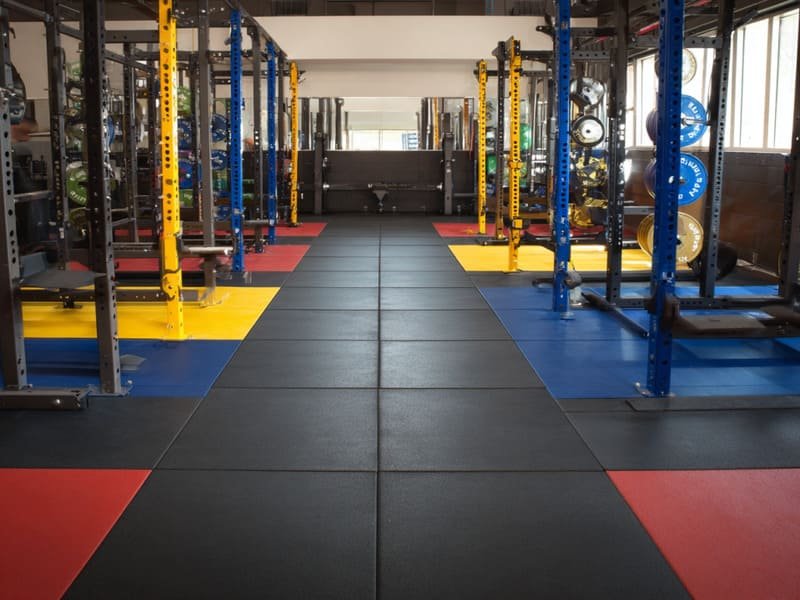
The core drawbacks of rubber flooring are often strong odor, heavy mass, high cost for non-recycled compounds, and the potential for severe wet-slip hazards.
Why rubber, despite its proven durability and impact resistance, might be the incorrect choice for your specific engineering or architectural project is a critical calculation. Rubber offers long-term performance, but as a manufacturing process engineer, I focus on its technical constraints. Recycled rubber (SBR) introduces unavoidable odor issues. Virgin compounds like EPDM resolve the smell but escalate material costs significantly. The inherent high friction of rubber is compromised by moisture, which drastically reduces the Dynamic Coefficient of Friction (DCOF) and creates a safety liability. Engineers must analyze these data-driven trade-offs to select the optimal material and design for the application.
You require practical, data-driven solutions for every drawback. Identifying the problem is the first step; implementing a manufacturing-level, technical solution is how product integrity is ensured. Let’s break down the hidden costs and specific engineering hurdles of rubber flooring.
Does the Choice of Rubber Type Directly Impact the Floor’s Biggest Drawbacks?
Yes, the rubber compound dictates the severity of drawbacks; SBR causes strong odor and high mass, while virgin EPDM results in significantly higher raw material costs.
Understanding the source material—the polymer formulation—is fundamental for proper engineering specification. The table below compares the most common rubber types used in flooring against the critical drawbacks we manage in production and application. This provides a clear technical specification guide.
| Disadvantage | Severity (Design Impact) | Cost to Mitigate (Manufacturing Cost) | Type Most Affected |
|---|---|---|---|
| Strong Odor (Off-Gassing) | High | Medium (Extended Curing/Washing) | SBR (Recycled) |
| High Mass/Density Load | Medium | Low (Material Choice Only) | SBR (Recycled) |
| High Raw Material Cost | High | Low (No Mitigation) | EPDM (Virgin) / Natural |
| Poor Wet-Slip Resistance | High | Medium (Engineered Surface Texturing) | All Smooth Finishes |
| High Hardness/Low Comfort | Medium | Medium (Add Foaming Agents/Increase Thickness) | All High-Density Grades |
| Susceptibility to Oil/Grease | High | Low (Specify Nitrile Blends) | SBR/Natural Rubber |
| Color Fading (UV) | Medium | High (Specify UV Stabilizers/EPDM) | SBR/Natural Rubber |
| Installation Difficulty | Medium | Low (Design Interlocking Systems) | Heavy Rolls/Thick Tiles |
Strong Odor (Off-Gassing) – The VOC Chemical Residue Challenge
The Core Problem: A persistent, penetrating smell caused by the off-gassing of Volatile Organic Compounds (VOCs). This is unacceptable in low-ventilation environments like residential gyms or commercial offices.
Type-Specific Breakdown: Styrene-Butadiene Rubber (SBR), which is typically derived from ground tire rubber (GTR), is the primary source. The odor originates from residual processing oils, accelerators, and other chemical agents retained during the vulcanization process of the source tire. [Virgin compounds (EPDM or Natural Rubber)] undergo stricter purification, resulting in significantly lower VOC levels and minimal to zero odor, though the cost is higher.
Relevant Industry Standard/Data Point: Compliance with CDPH/CA Section 01350 is the gold standard for low-emitting building materials in the US market. This standard tests for a range of VOCs to ensure acceptable indoor air quality. Specifying materials that meet this standard is the only true way to technically mitigate the odor problem.
The 10x Solution (Actionable Pain Point Resolution): Verified Off-Gassing Protocol. 1. Require a manufacturer’s certificate of compliance with CDPH 01350. 2. Upon delivery, unroll the flooring and clean the entire surface with a diluted, non-ammonia cleaning solution to remove surface residues. 3. Mandate an external ‘airing out’ or ‘off-gassing’ period in a high-ventilation, covered area for a minimum of 96 hours (4 days) prior to final indoor installation.
Superior Material Alternatives: For projects with zero-odor specifications, consider PVC-Free Homogenous Sheet Flooring or Polyurethane (PU) Binder-based systems with verified low-VOC ratings.

Poor Wet-Slip Resistance – The DCOF Safety Challenge
The Core Problem: While rubber’s material properties provide high friction when dry, the introduction of water creates a thin film, drastically reducing the friction between the foot and floor. This significantly raises the probability of a slip-and-fall incident in damp areas.
Type-Specific Breakdown: This critical failure affects all smooth-finish rubber flooring, regardless of polymer type (SBR, EPDM, Natural). The issue is not the material, but the lack of an engineered surface profile to displace the liquid.
Relevant Industry Standard/Data Point: The key metric for safety is the Dynamic Coefficient of Friction (DCOF). The recognized standard for pedestrian safety is ANSI A326.3. For level, interior, wet areas, the required DCOF is typically 0.42 or greater. Smooth rubber in wet conditions often tests significantly below this safety threshold.
The 10x Solution (Actionable Pain Point Resolution): Mandate Engineered Surface Texturing and Drainage. When writing the specification, require a rubber product that incorporates a high-relief surface profile, such as a raised studded texture, deeply hammered finish, or grooved surface (like coin or tread pattern) to create micro-drainage channels. For extreme wet areas (e.g., poolside), specify open-grid modular PVC tiles that actively drain water away from the walking surface.
Superior Material Alternatives: For high-moisture risk, specify Porcelain Tile with a certified R11 or R12 Anti-Slip Rating (according to EN 16165) or Polyurethane coatings with embedded aggregate for a consistent high DCOF.

High Mass and Density – The Structural Load Challenge
The Core Problem: Rubber is a dense polymer, leading to a heavy finished product. This high mass significantly impacts shipping costs, complicates installation logistics, and requires careful verification of the building’s structural load capacity, especially in elevated or cantilevered spaces.
Type-Specific Breakdown: High-density SBR used in thick gym rolls (e.g., for free weight zones) exhibits the greatest mass. This type of flooring commonly has a density range of 1.15 to 1.50 grams per cubic centimeter (72 to 94 pounds per cubic foot). Lighter, lower-density rubber (e.g., EPDM foam-backed) exists but compromises impact durability.
Relevant Industry Standard/Data Point: The critical factor is the Dead Load contribution to the structural engineer’s calculations. A 1/2-inch (12.7 mm) rubber tile at a typical density of 1.2 grams per cubic centimeter contributes approximately 15.24 kilograms per square meter (about 3.12 pounds per square foot) to the floor load. This is a non-trivial factor over a large commercial area (1,000 square meters adds over 15 metric tons).
The 10x Solution (Actionable Pain Point Resolution): Targeted Thickness Zoning and Modular Design. 1. Specify strategic zoning: Use the maximum thickness (e.g., 1/2 inch) only in critical high-impact zones (under weight racks). Reduce the thickness to 3/8 inch or 1/4 inch in transition and cardio areas, achieving up to a 50% weight reduction in those zones. 2. Specify smaller, interlocking tile formats over heavy rolls; this minimizes manual handling weight, reducing installation time and labor risk.
Superior Material Alternatives: EVA (Ethylene-Vinyl Acetate) foam mats are inherently lightweight and provide cushioning, or consider Low-Density Polyethylene (LDPE) modular systems for applications where minimal structural load is required.
Susceptibility to Oil and Grease – The Chemical Attack Challenge
The Core Problem: Exposure to petroleum-based fluids, lubricants, and many common industrial cleaning solvents causes standard rubber to swell, soften, lose its shape, and suffer a permanent reduction in mechanical strength. This leads to structural failure in automotive bays or maintenance areas.
Type-Specific Breakdown: Natural Rubber (NR) and general-purpose SBR are highly susceptible to non-polar solvents (like oils and grease). The oil is absorbed into the polymer matrix, leading to the destructive swelling. EPDM offers better resistance to polar solvents (like water/acids) but still fails against non-polar petroleum products.
Relevant Industry Standard/Data Point: The key test for chemical compatibility is ASTM D471 (Standard Test Method for Rubber Property—Effect of Liquids). This test quantifies the percentage change in the material’s volume and hardness after immersion in a reference fluid. For use in oily environments, a material with a volume change of less than plus or minus 8% is necessary to ensure long-term integrity.
The 10x Solution (Actionable Pain Point Resolution): Mandate Nitrile-Butadiene Rubber (NBR) Blending. The specification for oil-exposed areas must explicitly call for a formulation heavily blended with Nitrile-Butadiene Rubber (NBR), which is chemically engineered to resist oil penetration. As an alternative, a solvent-resistant polyurethane top-coat must be applied over the installed rubber to create an impermeable barrier.
Superior Material Alternatives: Solid Vinyl (PVC) or Epoxy Coatings offer excellent inherent resistance to a broad range of oils and industrial chemicals, forming a non-porous, chemically inert surface.
Conclusion
Rubber flooring excels where impact absorption and durability are paramount, but its engineering constraints—driven by material choice, density, safety standards, and chemical compatibility—require precise, data-backed specification. Never overlook the critical role of material science in floor performance.
I recommend you connect with my team for an engineering consultation. We specialize in custom rubber formulations, including NBR/SBR blends and high-UV EPDM, designed to mitigate these exact performance drawbacks. Contact us to receive a technical specification review or to request a quote and free samples of our custom-engineered rubber compounds.