


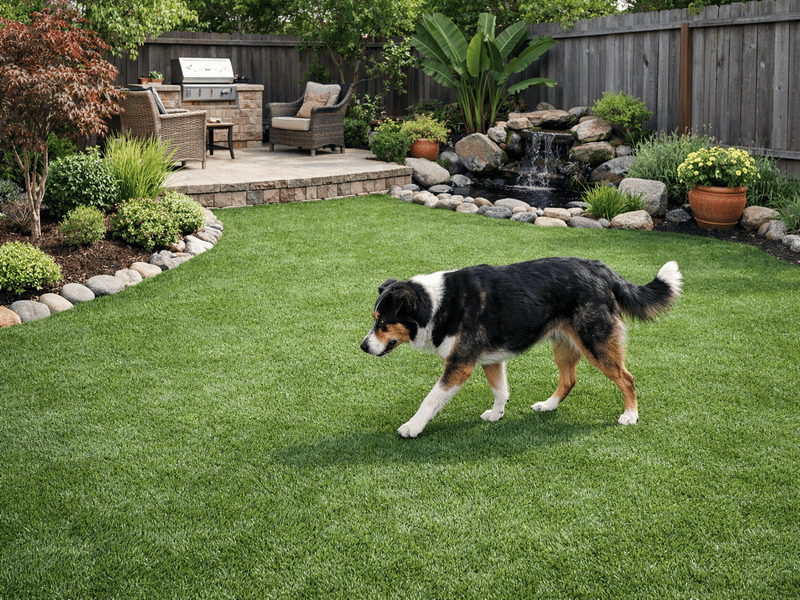
Does your backyard smell like a kennel? As an Installation Director, I see homeowners make the same mistake: they treat pet turf like a carpet. The result? A yard that smells unbearable after one summer.
The secret isn’t just the grass; it’s the vertical drainage engineering. Understanding why choose artificial grass for dogs is the first step, and this guide strips away the fluff to give you the exact professional protocols to build a system that drains instantly, stays cool, and remains odor-free for 15+ years.
TL;DR: Project Snapshot (For the Busy Homeowner)
Quick Answer: Can you DIY this? Yes, but it is heavy construction, not gardening.
| Metric | Expectation |
|---|---|
| Cost | DIY: $6–$10/sq.ft. | Pro: $12–$20/sq.ft. |
| Time | 2 Days (for 500 sq.ft. with 2 people). |
| Crucial Secret | Weed Barrier goes UNDER the rock base, not under the turf. |
| Must-Have | Zeolite Infill (Traps odor). Never use Crumb Rubber. |
| Best Base | 3 inches of compacted Class II Road Base. |
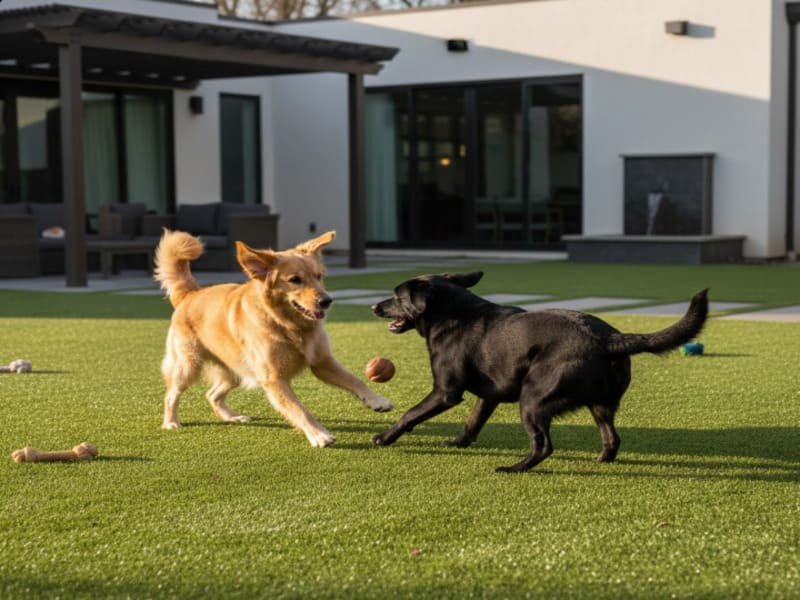
Part 1: The Honest Truth – DIY or Hire a Pro?
Before you rent a truck, decide if you are up for the challenge.
DIY This If:
- You have a helper (Turf rolls weigh 200+ lbs).
- Your yard is relatively square (Curves require advanced cutting skills).
- You are detail-oriented (Seams require precision).
Hire a Pro If:
- You have drainage issues: If water pools in your yard now, you need a French drain system first.
- Large Scale: Projects over 1,000 sq. ft. require massive logistical effort for moving tons of rock.
Part 2: The Engineering Stack – What to Buy
Don’t buy generic materials. To stop the smell, you need this specific "stack":
1. The Turf (Surface)
- Spec: Look for "Flow-Through" or "Fully Permeable" Backing.
- Avoid: Standard polyurethane hole-punched backing. It drains too slowly for dog urine, causing bacteria buildup.
2. The Comfort Layer (Optional)
- Shock Pads: For older dogs or concrete installations, we recommend a drainage shock pad. Similar to the high-density foam we use at MF FLOOR for gym mats, this adds cushion and an air gap for airflow.
3. The Sub-Base (Foundation)
- Class II Road Base: Jagged rocks that lock together.
- Fines/DG: For the smooth top layer.
4. The Infill (Odor Control)
- The Hero: Zeolite or Antimicrobial Coated Sand.
- The Villain: Crumb Rubber. Never use it. It absorbs heat (burns paws) and holds urine like a sponge.
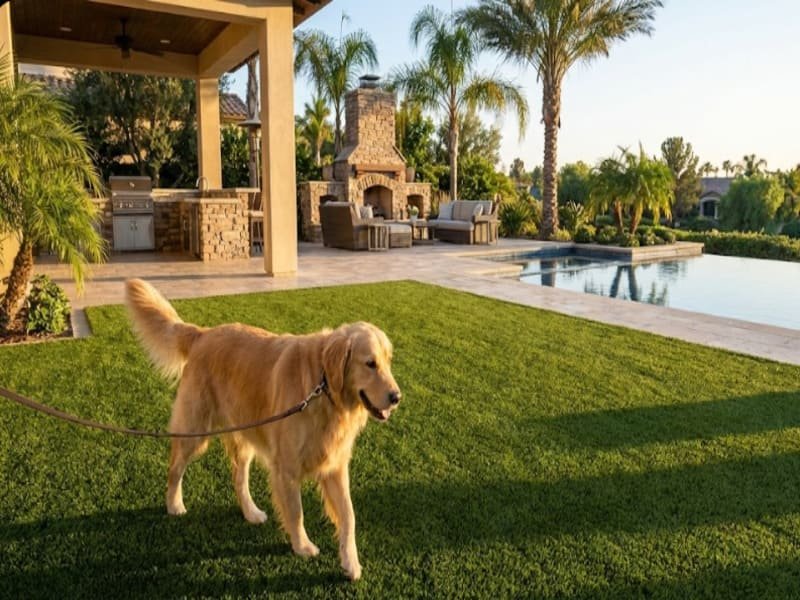
Part 3: Step-by-Step Installation Guide
Step 1: Excavation & The "Anti-Stink" Rule
The Goal: Create a buffer zone.
Dig down 3 to 4 inches. You need room for the drainage rock. Cap all sprinkler heads—you don’t want water under the turf. For a deeper dive into dog-specific sub-base prep, you can also refer to our guide on how to install artificial grass for dogs.
The Critical Mistake:
Most manuals say to put the weed barrier under the turf. WRONG.
- Correct Method: Place the weed barrier on the bare soil, at the very bottom.
- Why? If the fabric is right under the turf, urine gets trapped on it and creates a stink zone. By burying it under 3 inches of rock, the urine filters down and away from your nose.
Step 2: Building the Rock Base
The Goal: A concrete-hard floor that drains.
- Spread: Add 3 inches of road base.
- Hydrate: Soak it with water to settle dust.
- Compact: Use a Plate Compactor. Do not hand tamp.
- Slope: Ensure a 1-2% grade sloping away from your house.
Test: You should be able to walk on it without leaving footprints.
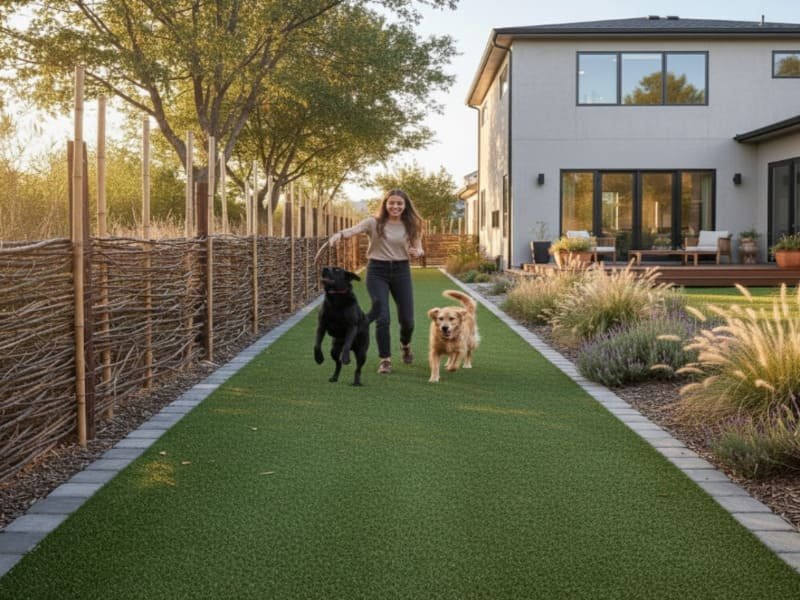
Step 3: Laying & Acclimating
The Goal: Managing expansion.
- Unroll & Wait: Let the turf sit in the sun for 2 hours. Plastic expands in heat; if you skip this, your turf will wrinkle later.
- Grain Direction: Face the grass blades towards your house/viewing area. This makes the grass look green, not shiny.
Step 4: The Surgical Cut
The Goal: Invisible seams.
- Tool: Utility knife with a Hook Blade.
- Technique: Cut from the back (backing side). Never cut from the top, or you will trim the grass blades.
- Seaming: Cut off the "selvage" (factory edge) plus 3 stitch rows to ensure a tight fit.
Step 5: Secure & Infill
The Goal: Stability and Hygiene.
- Nail It: Use 5-inch Non-Galvanized Nails every 6 inches along the perimeter. (Rust helps them grip the soil).
- Infill: Apply 1.5 lbs of Zeolite per sq. ft.
- Brush: Use a power broom to force the infill deep into the fibers. This holds the blades up and protects the backing.
Part 4: Maintenance & Troubleshooting
Even the best system needs care.
- Weekly: Rinse "potty spots" with a hose to recharge the Zeolite.
- Monthly: Use an Enzyme Cleaner (not bleach) to eat bacteria.
- The "Hot Spot" Fix: If an area smells, check if debris (leaves/hair) has clogged the mesh. You may need to power wash and re-infill that spot.
Conclusion
Installing pet turf is an engineering project. By placing the weed barrier at the bottom and using Zeolite infill, you solve the two biggest problems: Smell and Drainage.
Need Specialized Flooring?
Sometimes, turf isn’t the only answer. If you are building an indoor dog run, a kennel, or need heavy-duty rubber underlayment for a gym-turf hybrid area, you need industrial-grade materials.
At MF FLOOR, we specialize in high-performance artificial turf solutions. [Contact our team today] for advice on shock pads or to request samples of our heavy-duty flooring systems.