


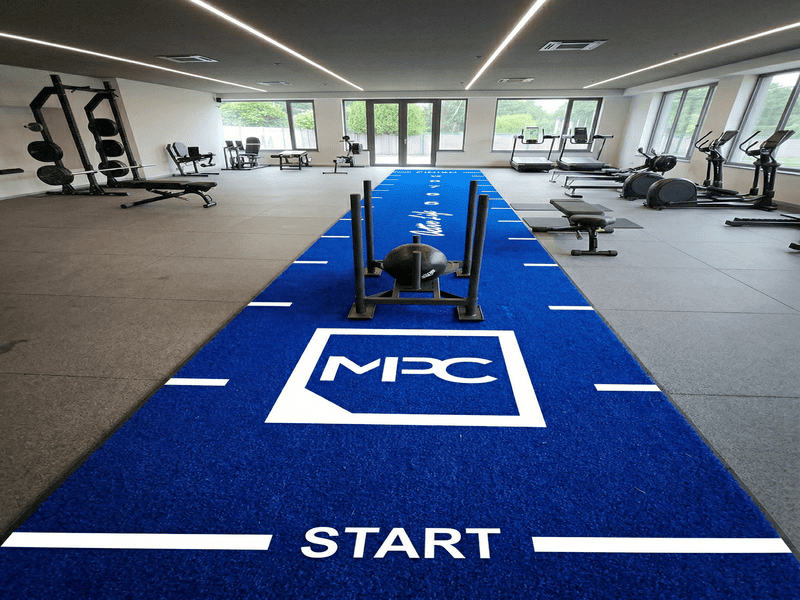
Yes, you can install gym turf over existing rubber flooring provided the base layer is a high-density, non-porous material that is fully adhered to the subfloor. To ensure stability during sled work, you must use a specialized urethane adhesive and heavy-duty transition ramps to eliminate trip hazards and prevent material shifting.
Installing turf over rubber is a common practice in functional fitness zones to avoid the high cost of demolition. Technical assessments show that the Shore A hardness of the existing rubber is critical; if the base is under 60 Shore A, the turf may "sink," causing the adhesive bond to fail under load. The mechanical bond between the turf backing and the rubber depends on surface energy and cleanliness. Most failures occur because the rubber was not stripped of factory mold-release agents or accumulated floor wax. Engineering calculations also suggest that layering significantly improves the Impact Insulation Class (IIC) ratings, reducing low-frequency vibration from dropped weights better than a single layer.
While the technical benefits of layering are clear, the success of the project depends on weighing specific site conditions against performance requirements.
Is Layering Turf Over Rubber Actually a Good Idea?
Layering is highly effective for noise reduction and cost-saving, but it introduces risks of shear failure and moisture entrapment if the environment is not climate-controlled. This setup works best for sled lanes where the rubber provides extra cushion for joints while the turf handles the friction of the equipment.
Data from site pull-tests shows that turf bonded to rubber can withstand significant horizontal force, but only if the rubber itself remains stationary. If the base rubber expands and contracts at a different rate than the turf (often a 1-2% variance in high heat), the seams will buckle. The thermal expansion coefficient of EPDM rubber differs from the Polyethylene used in turf, meaning that in non-AC environments, the layers may undergo dimensional conflict. Furthermore, adding 20mm of turf on top of 10mm rubber creates a vertical offset that requires a 1:12 slope ratio to meet international safety and accessibility standards.
| Performance Metric | Single Layer (Turf Only) | Layered (Turf + Rubber) |
|---|---|---|
| Shock Absorption | Moderate (15-20%) | High (35-45%) |
| Acoustic Dampening | 20dB reduction | 35dB+ reduction |
| Installation Time | Standard | 40% faster (no demolition) |
Before proceeding with the adhesive application, the structural integrity of the base layer must be verified through standardized field tests.
What Should You Check Before Starting the Installation?
You must confirm the rubber is a permanent-bond install and perform a water drop test to check for surface sealers that prevent glue adhesion. If the water beads on the rubber, the glue will not stick, and the turf will slide the first time a sled is pushed.
A critical check is the Tape Test: apply high-tack tape to the rubber and remove it; if black residue or crumb comes with it, the rubber is too degraded for layering. Door clearances and equipment stability must also be measured. A squat rack bolted through two layers of flooring can become unstable if the compression rates differ. If the rubber is 15% more compressible than the turf, the rack will tilt under a heavy load. Seams of the existing rubber should also be inspected—any gaps wider than 2mm must be filled with a rubberized filler to prevent the turf from telegraphing the lines through the surface.
Engineering Site Prep Requirements
| Test Type | Target Result | Consequence of Failure |
|---|---|---|
| Bond Test | No residue on adhesive | Turf delamination |
| Levelness | < 3mm over 3 meters | Pooling water or trip spots |
| Moisture Vapor | < 3 lbs / 1,000 sq.ft | Mold growth between layers |
Once the site passes these technical checks, the installation moves into the precision phase of layout and bonding.
How Do You Properly Install Turf Over Rubber Step-by-Step?
The process requires a 48-hour acclimatization period, a dual-component urethane adhesive, and a 100lb floor roller to ensure 100% contact between the materials. Transition strips must be anchored into the concrete subfloor through both layers to prevent the edges from curling over time.
The first step is a mechanical scrub using a low-speed floor machine with a red pad to open the pores of the rubber. Once dry, the turf is unrolled and left to relax. Laboratory testing shows that turf can shrink up to 1% in length within the first 24 hours of being unrolled due to tension release from the manufacturing core. For bonding, a 1/16" x 1/16" x 1/16" square-notch trowel is used to apply glue. This ensures a spread rate of roughly 60 square feet per gallon. After laying the turf into the wet glue, a floor roller must be used in both directions to remove air pockets and force the adhesive into the turf backing and rubber pores.
Adhesive Selection Logic
| Glue Type | Pros | Cons |
|---|---|---|
| Urethane (2-Part) | Waterproof, strongest bond | Expensive, difficult to clean |
| Acrylic Tape | Easy DIY, no odor | Can fail under heavy sled heat |
| Pressure Sensitive | Repositionable | Low shear strength for sprints |
The success of this layered system is most severely tested by the shear stress generated during functional training.
Why is the Sled Push the Biggest Challenge for This Setup?
Sled pushes generate horizontal force that attempts to slide the turf across the rubber, creating waves or permanent stretching in the plastic fibers. This stress is concentrated at the glue line, requiring an adhesive with a high peel and shear strength rating to prevent system failure.
When a heavy sled moves, the friction between the sled rails and the turf fibers creates a pulling effect. If the turf is a free-lay or only taped at the edges, the middle will bunch up. From a material science perspective, padded-back turf is superior for layering because the foam layer acts as a buffer, absorbing horizontal energy before it reaches the glue. In field tests, non-padded turf over rubber showed 30% more seam separation than foam-backed turf over the same period. Sled lanes should run parallel to the turf rolls to minimize the number of seams exposed to the sled’s path.

After the installation is complete, the focus shifts to preventing long-term degradation from moisture and debris.
How Do You Maintain a Double-Layered Floor System?
Maintenance requires a vacuum with a beater bar to pull dust out of the turf fibers and a low-moisture cleaning protocol to prevent liquid seepage. Excess water can get trapped between the turf and rubber, leading to adhesive hydrolysis and bacterial growth.
The "sandwich" effect of turf-over-rubber means that the floor cannot breathe as easily as a single layer. A dry-powder or encapsulation cleaning method every 6 months is recommended to deep clean without saturating the base. If a spill occurs, it must be wet-vacuumed immediately. For daily care, a high-CFM (Cubic Feet per Minute) vacuum is necessary because fine dust acts like sandpaper at the base of the turf fibers, cutting them over time. Seam integrity must be monitored; if a seam gap grows more than 3mm, it indicates turf shrinkage or glue failure, requiring immediate re-bonding.
Maintenance Schedule
| Action | Frequency | Technical Reasoning |
|---|---|---|
| HEPA Vacuuming | Daily | Prevents fiber abrasion from dust |
| Sanitizing Spray | Weekly | Neutralizes bacteria in turf pile |
| Seam Inspection | Monthly | Identifies adhesive failure from shear |
Even with rigorous maintenance, there are specific scenarios where layering is technically unfeasible.
When Should You Avoid Installing Turf Over Rubber?
Avoid layering if the rubber base is loose-lay tiles, if the subfloor has high moisture emissions, or if the total height creates an unfixable trip hazard. Installing over unstable or wet foundations will lead to total system failure within the first year of use.
If the rubber tiles are installed over unstable subfloors such as plywood bases without proper bonding, adding turf will cause the entire floor system to buckle. Puzzle seams are not designed to handle lateral force transmitted through a top layer. Furthermore, check for efflorescence (white powder) on the concrete near rubber edges, which indicates high moisture vapor. Since both rubber and turf backings are non-breathable, you will trap moisture, creating a breeding ground for mold. Finally, local building codes should be verified; some regions require specific transition lengths that your space may not accommodate.
Conclusion
Layering turf over rubber works efficiently if the base is glued down and the stack height is managed with ramps. Prioritize high-shear adhesive.
If you are planning a gym renovation and aren’t sure if your current rubber flooring can handle a turf upgrade, send me a private message! I can provide a professional engineering assessment and technical solution based on your site photos and current material specifications.