


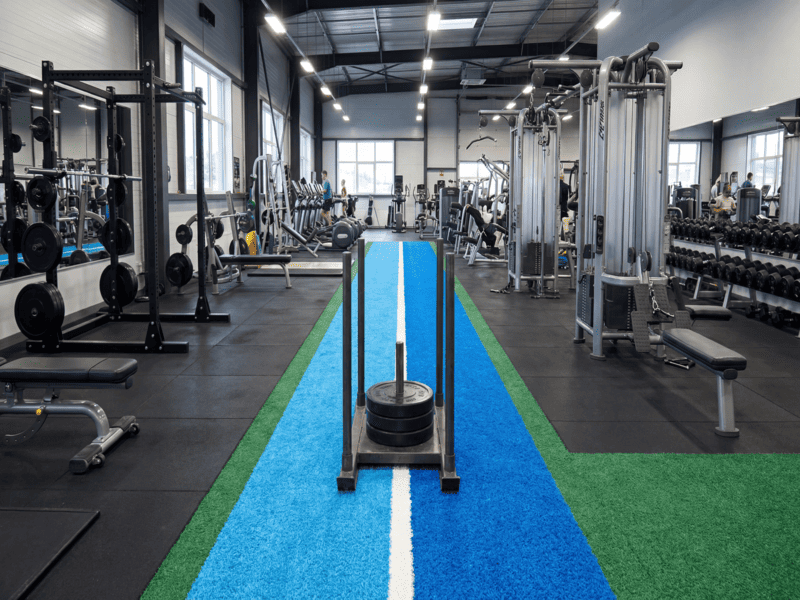
Sled weight and technique accelerate turf wear by increasing the Normal Force ($N$), which proportionally increases friction and heat. When the interface temperature exceeds the melting point of Polyethylene (approx. 120°C-130°C), fibers soften and permanently deform under the localized pressure (PSI) of the sled runners.
Deep Dive: The Hidden Cost of High-Friction Training
As a Quality Control Specialist, I rely on data, not guesses. When I analyze failed turf samples from gyms, I often perform a "fiber pile analysis." The results are consistent: standard turf doesn’t just "wear out"; it fails due to thermal and mechanical overload.
Before you blame the glue or the installer, perform this Scientific Self-Diagnosis:
- Check for "Plasticization": Look closely at the tips of the fibers in the high-traffic zone. Do they look shiny or capped? This indicates the plastic reached its Glass Transition Temperature and reshaped.
- The "Shear Pattern": Are the fibers pulled out cleanly, or are they snapped? Snapped fibers indicate abrasive failure (rough runners), while pull-outs indicate vertical force failure (bad technique).
We aren’t just talking about "rough use"; we are talking about exceeding the material properties of the flooring.
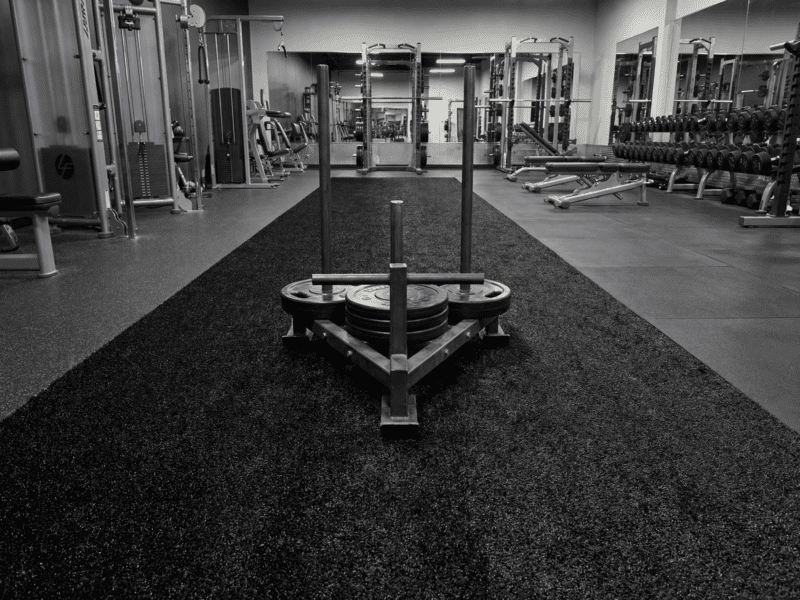
So, what is the math behind this destruction?
What Is the "Turf Killer" Formula? (Physics of Weight & Friction)
The damage follows the Friction Formula: $F_f = \mu N$. Wear is accelerated when High Weight + "Digging In" increases the Normal Force ($N$), generating heat that exceeds the thermal limit of standard Polyethylene fibers.
Deep Dive: Friction Coefficients and Thermal Limits
To understand why your turf creates "bald spots," we must look at the physics.
-
The Friction Equation ($F_f = \mu N$): Friction Force ($F_f$) equals the Coefficient of Friction ($\mu$) times the Normal Force ($N$).
- The Myth: People think "Sled Weight" is the only factor.
- The Reality: The Normal Force ($N$) is the killer. If you push a 200lb sled but lean on it with 150lbs of body weight, you are effectively dragging 350lbs of downward pressure.
-
The Thermal Threshold:
- Standard Gym Turf (Polyethylene): Melts at roughly 120°C – 130°C (248°F – 266°F).
- Premium Nylon Turf: Melts at roughly 220°C – 265°C (428°F – 509°F).
The Evidence: In our Lisport Wear Testing (the industry standard for simulating foot traffic), we see that continuous friction can spike surface temperatures rapidly. If a heavy sled with narrow runners generates localized heat of 140°C, Polyethylene will fail physically. It softens, flattens under the pressure, and cools in that matted shape. Nylon, with a much higher thermal threshold, resists this "heat set" memory. Beyond fiber type, turf infill choices also play a critical role in managing interface friction and heat dissipation.
| ⚠️ Turf Damage Accelerators – Quick Checklist | Physics Basis | Risk Level |
|---|---|---|
| Metal Runners (High $\mu$) | High Coefficient of Friction = More Heat | 🔴 CRITICAL |
| Narrow Runners (<1 inch) | High PSI (Pressure per Sq Inch) | 🔴 CRITICAL |
| Polyethylene Fiber Sled Lanes | Low Melting Point (~125°C) | 🟠 HIGH |
| Nylon Fiber Sled Lanes | High Melting Point (~250°C) | 🟢 SAFE |

Understanding the thermal limits explains the "burn," but the mechanical damage is often caused by how force is applied.
Why Does "Digging In" Destroy Turf Faster Than Gliding? (Vector Analysis)
"Digging in" changes the Force Vector from horizontal to vertical. This dramatically increases the Normal Force ($N$), driving runners into the backing and exceeding the "Tuft Bind" strength (the force required to pull a fiber out).
Deep Dive: Vertical Force vs. Horizontal Drive
In biomechanics, we analyze force vectors. An efficient sled push applies force horizontally ($F_x$). However, when athletes fatigue, they lean down, creating a vertical force component ($F_y$).
Why is this fatal for turf?
Every turf product has a rated "Tuft Bind" strength—usually measured in pounds (e.g., 8 lbs of force to pull a blade out).
- Scenario A (Good Form): The sled glides. The friction is kinetic. The shear force on the fiber is low.
- Scenario B (Bad Form – Leaning): The athlete adds 100lbs of vertical pressure. The sled runners "sink" into the fiber pile. Now, to move the sled, the runner must physically shear through the fibers rather than glide over them. This shearing force often exceeds the 8-10 lb Tuft Bind limit, ripping fibers out at the root or delaminating the secondary backing.
The Lab Result: In controlled tests, increasing vertical load by 50% can reduce the cycle-life of the turf by over 60%. It is not linear; it is exponential.

The physics of force is undeniable, but the "contact point"—the equipment—is where the rubber meets the road.
Is Your Equipment Ruining Your Floor? (PSI & Surface Roughness)
Yes. According to tribology (the study of wear), surface roughness ($R_a$) and contact pressure (PSI) dictate wear rates. Rusted metal runners act like abrasive sandpaper, while narrow runners concentrate load, exceeding the compressive strength of the foam backing.
Deep Dive: The PSI Problem
It is a simple pressure calculation.
- Sled A: 300 lbs on 2-inch wide plastic skis (Total area ~60 sq inches) = 5 PSI.
- Sled B: 300 lbs on 0.5-inch metal rails (Total area ~15 sq inches) = 20 PSI.
Sled B applies 4x the pressure. This high PSI compresses the foam backing beyond its rebound limit. Once the backing is crushed, the fibers lose their anchor stability. Furthermore, we must check the Surface Roughness ($R_a$). New plastic (UHMW) is smooth. Old, rusted metal is jagged. Dragging rusted metal across plastic fibers is essentially "machining" your floor—removing microns of material with every pass.
My QC Recommendation: If you run your fingernail across the bottom of a sled runner and it catches, that runner is actively destroying your investment.

If the equipment and physics are harsh, the material must be engineered to survive it.
Why Do Some Gyms Last Years While Others Fail in Months? (Material Specifications)
Premium turf survives because it uses Nylon fibers (High Melting Point) and High Face Weight (>80oz). High density increases the surface area supporting the sled, reducing the PSI per fiber and preventing the runner from touching the backing.
Deep Dive: Face Weight and Load Distribution
Why does Face Weight (ounces of material per square yard) matter scientifically? It comes down to Load Distribution.
- Low Density (40oz): The sled runner contacts fewer fibers. Each individual fiber bears a massive load, leading to rapid "creep" (deformation) and crushing.
- High Density (80oz+): The sled runner is supported by thousands of fibers simultaneously. The load per fiber is minimal.
Additionally, we look at the Backing adhesion. Standard turf uses a simple Latex coating. Premium sled turf uses Polyurethane (PU) or multi-layer geotextiles. In "Grab Tear Strength" tests (ASTM D5034), PU backings show significantly higher resistance to the shearing forces created by sleds. If you are buying turf for sleds, you are not buying "grass"; you are buying an engineered wear surface.
| Feature | Scientific Benefit | The "Why" |
|---|---|---|
| Nylon 6,6 Fiber | High Melt Point (~260°C) | Resists friction burn from heavy sleds. |
| 80oz Face Weight | High Fiber Density | Disperses PSI load across more fibers. |
| PU Backing | High Shear Strength | Prevents delamination under torque. |
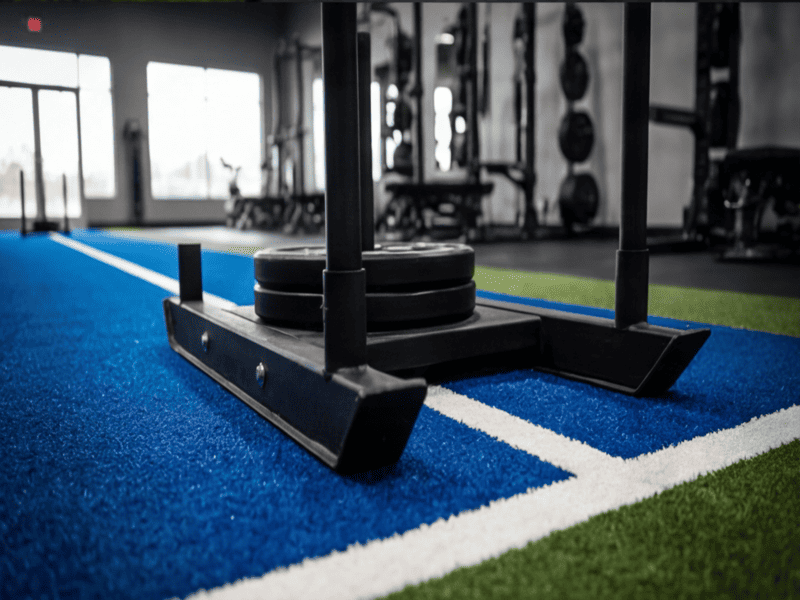
Knowing the science allows us to implement protocol-based solutions.
How Can I Stop My Turf From Wearing Out? (Protocol-Based Solutions)
Extend turf life by managing the variables of the wear equation: Reduce $\mu$ (smooth runners), Reduce $N$ (correct technique), and maintain Fiber Verticality (brushing) to optimize load distribution.
Deep Dive: Maintenance Protocols
Based on the physics we’ve discussed, here are the evidence-based protocols to save your floor:
- Reduce Surface Roughness: Inspect sleds monthly. Polish metal runners or install UHMW plastic covers to lower the Coefficient of Friction ($\mu$).
- Optimize Contact Area: Implement "Lane Migration." Don’t let the high PSI load concentrate on the exact same pixels of flooring every day. Shift the start line by 1 foot every week.
- Restore Verticality: Use a stiff broom to stand fibers up. Why? Vertical fibers act as springs (compression). Matted fibers act as a solid block. Compressing a spring stores energy; compressing a block causes wear. Understanding the variables of turf fiber recovery ensures that your maintenance protocols effectively restore the "spring" mechanism of the floor.
Conclusion
The "mystery" of turf wear is simply physics in action. Friction Heat ($>120^{\circ}C$) + High PSI + Vertical Force = Failure.
You cannot cheat physics, but you can engineer against it. By choosing materials with high thermal thresholds (Nylon) and high density, and by correcting the biomechanics of your athletes, you can win the battle against wear.