


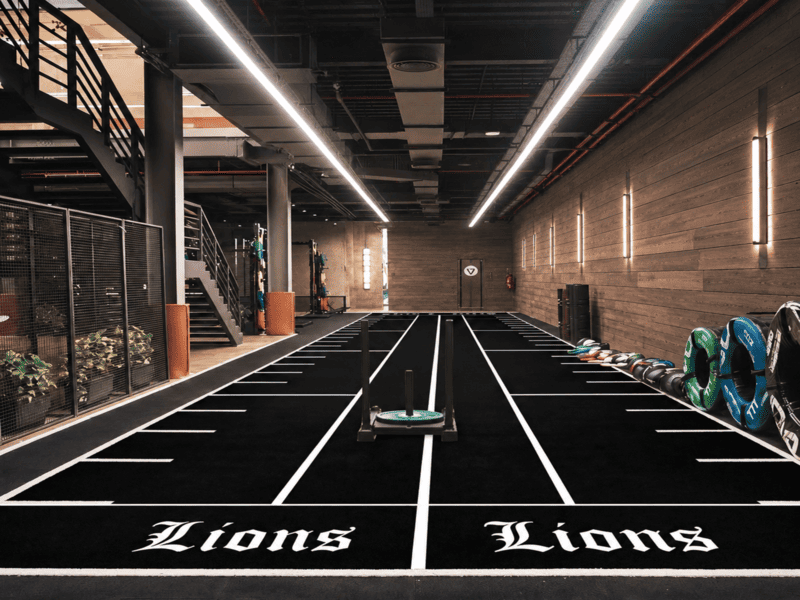
To endure the unique mix of heavy sled friction, high-impact plyometrics, and heavy lifting, Hyrox gyms require a hybrid flooring system involving high-density nylon turf for sleds and 20mm+ rubber tiles for strength zones.
As a Production Manager who has overseen the manufacturing of thousands of square meters of gym flooring, I see a clear trend: standard commercial gym setups fail when subjected to Hyrox training. Hyrox is not just lifting weights; it is a standardized global race that demands specific environmental conditions. The sled loads and repetition volumes used in Hyrox-style competitions place unique friction and impact demands on flooring that generic materials cannot match.
If your gym floor has a different friction coefficient than the race floor, your athletes are training with the wrong data. A facility owner must stop viewing flooring as a generic black mat and start viewing it as performance equipment that replicates the race day experience. In this guide, I will break down exactly how we specify materials to handle these extreme demands from a manufacturing perspective.
Contents hideQuick Decision Guide: The Ideal Hyrox Flooring Setup
For gym owners looking for an immediate specification list, here is the factory-recommended standard to match Hyrox demands:
- Sled Track: 100% Nylon Turf (Short pile, PU backing). Essential for consistent sled drag and heat resistance.
- Functional Zone: 20–25mm Rubber Tiles (Fine-grain EPDM top). Provides balance for lunges and protection for wall balls.
- Strength Zone: 30–40mm High-Density Tiles. Maximum shock absorption for heavy deadlifts and dropped weights.
- Transitions: Shock Pads or Underlay. Critical to raise the turf height to flush with rubber tiles, preventing trip hazards.
Why Standard Flooring Fails Hyrox: A Buyer’s Guide
Standard flooring fails because it lacks the tensile strength to resist tearing from sleds. To understand the fundamental requirement, one must ask why does Hyrox training need artificial turf—it provides the density to absorb repetitive shock without bottoming out, leading to joint pain and rapid material degradation, leading to joint pain and rapid material degradation.
I often see gym owners try to save money by installing standard 10mm rolled rubber across their entire facility. Within six months, they call us because the seams are curling and the rubber is crumbling in the sled area. From a materials engineering standpoint, generic SBR (styrene-butadiene rubber) rolls are designed for static loads, like parked treadmills or benches. They are not engineered for the dynamic, lateral shear forces seen in a Hyrox race.
In a competitive scenario, the "Sled Push" and "Sled Pull" generate massive lateral friction. This creates heat. If the flooring material—especially artificial turf—is made from low-grade Polyethylene (PE) without a high enough melting point, the friction will literally melt the fibers flat. For the plyometric sections, like Burpee Broad Jumps, a thin floor bottoms out immediately against the concrete. This sends the impact force straight back into the athlete’s knees. We formulate our performance tiles with a specific binder-to-rubber ratio to ensure energy absorption, not just coverage. You need a surface that protects the athlete’s joints during volume training while protecting your concrete subfloor from dropped kettlebells.
Understanding the Demands: It’s Not Just Lifting
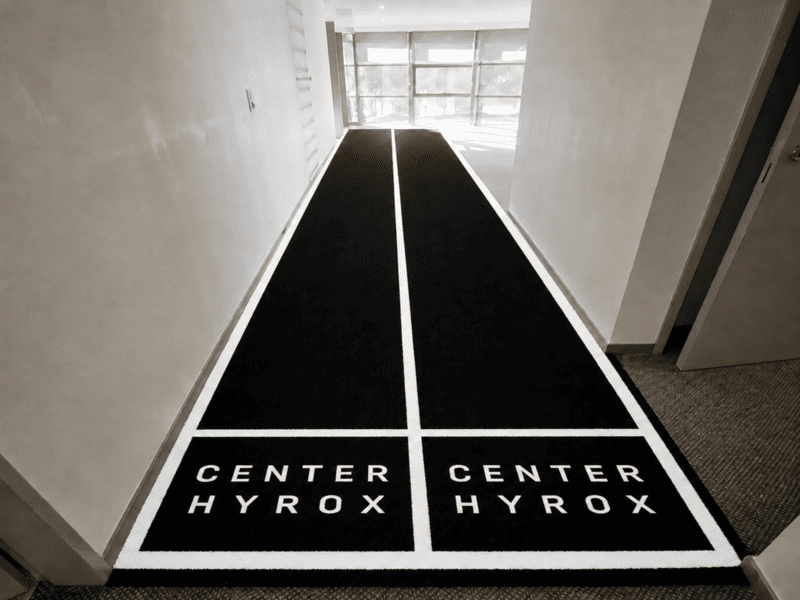
Hyrox demands a trifecta of flooring properties: high abrasion resistance for sleds, medium-density cushioning for plyometrics, and high-density impact protection for heavy compound lifts.
We approach Hyrox flooring specifications by analyzing the physics of the eight core workout stations. Each station exerts a different stress on the material. The Sled Push is an abrasion event; the Wall Balls and Lunges are impact events; the Farmers Carry is a compression event. A single flooring type rarely satisfies all three.
Crucially, for athletes preparing for a race, the "feel" of the floor must be consistent. If a gym uses slippery turf, an athlete might push 150kg easily in training, only to struggle on race day when the drag is higher. Below is a breakdown of how we map flooring specs to Hyrox movements to ensure training transferability.
| Hyrox Station | Physical Stress on Floor | Required Flooring Property |
|---|---|---|
| Sled Push/Pull | High Heat & Lateral Shear | High Melting Point & strong backing (Nylon) |
| Burpee Broad Jumps | High Impact Shock | Energy restitution (bounce) & cushioning |
| Sandbag Lunges | Skin Contact & Pressure | Smooth surface texture & moderate softness |
| Farmers Carry | Heavy Point Load Compression | High Density (Shore A Hardness 65+) |
The Centerpiece: Turf for Sled Tracks & Agility
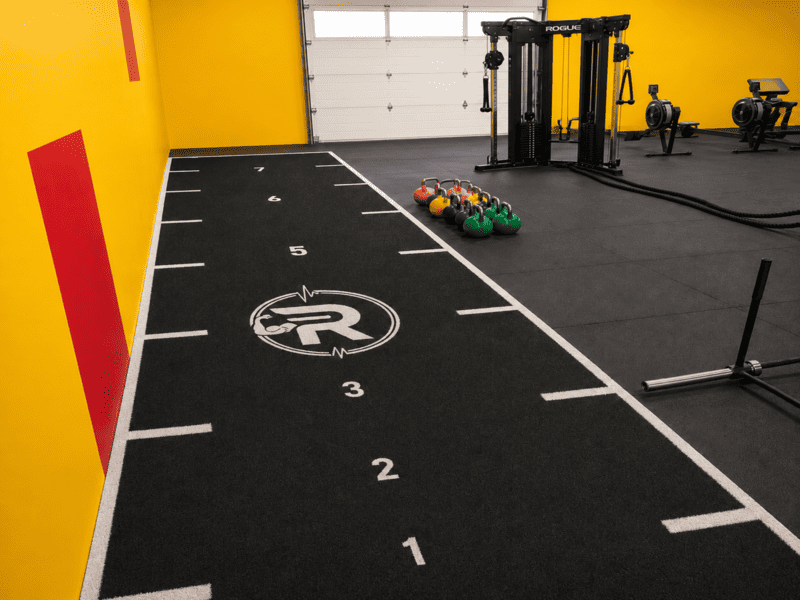
The best turf for Hyrox is high-density Nylon with a low pile height, which resists melting under heavy friction and provides the correct drag coefficient for realistic training.
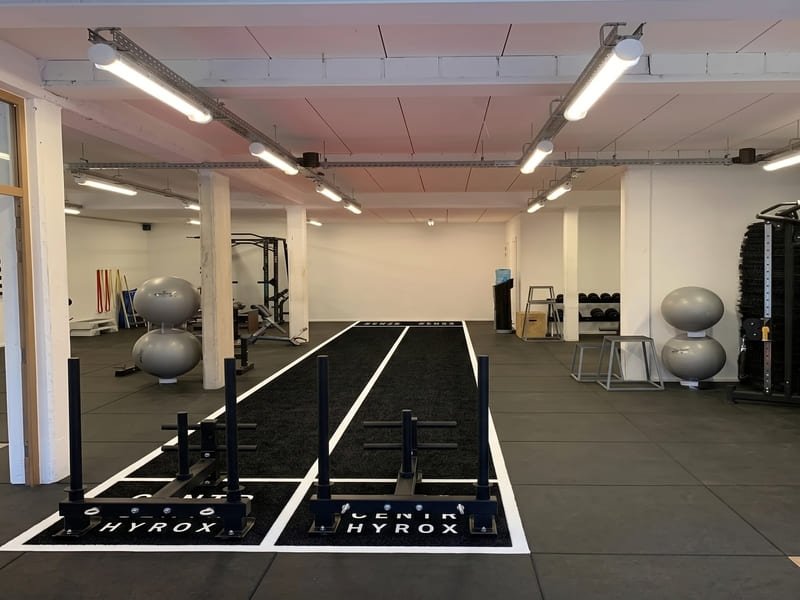
The sled track is where most gyms fail. On the production line, we handle two main types of artificial grass fibers: Polyethylene (PE) and Nylon. For a Hyrox track, I strongly advise against standard PE landscaping grass. Nylon is harder, more resilient, and has a significantly higher melting point. When a 150kg sled is pushed rapidly, the friction generates heat. Nylon stands up to this; cheap plastic blends will deform.
We also focus on "Tuft Lock"—how securely the grass blades are attached to the backing. Sleds try to rip the grass out. We use a double-backing process with polyurethane coating to lock fibers in. Customization is also vital here. Instead of painting lines on top (which flakes off in weeks), we use "in-woven" technology. We verify the loom settings to weave white fibers directly into the green or black mat for the 1m and 10m markers. This ensures the markings last as long as the turf itself, keeping your gym looking professional without maintenance.
| Feature | Nylon Sled Turf | Standard Landscaping Turf |
|---|---|---|
| Fiber Material | 100% Nylon (Polyamide) | Polyethylene/Polypropylene |
| Heat Resistance | High (Resists friction burn) | Low (Melts/flattens easily) |
| Durability | Rated for heavy drag | Rated for foot traffic only |
| Markings | In-woven (Permanent) | Painted (Fades quickly) |
The Workhorse: Rubber Flooring for Strength & Function
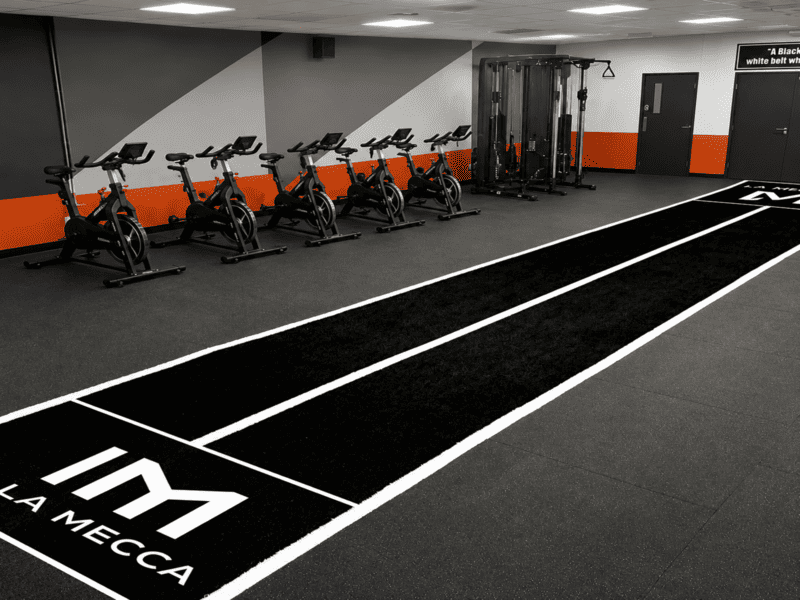
Heavy-duty 20mm to 40mm rubber tiles provide the necessary acoustic dampening and subfloor protection for weight zones, while thinner rolls serve well for cardio and transition areas.
For the "Functional Zones" where Wall Balls and Sandbag Lunges happen, we recommend 20mm rubber tiles. These are thick enough to absorb impact but stable enough for balance. In the manufacturing process, we can adjust the density. For Hyrox, we aim for a "top layer" of fine-grain EPDM. This provides a tighter surface structure. It prevents sweat and chalk from penetrating deep into the rubber, which breeds bacteria and smells over time.
For pure weightlifting zones, if your facility is on a second floor, we might bump this up to 30mm or 40mm tiles with an under-structure designed for acoustics. These tiles have "feet" or a grid pattern on the bottom that creates air pockets. These pockets trap sound waves and vibration. For cardio areas (rowers, ski-ergs), heavy tiles are overkill. Here, we supply rubber rolls. They act as a protective skin for the floor, prevent machines from sliding, and are much faster to clean because there are fewer seams.
Technical Success: Transitions & Installation
To ensure safety, use rubber underlayment or shock pads to raise the height of thinner turf to match the thicker rubber tiles, creating a completely flush, seamless training surface.
This is the number one technical oversight I see in gym designs. Your sled turf might be 15mm thick, but your rubber tiles are 25mm thick. That 10mm lip is a trip hazard, especially when an athlete is fatigued during a race simulation. As a manufacturer, we solve this by supplying specific sub-layers or "shock pads."
If your tiles are 25mm and turf is 15mm, we provide a 10mm high-density foam or rubber underlay for the turf lane. We install this underlay first, then glue the turf on top. The result is a mathematically perfect zero-level transition. We also produce beveled edge strips (ramped edges) for areas where the gym floor meets a lobby or hallway. A flush floor allows athletes to transition from the sled push directly into a farmers carry without looking down to check their footing. It speeds up the workflow and dramatically increases safety.
Why Choose Factory Direct Customization?
Sourcing directly from the manufacturer allows for custom logo integration and specific color matching while eliminating retail markups, ensuring you get premium performance specs for your budget.
When you buy from a reseller, you are buying "off the shelf." You get whatever black tiles they have in the warehouse. Working with the factory opens up the "OEM" (Original Equipment Manufacturer) catalog. We can water-jet cut your gym’s logo into the center of the rubber lifting platform. We can match the color flecks in the rubber floor to your brand’s specific Pantone color.
More importantly, manufacturing consistency matters. Rubber tiles are made in batches. If you buy from a reseller, you might get tiles from three different production runs, resulting in slight shade variations of black or gray. When we produce an order for a full facility, we run it in a single continuous batch. This ensures every tile has the exact same density, thermal expansion rate, and color. It looks cleaner and installs tighter. You are also cutting out the middleman, meaning your budget goes toward higher quality materials (like Nylon instead of PE) rather than distributor margins.
Conclusion
Building a Hyrox gym requires more than just space; it needs a technical flooring foundation. The right mix of Nylon turf and impact-absorbing rubber ensures safety, durability, and a professional athlete experience.
Are you planning a Hyrox-style facility? Don’t guess on the specs. Contact our team today for a free floor plan design consultation or request our custom flooring sample kit to feel the difference in quality yourself.