


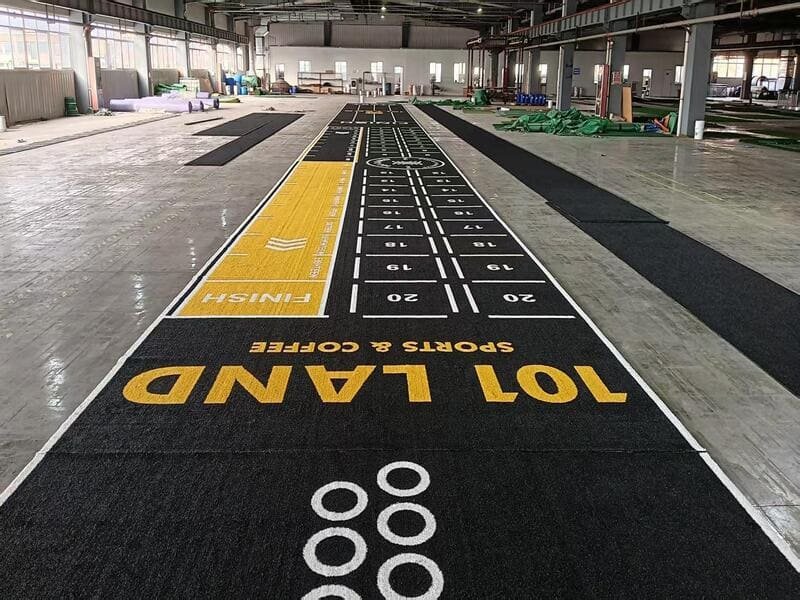
Quick Answer: What Makes a Gym Track “Premium”?
A premium gym track must meet three non-negotiable criteria to survive commercial use:
- Heat-Resistant Fibers: High-density Nylon or specialized blends that won’t melt under friction.
- Permanent Inlaid Markings: Lines and numbers tufted into the mat, not spray-painted on top.
- PU Backing: A poly-urethane coating for superior dimensional stability and tuft lock.
If a track fails any one of these, it is decorative turf—not performance flooring.
In my daily role as a Quality Control Specialist for gym flooring, I witness a recurring pattern in the industry. As functional training explodes in popularity, the demand for sled tracks has skyrocketed. However, the market is currently flooded with generic "decorative" turf marketed as performance flooring. These products look identical to the naked eye on day one. But after three months of heavy sled pushes, the difference becomes obvious.
For wholesalers and distributors, this distinction is financial. Selling a product that fails leads to warranty claims and damaged reputations. A true premium track is engineered specifically to handle the thermodynamics of friction. In this guide, I will break down the exact specifications you need to ensure you are sourcing a product that lasts.
Why Does Material Choice Matter for Sled Tracks?
Material choice determines the track’s melting point and recovery capability. Standard Polyethylene (PE) fibers often flatten or melt under the intense friction heat generated by heavy sleds, whereas Polyamide (Nylon) or specialized high-dtex blends possess a higher thermal threshold and superior elastic memory.
When I run friction tests in the lab, the results are immediate. A weighted sled does not just push down on the turf; it creates significant friction heat. Standard landscaping grass (PE) has a low melting point. When a 100kg sled is pushed rapidly, the contact points heat up, causing the PE fibers to soften and flatten permanently. We call this "matting down."
For a premium track, we insist on Nylon (Polyamide) or a hybrid blend designed for sports performance. Nylon acts differently. It is more rigid, has a much higher melting point (~220°C vs ~120°C for PE), and has "memory." When you push a sled over it, it springs back.
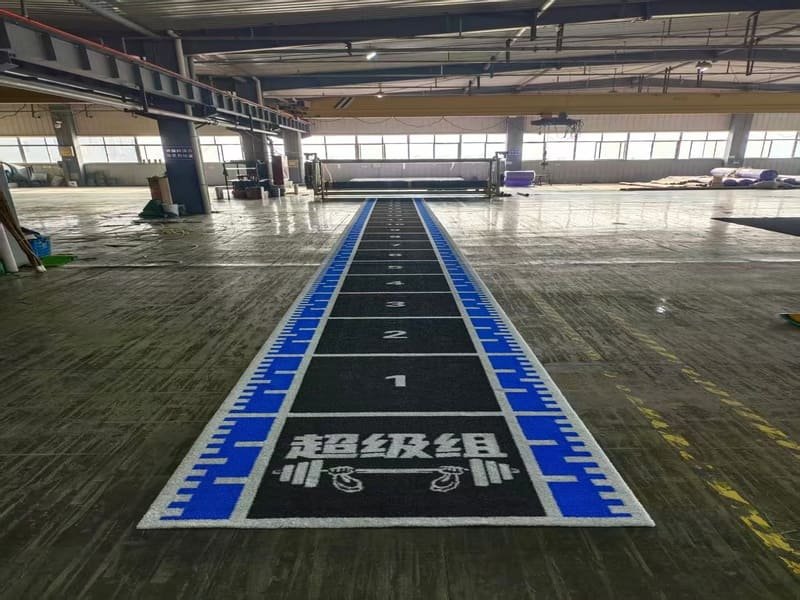
You must also check the Dtex (fiber weight) and Gęstość. For commercial use, I recommend a high-density configuration (typically over 60,000 stitches/m²) to ensure a smooth glide for the sled.
| Cecha | Standard PE Turf | Premium Nylon/Blend Track |
|---|---|---|
| Melting Point | Low (~120°C) | High (~220°C) |
| Friction Resistance | Poor (Melts/Flattens) | Excellent (Resists Heat) |
| Fiber Memory | Low (Stays flat) | High (Springs back) |
Are Inlaid Markings Better Than Painted Lines?
Yes, inlaid markings are vastly superior for commercial applications. While painted lines fade and peel within 6 to 12 months, inlaid markings are created by tufting colored fibers directly into the backing, ensuring the design remains permanent.
This is the most common complaint I hear: "My numbers are gone." In low-cost manufacturing, factories spray paint the lines on green turf. Even with industrial paint, the friction from the sled acts like sandpaper, erasing the lines in under six months.
The premium alternative is the Inlaid (or Tufted) process. We program the tufting machine to switch yarn bobbins at precise intervals. The white line is physically part of the carpet structure. You can bleach it, scrub it, or drag a sled over it, and it will never fade. Furthermore, this technology allows for Custom Logo Integration, a massive value-add for wholesalers.
How Does Backing Affect Gym Track Stability?
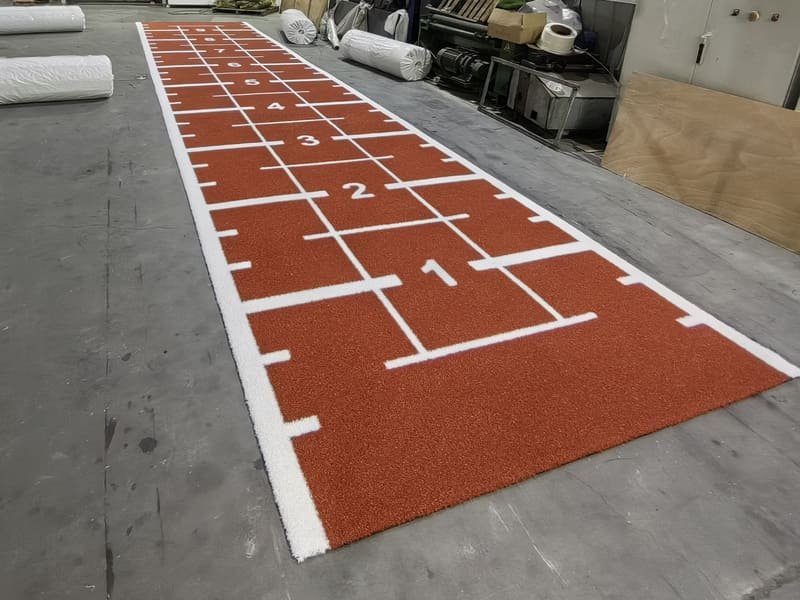
The backing system anchors the fibers and prevents dimensional distortion. A premium Polyurethane (PU) backing offers superior tuft lock strength and water resistance compared to traditional SBR Latex, preventing the track from rippling under shear force.
If a track has "waves" or ripples, the backing has failed. Heavy sled pushes create horizontal shear force. If the backing is weak, the turf stretches and creates a tripping hazard.
Traditionally, the industry used SBR Latex. SBR is fine for landscaping, but it can become brittle and crack over time. In my QC tests, PU (Polyurethane) backing consistently outperforms SBR. PU creates a stronger "Tuft Lock," making fibers harder to pull out. More importantly, PU is dimensionally stable, meaning fewer calls from installers complaining that the seams are opening up.
What Is Often Mistaken for a Premium Gym Track? (But Isn’t)
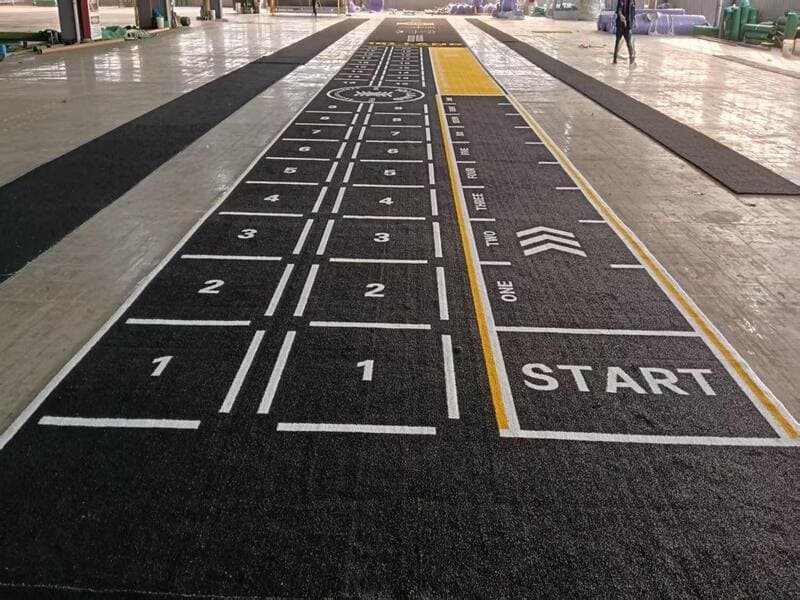
Many products marketed as "Gym Turf" are simply rebranded landscaping grass. It is crucial for wholesalers to recognize these imposters to avoid stocking inferior goods.
In my experience, 30% of the "Gym Tracks" sold online are not engineered for gyms at all. Here is what to avoid:
- Rebranded Landscaping Turf: If it feels incredibly soft like a residential lawn, it is likely pure PE designed for bare feet, not weighted sleds. It will flatten in weeks.
- Spray-Painted Yard Lines: If you can scrape the white line off with your fingernail or see the green root underneath the white paint, it is a low-quality painted track.
- SBR-Only Latex Backing: If the black backing crumbles easily when you scratch it, it is likely cheap latex that will degrade in a humid gym environment.
Who Should Invest in a Premium Gym Track?
Not every facility needs a competition-grade track. However, for commercial environments, the investment is necessary to prevent rapid replacement costs.
Before you stock your warehouse, understand who this product is for:
| Docelowi odbiorcy | Zalecenie |
|---|---|
| Commercial Gyms / Health Clubs | Essential. High traffic requires Nylon/PU durability. |
| CrossFit Affiliates | Essential. Heavy sled work will destroy generic turf. |
| Profesjonalne obiekty szkoleniowe | Essential. Custom branding and performance are key. |
| Home Gyms (Light Use) | Optional. Standard turf may suffice for occasional use. |
| Decorative Areas / Break Rooms | Not Needed. Premium tracks are overkill here. |
The Business Case for Wholesalers
Investing in premium tracks increases long-term ROI by reducing customer churn. While the procurement cost is higher, supplying "zero-complaint" materials builds a reputation for reliability.
If you sell a budget track that fails in 8 months, you are liable for replacement turf, freight, and labor. One warranty claim can wipe out the profit from five orders. By sourcing tracks with Nylon blends, inlaid markings, and PU backing, you are buying an insurance policy against complaints.
Wnioski
To summarize, do not let visual similarities fool you. A commercial-grade gym track is defined by heat-resistant fibers, permanent inlaid markingsoraz stable PU backing.
O autorze
I am a Gym Track Quality Control Specialist and Production Process Engineer. With years of experience testing polymer flooring, I help wholesalers navigate the technical complexities of sourcing high-performance athletic surfaces.
Ready to upgrade your inventory?
If you want to see the difference between painted lines and inlaid technology for yourself, or if you need to test our PU backing against standard SBR, my team is here to help.
[Contact us here] to request a free sample kit or a technical specification sheet for your next project.