


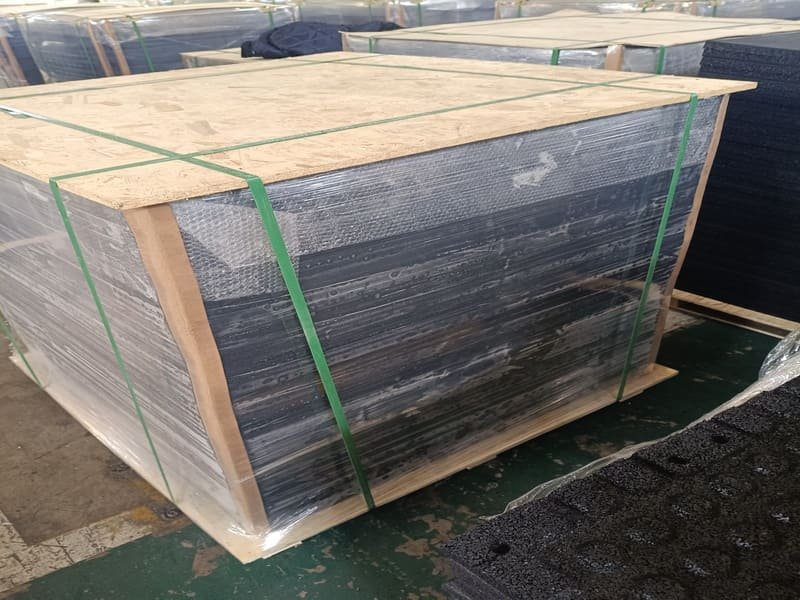
Buying in bulk saves money, but hidden costs in logistics, waste calculation, and material quality often catch buyers off guard. Whether you are a first-time gym owner or a facility manager, focusing solely on price per square foot is a mistake.
In my 15 years as a flooring contractor, I have seen the same story play out. A buyer sees a low bulk price, signs the check, and thinks the job is done. But the "Price Per Square Foot" is just the tip of the iceberg. The real costs lie in the details that aren’t on the invoice: the 2,000 lbs pallet left in a parking lot, the unexpected chemical smell, or the shortage of material because no one calculated the waste factor.
This guide is not just about what goes wrong; it is about how to prevent it. I wrote this specifically for three types of buyers who most often fall into these traps:
- First-Time Gym Builders: You are likely underestimating the sheer physical difficulty of logistics and installation.
- Retail-to-Bulk Switchers: You are used to buying 10 mats at a time and don’t realize that bulk manufacturing has different rules for dye lots and consistency.
- Facility Managers (Schools/Military): You often focus heavily on specs but overlook the site conditions (subfloor moisture) that ruin the install.
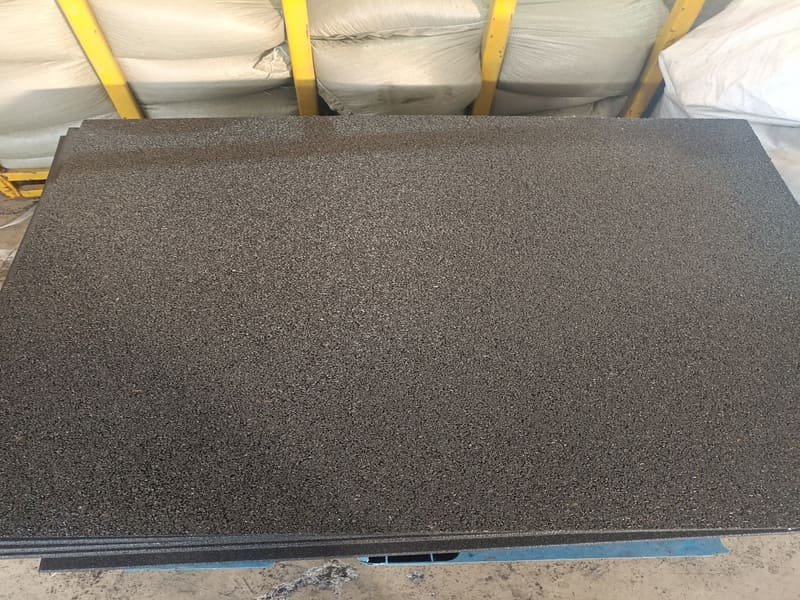
First, we need to address the math error that delays more projects than anything else.
Why Is Your Square Footage Calculation Likely Wrong?
Ordering exact room dimensions is a rookie mistake that leads to shortages. You must add 5-15% for waste to account for trimming and cutting, ensuring you don’t run out of material mid-installation.
If your room is 2,000 square feet and you order exactly 2,000 square feet, you will fail. I guarantee it. Walls are rarely perfectly straight, and columns require complex cuts. When you cut a rubber roll to fit a corner, the off-cut is often unusable scrap. This is the "Waste Factor."
For a simple rectangular room, a 5-7% overage is usually enough. However, if your layout includes pillars, alcoves, or diagonal walls, you need to budget for 10-15% extra. This is especially critical for Retail-to-Bulk Switchers. If you run short and try to order one more roll two weeks later, you face the "Lot Number" risk. Rubber is made in batches. A roll made on Monday might be a slightly different shade of black than one made on Thursday. If you mix batches, you will have a permanent, visible seam in your gym.
| Room Complexity | Recommended Overage | Dlaczego? |
|---|---|---|
| Simple Rectangle | 5% – 7% | Minimal cuts required; mostly straight runs. |
| Columns/Obstacles | 10% | Frequent trimming around posts creates unusable scraps. |
| Complex/Diagonal | 12% – 15% | Angled cuts result in significant material waste. |
| Tile Format | 5% – 10% | Interlocking tiles lose perimeter footage when edges are trimmed. |
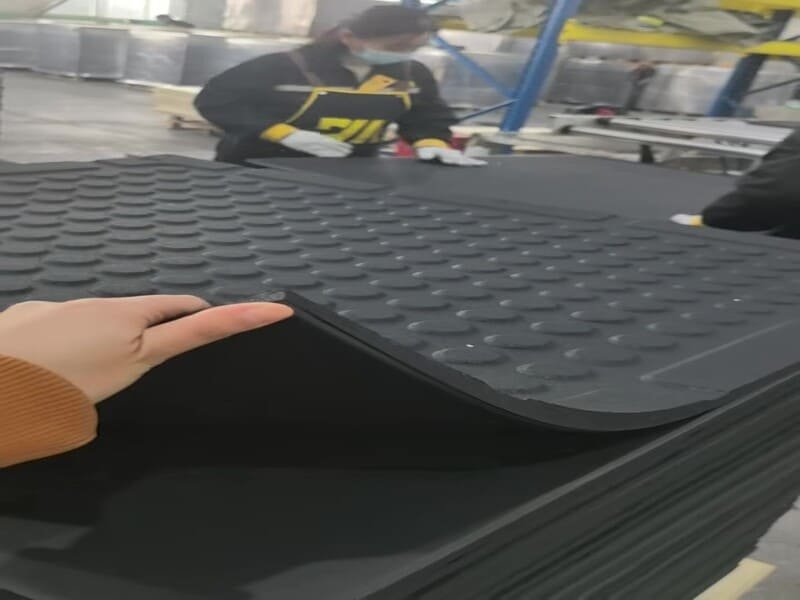
Once you have the right amount, you have to verify that you aren’t buying a low-quality product disguised as a bargain.
Is All "Rubber" Created Equal?
No. Cheap bulk flooring often uses weak binders and low-density rubber, leading to crumbling and strong chemical odors. High-quality flooring uses premium PU binders and has a neutral smell.
I have walked into new gyms where the smell of sulfur and burning tires is so strong it burns your eyes. This is a common issue for First-Time Buyers who choose the cheapest option on Alibaba or eBay. This smell comes from high VOCs (Volatile Organic Compounds) in low-grade recycled rubber. In a bulk order, this off-gassing can make a confined space unusable without massive ventilation upgrades.
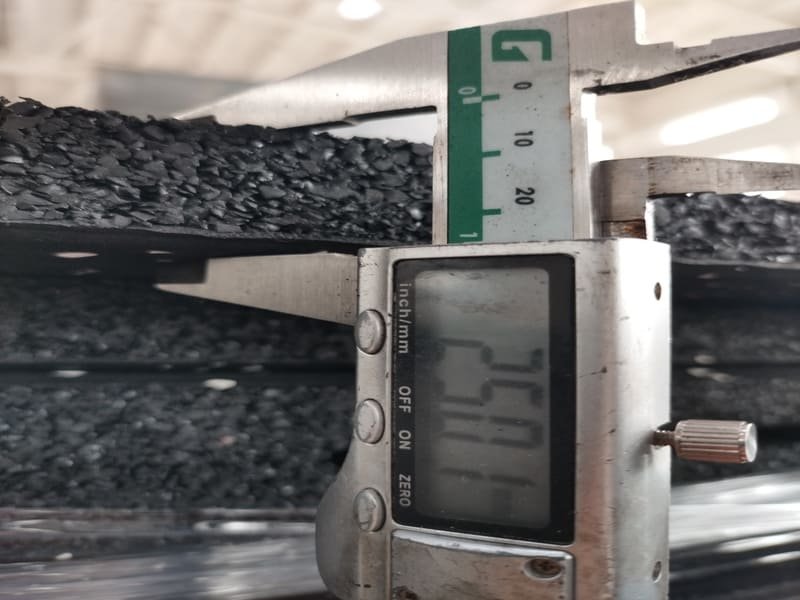
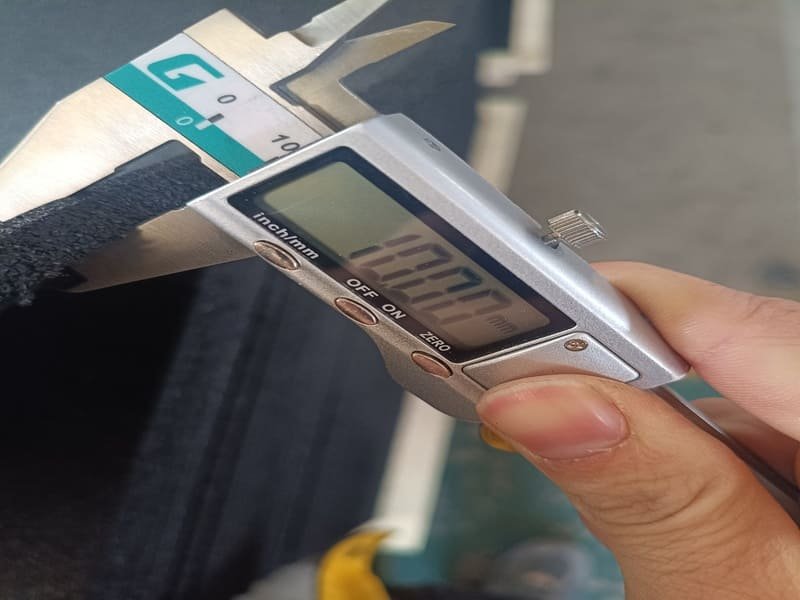
But the biggest technical differentiator is the Binder Quality. Rubber flooring is essentially rubber crumbs held together by glue (Polyurethane binder). To cut costs, some manufacturers reduce the ratio of binder. The floor looks fine on day one, but under the friction of sled pushes or dropped weights, the surface starts to "shed." You will see black dust constantly appearing on your cleaning mops. Also, do not confuse Grubość z Gęstość. A 10mm mat with low density is weaker than an 8mm mat with high density. For heavy lifting areas, density prevents the rubber from bottoming out.
- Virgin Rubber: Non-porous, easiest to clean, vibrant colors, virtually odorless.
- Recycled Rubber (High Quality): Re-vulcanized or high-binder content, minimal smell, durable.
- Recycled Rubber (Budget): Strong odor, low binder content, prone to surface crumbling.
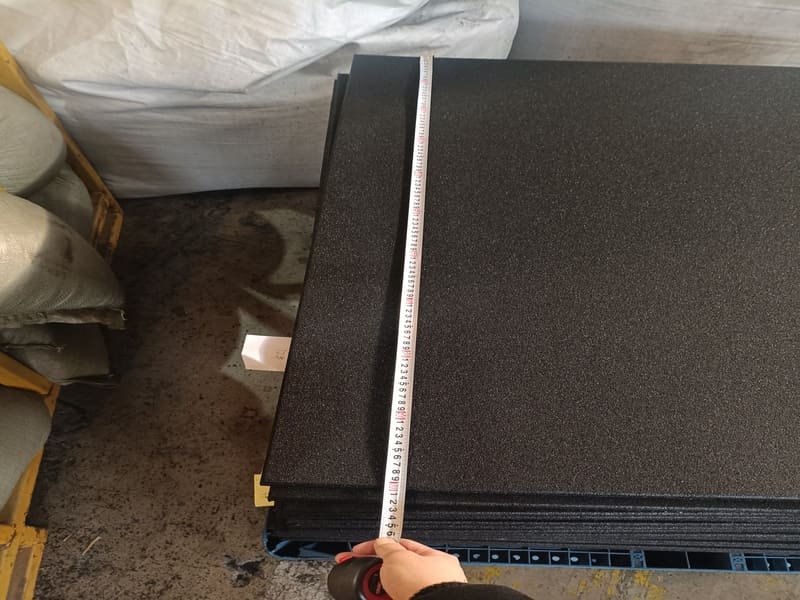
You have selected the right material, but getting it off the truck is a challenge most buyers are not ready for.
Will the Truck Driver Unload Your Pallets?
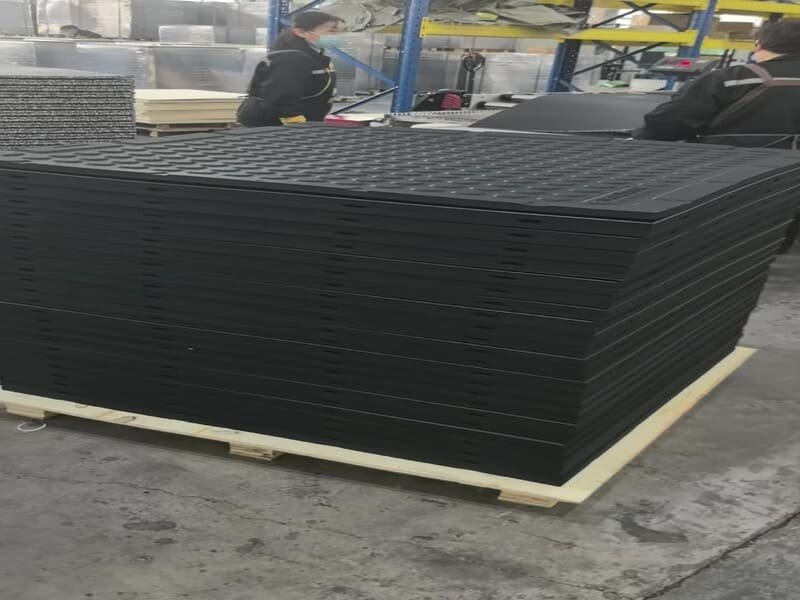
Standard freight is "Curbside Delivery," meaning the driver is not obligated to bring pallets inside or even lower them to the ground without a lift gate. You must arrange unloading equipment or pay for extra services.
This is the number one complaint I hear from Facility Managers. They assume delivery works like Amazon. It doesn’t. A semi-truck carrying 4,000 lbs of flooring pulls up. If you do not have a loading dock, and you didn’t pay for "Lift Gate Service," the driver might refuse to unload. They are drivers, not movers. I have seen clients frantically breaking down pallets in the back of a trailer to hand-bomb rolls down to the street.
You also need to check for "Accessory Fees." Is your gym on a residential street? That’s a fee. Is it in a "Limited Access" area like a school? That’s a fee.
Crucially, follow the "Damaged Goods" Protocol. When the shipment arrives, inspect the packaging immediately. If the shrink wrap is torn or a corner looks crushed, you musi write "DAMAGED" on the Bill of Lading (BOL) przed the driver leaves. If you sign the BOL without noting damage, you are legally stating the shipment arrived in perfect condition. If you find damage later, the insurance claim will be denied.
The material is on-site. Now, we look at the foundation, because a bad subfloor ruins a good gym floor.
What Lies Beneath Your Gym Floor?
Ignoring moisture levels and surface irregularities causes mold growth and safety hazards. Rubber conforms to the subfloor, meaning bumps will telegraph through, and trapped moisture will destroy adhesives.
Rubber flooring is not a magic eraser for a bad concrete slab. It is flexible. If you have a ridge or a divot in your concrete, the rubber will settle into it. This creates "Telegraphing," where every imperfection is visible, creating trip hazards. Before installation, the subfloor must be leveled.
The invisible killer is Wilgotność. Concrete acts like a hard sponge. If you are installing in a basement or garage (slab-on-grade), you must test the Relative Humidity (RH) of the slab. If you glue down rubber over damp concrete, the moisture gets trapped. Over time, this breaks down the adhesive bond and creates a perfect breeding ground for mold underneath your mats. You won’t see it until the smell starts or the edges curl up.
Underlayment Strategy:
- Slab-on-Grade: Usually requires a vapor barrier if moisture is high.
- Upper Levels: Requires acoustic underlayment to dampen impact noise for tenants below.
- General: Don’t use underlayment just "for softness"—it can make the floor too unstable for heavy lifts.
The floor is prepped. Now comes the hard work—installation costs are often higher than the material itself.
Are You Underestimating Installation Costs?
Adhesive installation is labor-intensive and expensive, while interlocking tiles require precise cutting. Failing to let the rubber acclimatize for 24-48 hours can lead to permanent buckling and gaps.
There is a debate between Glue-Down vs. Blokada (or dry-lay). Glue-down creates the most professional finish, but it is expensive. You aren’t just paying for labor; high-grade urethane adhesive costs upwards of $150-$200 per bucket. It is messy, toxic, and unforgiving.
Interlocking tiles save you the glue cost, but they require more finesse at the edges. If your walls aren’t straight, you will spend hours trimming borders.
The step everyone skips is Aklimatyzacja. Rubber rolls are wound tight under tension. When you unroll them, they have "memory" and want to curl. You musi unroll them and let them relax in the room’s temperature for at least 24 to 48 hours before cutting or gluing. If you cut them immediately, they will shrink or expand later, leaving you with gaps between seams.
| Cecha | Rolki z klejem | Płytki blokujące |
|---|---|---|
| Koszt materiałów | Niższy | Wyższy |
| Labor/Supply Cost | High (Requires Glue + Pro Labor) | Low (DIY Friendly) |
| Trwałość | Na stałe | Portable/Removable |
| Wodoodporność | High (Seams are sealed) | Moderate (Liquids can seep through seams) |
To help you avoid these mistakes, I have created a checklist to use przed you sign the invoice.
The Ultimate "Before You Buy" Checklist
Do not pay your deposit until you can answer "Yes" to these questions. This list separates the pros from the people who end up with extra fees and bad floors.
Before you place that bulk order, run through this 10-point inspection. If you are unsure about any of these, ask your supplier immediately.
Logistics & Delivery
- Did I request a Lift Gate? (Unless you have a forklift on site).
- Is my address classified correctly? (Residential, Commercial, or Limited Access).
- Can a 53-foot semi-truck physically fit on my street? (If not, request a smaller box truck).
Material & Quantity
- Did I add the Waste Factor? (Minimum +5% for squares, +10-15% for complex shapes).
- Is this all from one Dye Lot? (Confirm the supplier is pulling from a single batch).
- Have I seen a physical sample? (Do not trust online photos for texture or smell).
Installation Readiness
- Is my subfloor level? (Identify bumps or dips before the rubber arrives).
- Have I tested for moisture? (Tape a plastic sheet to the concrete for 24 hours; if it’s damp, you have a moisture issue).
- Do I have the right adhesive? (If gluing, ensure the glue matches the rubber type).
- Do I have a plan for off-loading? (You need 2-3 strong people to help move rolls once they hit the ground).
Wnioski
Ordering in bulk is smart, but only if you navigate the minefield of logistics and technical specs. Whether you are building your first gym or managing a large facility, the key is preparation.
A gym floor is the foundation of your business. Don’t let a shipping error or a bad calculation crumble that foundation.
If you are stuck on the "Waste Factor" calculation or just want to double-check your specs against our checklist, reach out to my team. We can help you verify your layout and send you a free sample so you can test the density and smell yourself before you commit to the full order.
Bio autora
I am a Rubber Gym Flooring Contractor with over 15 years of experience in polymer extrusion and surface coating technologies. I specialize in helping facility managers and gym owners navigate the complexities of bulk manufacturing, logistics, and installation to build durable, high-performance training spaces.