


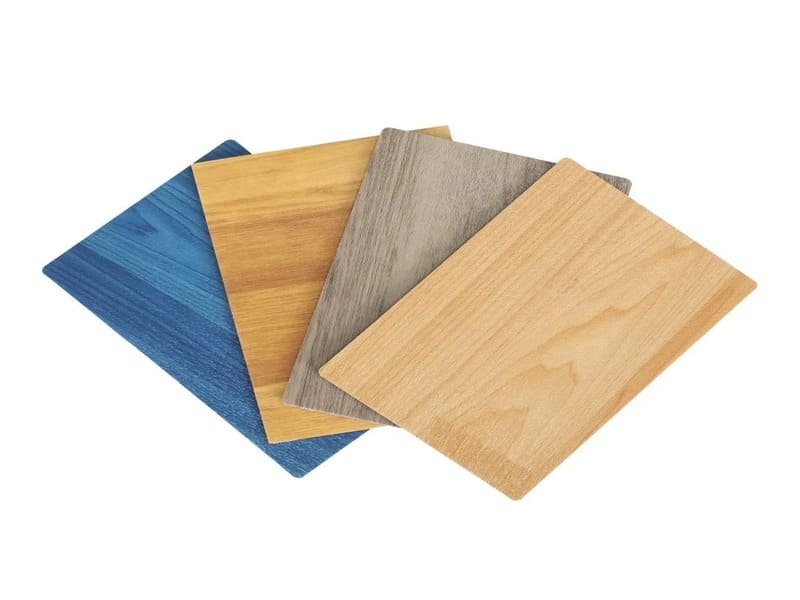
Yes, dumbbells can damage PVC sports flooring. Whether it actually happens depends on the weight, drop height, dumbbell material, and the specific flooring system, not on any fixed safety threshold.
I get this question a lot from gym owners and facility managers who are building out a new space. They love the look and feel of PVC sports flooring, but they worry about what happens the first time someone drops a dumbbell. That worry is fair. In this article, I will walk you through how damage actually happens, what factors raise or lower the risk, and how you can protect your investment. I have spent years working on the manufacturing side of PVC sports flooring, testing wear layers, foam backings, and coatings against real-world impact. So this is not guesswork. This is what I see in the field and in the factory.
I will break this down into the construction behind PVC sports flooring, the mechanics of impact damage, the variables that matter most, and the practical steps you can take today. By the end, you will understand exactly how to zone your gym so your PVC floor lasts as long as it should.
Let’s start with the basics. Before you can understand damage, you need to understand what this material is actually built to do.
What Is PVC Sports Flooring Built For?
PVC sports flooring is built for dynamic human movement. It is engineered and tested for athlete performance, not primarily for repeated high-energy impact from heavy metal free weights.
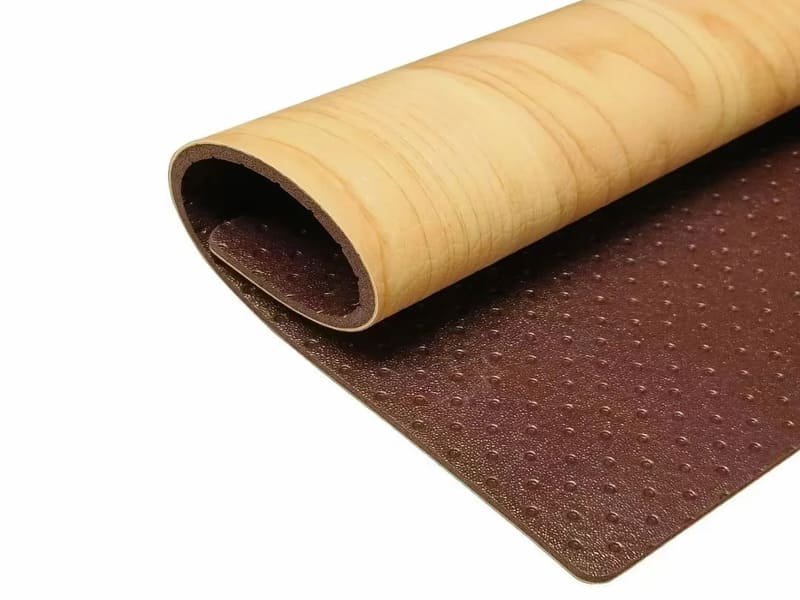
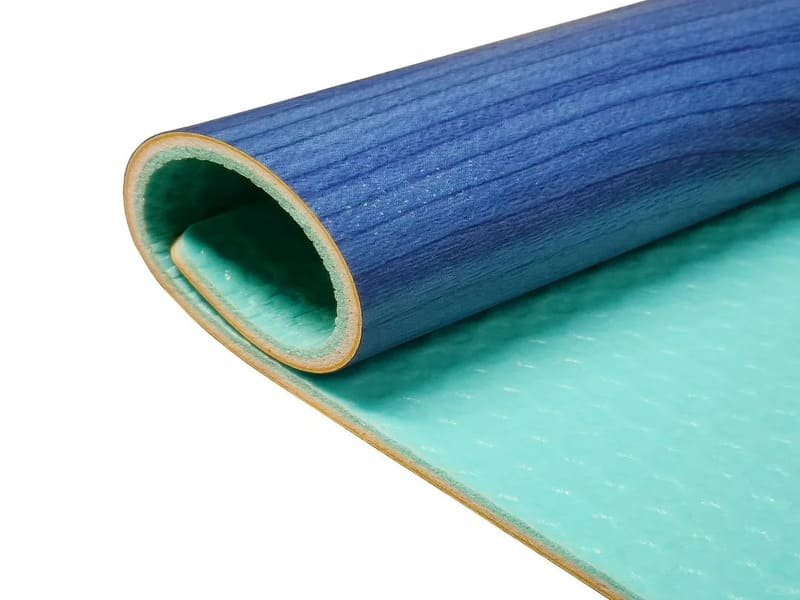
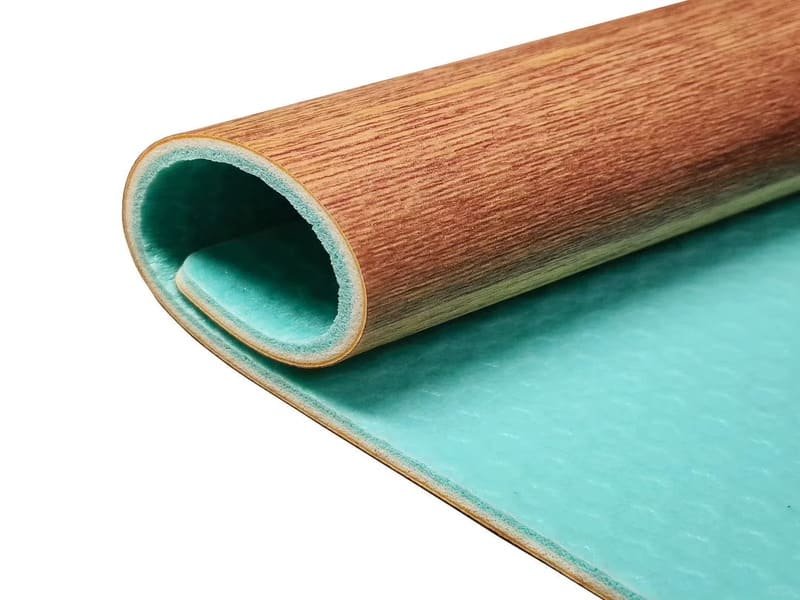
PVC sports flooring is not one single layer. Most heterogeneous cushioned sports floors use a multi-layer construction, though the exact makeup varies by manufacturer and product line. Typically, a UV-cured PUR or PU surface treatment protects against scuffs and makes cleaning easier. Below that sits a wear layer, then a printed design layer, often a reinforcement mesh for dimensional stability, and a backing layer that gives the floor its structural and cushioning characteristics.
| Laag | Typical Function |
|---|---|
| Surface Treatment (PUR/PU) | Surface protection, easier maintenance |
| Draaglaag | Abrasion and surface resistance |
| Printed Layer | Aesthetics and branding |
| Reinforcement (where present) | Dimensionale stabiliteit |
| Steunlaag | Construction-dependent support, cushioning, and dimensional performance |
This type of construction is commonly evaluated against standards like EN 14904, which covers indoor sports surface performance including shock absorption, vertical deformation, slip resistance, ball behavior, wear resistance, impact resistance, indentation resistance, and resistance to rolling loads. It’s worth being clear about what this means in practice: EN 14904 tells you the floor performs well under athlete movement, sports equipment, and ball interaction, all evaluated under defined test conditions. It does not tell you the floor is rated for repeated high-energy impact from heavy metal free weights striking a small area. That is a different category of load, and it’s the core limitation behind everything in this article: these systems are engineered and tested for sport-specific performance, not for absorbing concentrated metal impact.
Once you understand this limitation, the next question becomes obvious. What actually happens when a dumbbell hits the floor?
How Do Dumbbells Cause Damage to PVC Flooring?
Dumbbells damage PVC flooring in three main ways: punctures from sharp edges, permanent indentations from sustained or concentrated loads, and surface scratches from dragging.
The most dramatic damage comes from punctures and tears. Hex-shaped dumbbells have angular edges, and when one is dropped with enough force, that edge can cut through the wear layer and into the backing underneath. Once the surface is breached, it cannot self-heal. It becomes a permanent point of weakness.
The second type is quieter but just as costly. Permanent indentations happen when heavy dumbbells rest on the floor for long stretches, or when a concentrated point load exceeds what the backing can recover from. This is a point-load issue, not simply a matter of total weight in the room, which is an important distinction when you’re evaluating risk.
Third, dragging dumbbells across the surface wears down the surface coating fast. This does not always breach the floor, but it does dull the finish, expose lower layers to faster wear, and make the surface harder to keep clean over time.
Not every drop causes the same level of damage though. Several factors decide whether you get a minor scuff or a full tear.
What Factors Determine How Much Damage a Dumbbell Will Cause?
Damage risk depends on dumbbell weight, drop height, dumbbell material, and whether the flooring system is specifically designed for concentrated or impact loads. There is no universal safe weight or drop height for PVC sports flooring.
This is where I spend most of my time when I consult with facility owners, because the risk is never a single number. It is a combination of variables stacking on top of each other, and the flooring industry generally treats this as a system-level question rather than a single-spec answer.
| Factor | Tends to Lower Risk | Tends to Raise Risk |
|---|---|---|
| Gewicht | Lighter dumbbells | Heavier dumbbells |
| Dalingshoogte | Set down rather than dropped | Dropped from height |
| Materiaal | Rubber-coated or urethane | Bare cast iron with sharp edges |
| System Construction | Product specifically designed and tested for concentrated or impact loads | Standard sports flooring not rated for repeated free-weight impact |
| Subfloor & Installation | Manufacturer-specified system | Non-approved or mismatched subfloor |
For example, a lightweight rubber-coated dumbbell set down carefully, or even accidentally dropped from a low height, may leave no visible mark on some sports PVC systems. A heavy cast-iron dumbbell landing on its edge, on the other hand, can cut or permanently deform the surface. There is no universal "safe" dumbbell weight or drop height for PVC sports flooring, because the answer changes with the specific product and installation.
One factor deserves special attention because intuition often gets it backward: subfloor and system construction. A cushioned sports floor may absorb impact well for athletes running and jumping, but that same compressible backing can still be vulnerable to a concentrated point load. A softer underlayment is not automatically safer against dumbbell drops. In fact, manufacturers of foam-backed sports systems typically caution against point loading altogether, and recommend distributing the load of heavy fixed equipment, like table legs or machine feet, using load distribution plates rather than relying on the floor’s cushioning to absorb it. The same logic applies to free weights. Heavy equipment should be evaluated against the complete flooring system, not against how soft or firm the underlayment feels, and not against whether the product happens to include a reinforcement layer, which is primarily there for dimensional stability rather than impact resistance.
Knowing your risk factors is one thing. Acting on them is what actually protects your floor.
How Heavy Is Too Heavy for PVC Sports Flooring?
There is no fixed weight limit. Risk depends on static load, point load, impact energy, drop frequency, and what the flooring manufacturer approves for the specific product.
This is the question most people are really asking, and I want to answer it directly rather than give you a number that sounds precise but isn’t backed by anything. PVC sports flooring manufacturers typically publish guidance around static and dynamic load performance, but they treat impact loading, sustained point loading, and rolling loads as separate technical questions, each with its own considerations.
In practice, this means the honest answer is: it depends on your specific product, and the manufacturer’s technical documentation or approval is the right place to look before you commit a zone to unprotected free-weight use. If that documentation doesn’t address repeated dumbbell drops directly, the safer assumption is that added protection is warranted.
How Can You Protect PVC Flooring in Weight Zones?
Protect PVC flooring with rubber flooring designed for free-weight use, dedicated lifting platforms, clear no-drop policies, and proper dumbbell storage on racks rather than the floor.
The most direct fix is rubber flooring placed over the PVC in any area where weights get dropped or set down repeatedly. Rubber protection for free-weight and heavy-lifting zones spans a wide range, from relatively thin commercial free-weight products to much thicker high-impact tiles or platforms. The thickness you actually need depends on dumbbell weight, drop height, frequency, rubber construction, and the manufacturer’s tested application, so it’s worth checking a product’s rated use case rather than assuming a generic thickness is enough. Some purpose-built systems for lighter free-weight zones run in the single digits of millimeters, while systems designed for CrossFit or heavy-lifting areas can run 30mm or more.
For heavy compound lifts like deadlifts, a dedicated lifting platform built from wood and thick rubber is the standard choice in most serious strength training facilities, and it keeps the highest-impact activity off the PVC entirely.
Beyond equipment, policy matters just as much. A clear "no dropping weights" rule in PVC-covered areas prevents most accidental damage before it starts. And proper storage, meaning racks instead of the floor, helps avoid the slow, concentrated compression that builds up when dumbbells sit in the same spot for extended periods.
These fixes work well for existing PVC installations, but if you are still in the planning phase, there is a bigger strategic question worth asking.
PVC vs. Rubber Gym Tiles: Which Is Better for Weights?
High-impact rubber flooring is generally better suited to free-weight zones. PVC flooring is generally better suited to sports courts, cardio, and group fitness. Many gyms use both, zoned by activity.
This comes up constantly when I work with facility designers, and the answer isn’t about crowning one material the winner. It’s about matching the material to what happens in each zone.
| Functie | PVC Sportvloeren | High-Impact Rubber Flooring |
|---|---|---|
| Sports movement | Very suitable when engineered to sports standards | Depends on the specific system |
| Free-weight drops | Usually needs added protection | Generally better suited, product-dependent |
| Athlete shock absorption | Strong when certified to sports standards | Depends on thickness and construction |
| Ball behavior | Can be engineered for court-sport standards | Often not optimized for court sports |
| Point-load resistance | Afhankelijk van het product | Generally stronger in dedicated weight zones |
| Best use case | Courts, cardio, group fitness | Free weights, powerlifting, CrossFit |
Vulcanized rubber and high-density SBR or EPDM crumb rubber tiles are widely used in facilities as the go-to choice for heavy free-weight zones and cross-training, largely because point-load resistance is central to what those products are built for. My recommendation for most commercial gyms is a zoned layout: use PVC where movement, slip resistance, and court performance matter most, and transition to a dedicated high-impact rubber system in the free-weight sections. This is generally the most cost-effective way to build a facility that looks great and holds up long term.
Even with the best zoning strategy, accidents happen. So what do you do if damage has already occurred?
Can Damaged PVC Flooring Be Repaired?
Minor scuffs can sometimes be improved with manufacturer-approved cleaning or resurfacing methods. Deeper tears in sheet PVC can often be repaired with a patch, where the manufacturer’s specifications allow it.
If the damage is limited to surface scratches, you’re generally in good shape, though the right fix depends on the product. Some manufacturers approve specific cleaning or surface-restoration methods, and in some cases, a professional resurfacing treatment can bring the finish back close to new. This is very product-specific, so it’s worth checking with the manufacturer or installer before attempting a DIY fix, since not every factory surface treatment is designed to be reapplied on-site.
Deeper tears or gouges are a bigger job. For many sheet PVC systems, one common repair approach is a patch repair, where the damaged section is cut out and a matching piece of material is inserted. Depending on the product and application, the seam may be treated with heat welding or a chemical seam method, following the flooring manufacturer’s specifications. This restores structural integrity and stops the tear from spreading, though it’s worth knowing upfront that the repaired area or seam may remain slightly visible, even with skilled installation.
This is exactly why I tell clients that prevention has a much better return on investment than repair. Rubber protection in a free-weight zone generally costs a fraction of what it takes to patch or replace a section of commercial PVC roll goods.
Understanding your repair options is useful, but the real goal is avoiding the need for repair in the first place.
Conclusie
PVC sports flooring is a durable, high-performance surface, but it needs protection from concentrated metal impact in free-weight zones, since no universal weight or drop-height threshold makes it safe on its own. Walk through your facility, identify where heavy dumbbells get used and dropped, and invest in targeted protection like rubber tiles or drop mats to safeguard your PVC investment for the long run.
If you’re planning a gym build-out or need help matching flooring specs to your specific weight zones, send me a message. I work directly with facility owners and product developers on custom and bulk PVC sports flooring solutions, and I’m happy to walk through your layout with you.