


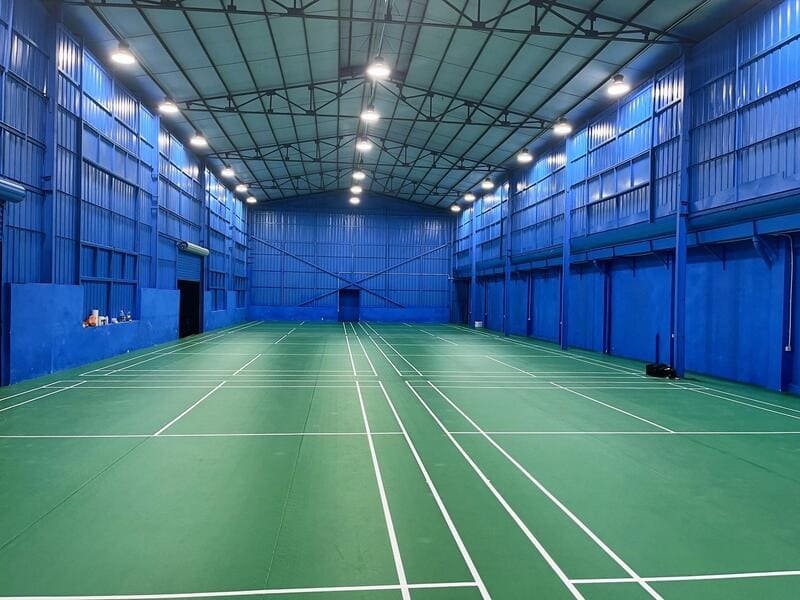
PVC vinyl roll flooring is the best overall choice for badminton courts, since it delivers strong shock absorption, sport-specific traction, and meets professional certification needs. Hardwood, interlocking tiles, and acrylic coating serve as alternatives depending on your budget, setting, and whether the space hosts other sports.
I have spent years inspecting sports flooring on the production line, so I know how a few millimeters of material can change the way a player lands, slides, or twists an ankle. The right floor is not just about looks. It affects player safety, since good flooring absorbs shock and gives steady traction under fast footwork. It also affects player comfort and movement quality, since glare, texture, and surface stability all shape how confident a player feels moving side to side. And it affects your long-term costs, since some floors need heavy maintenance while others just need a wipe down.
This guide is built for commercial club owners, school gym managers, architects, and home court builders alike. I will walk through each major flooring type, show you cost ranges and a head-to-head comparison table, and give you a buyer’s checklist so you can make a decision that fits your space and your budget.
What Is the Best Badminton Court Flooring by Application?
The best flooring depends on how the court is used. Professional and club courts do best with PVC vinyl. Multi-sport halls do best with hardwood plus a removable PVC overlay. Outdoor and budget courts do best with acrylic coating or PP tiles.
Buyers rarely need "the best floor" in the abstract. They need the best floor for their specific court. Here is how I match application to material based on the projects I have seen come through production:
| Anmeldung | Beste Wahl |
|---|---|
| Professional badminton courts | PVC vinyl roll flooring |
| Commercial badminton clubs | 5.0–7.0mm PVC flooring |
| School gyms | PVC or hardwood |
| Multi-sport halls | Hardwood with removable PVC overlay |
| Außenplätze | Acrylic coating or PP tiles |
| Home courts | PVC or PP tiles |
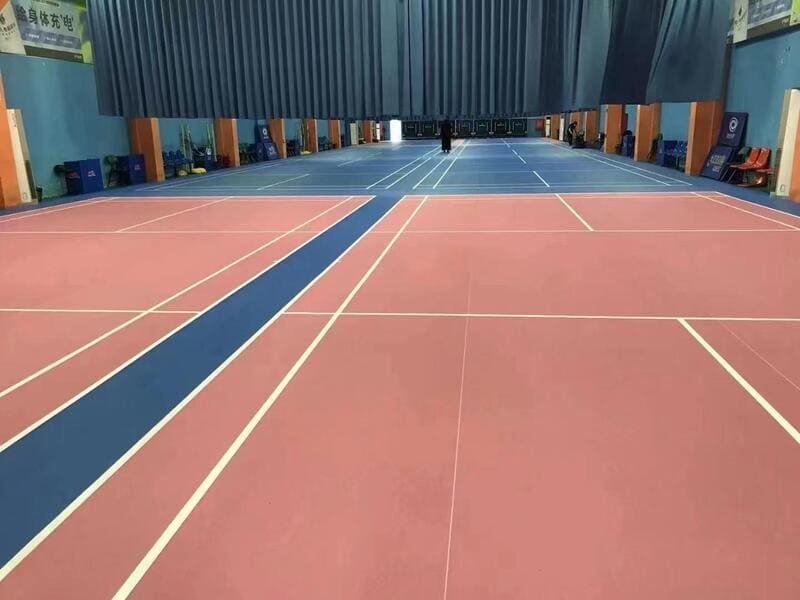
Once you know which category your court falls into, the next question buyers always ask me is what it will actually cost.
How Much Does Badminton Court Flooring Cost?
PVC roll flooring generally runs mid-range in price, hardwood systems sit at the premium end, and PP tiles or acrylic coating cost the least. Final price depends on thickness, certification level, and installation complexity.
Cost is the question I get asked first on almost every quote request, so let me break it down by material. PVC roll flooring sits in a budget-to-mid-range tier, and price moves up with thickness and certification grade. Hardwood systems cost the most upfront, since they require subfloor cushioning, sanding, and finishing labor on top of the wood itself. Interlocking PP tiles are the most affordable option and the easiest to self-install, which is why they show up so often in backyard and event setups. Acrylic coating costs the least per square foot but needs reapplication sooner than the other options.
| Bodenbelag | Relative Cost Tier | What Drives the Price |
|---|---|---|
| PVC roll flooring | Budget to mid-range | Thickness, BWF grade, seam type |
| Hardwood system | Prämie | Subfloor cushioning, labor, finishing |
| PP tiles | Wirtschaft | Tile thickness, drainage design |
| Acrylic coating | Ultra-low | Number of coats, surface prep |
Price alone does not tell the full story though. A lot of buyers assume PVC flooring is just decorative vinyl, so let’s clear that up next.
What Is the Difference Between Sports PVC Flooring and Regular Vinyl Flooring?
Sports PVC flooring is built with a shock-absorbing foam layer, fiberglass stabilization, and an anti-slip textured surface. Regular vinyl flooring is decorative and lacks the cushioning and traction needed for athletic movement.
This is a mix-up I see constantly, and it matters because the two products are not interchangeable. Regular vinyl flooring, the kind used in kitchens or offices, is built for looks and light foot traffic. It has no engineered cushioning layer, so it does nothing to protect joints during quick starts, stops, and lateral movement. Sports PVC flooring is a different product entirely. It carries a foam buffer layer for shock absorption, a fiberglass layer to stop stretching and warping under repeated stress, and a textured wear layer designed specifically for lateral grip during footwork. Laying regular vinyl on a badminton court would leave players exposed to harder impact and less reliable traction, especially during fast direction changes.
Once a buyer understands this distinction, the next thing they usually ask about is certification, since that’s what separates a casual court from a tournament-ready one.
What Standards Should Badminton Court Flooring Meet?
Competitive badminton flooring should meet BWF certification requirements and relevant sports surface safety standards, which cover shock absorption, slip resistance, and surface stability.
Certification is not just a checkbox for tournament venues, it’s a signal of consistent quality. The Badminton World Federation (BWF) reviews flooring systems for competitive play and grades them for use in sanctioned events. Sports surface safety standards, such as EN 14904 used widely in Europe, also cover the underlying performance categories that matter for player safety.
| Standard or Category | What It Covers |
|---|---|
| BWF approval | Competition eligibility for sanctioned play |
| EN 14904 (or equivalent) | General sports surface safety benchmarks |
| Stoßdämpfung | Reducing joint and impact stress |
| Rutschfestigkeit | Reducing fall and injury risk during footwork |
High-performance badminton PVC systems are engineered to meet the shock absorption and traction benchmarks required under these frameworks, though exact figures vary by product line and thickness, so it’s worth asking any supplier for their specific test data rather than relying on general marketing numbers.
With standards covered, let’s look at a detail that matters a lot for footwork but rarely gets explained: how the floor actually behaves under a player’s feet.
Should Badminton Courts Use Point Elastic or Area Elastic Flooring?
Badminton benefits most from point elastic flooring, like PVC, because it cushions impact right where the foot lands without flexing the surrounding area. Area elastic flooring, like hardwood, flexes over a wider zone, which suits multi-sport use but responds differently under fast footwork.
Badminton movement is built around quick starts, sudden stops, and sharp lateral steps, so the flooring’s elasticity type matters more here than in many other sports. PVC flooring is point elastic, meaning the cushioning responds directly under the foot at the moment of impact, which protects joints during rapid direction changes without affecting the stability of the surrounding surface. Hardwood is area elastic, meaning the whole panel flexes as a unit, spreading the load across a wider zone. This works well for sports with more continuous running, like basketball, but it is not tuned specifically for badminton’s stop-start footwork pattern, which is why competitive hardwood courts usually add a PVC overlay on top.
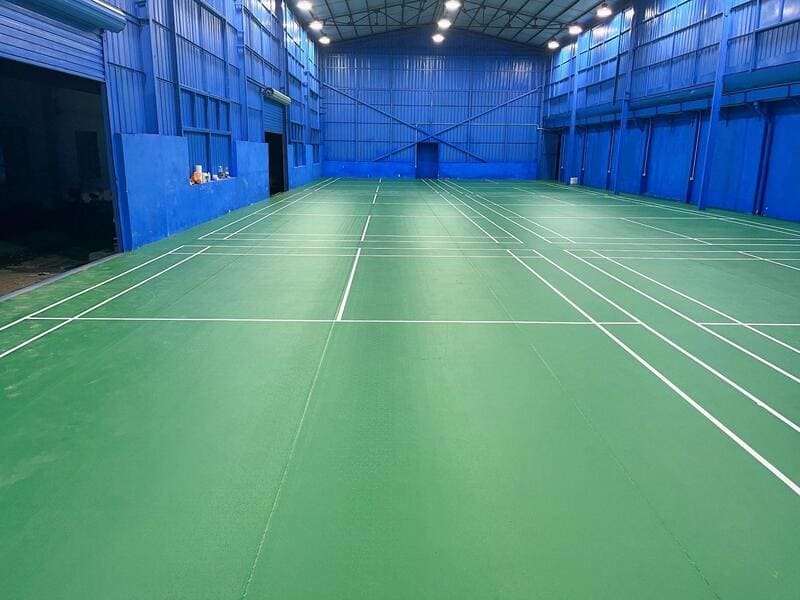
Elasticity type is one buying decision. Another one that trips up first-time buyers is whether to choose rolls or tiles, so let’s cover that next.
PVC Roll Flooring vs. PVC Tiles: Which Is Better for Badminton?
PVC roll flooring is better for professional and commercial courts because it has fewer seams and a more stable surface. PVC tiles are easier to install and better suited to home or temporary courts.
Rolls and tiles are both PVC, but they perform differently once players start moving fast. Roll flooring comes in wide sheets, so a single court needs far fewer seams, which means fewer weak points and a smoother, more consistent surface underfoot. This is why almost every professional and commercial venue uses rolls rather than tiles. PVC tiles interlock in smaller sections, which makes installation much easier for a DIY builder, but the higher seam count creates more opportunities for gaps, lifting, or uneven spots over time.
| Faktor | PVC Roll | PVC Tile |
|---|---|---|
| Nähte | Few | Viele |
| Professioneller Einsatz | Strong fit | Limited fit |
| Installation difficulty | Higher, often needs installer | Lower, DIY-friendly |
| Am besten für | Clubs, commercial venues | Home courts, temporary setups |
Rolls and tiles are both part of the PVC family, but they sit alongside a wider set of materials. Let’s zoom out and compare all the major options side by side.
How Do All the Flooring Materials Compare Side by Side?
PVC vinyl gives strong shock absorption for dedicated play at a mid-range cost. Hardwood lasts the longest but costs the most. PP tiles and acrylic coating cost the least but absorb the least impact.
| Bodenbelag Material | Primärer Anwendungsfall | Schockabsorption | Kostenstufe | Lebenserwartung | Wartung |
|---|---|---|---|---|---|
| PVC Vinyl Mat | Dedicated clubs / pro | Hoch | Budget to mid-range | 8–15 years | Low to medium |
| Hartholz (Ahorn) | Multi-sport gyms | Medium-high | Prämie | 25+ Jahre | Hoch |
| Interlocking PP Tiles | Outdoor / backyard | Low-medium | Wirtschaft | 10-15 Jahre | Niedrig |
| Acrylbeschichtung | Outdoor concrete | Niedrig | Ultra-low | 5-8 Jahre | Niedrig |
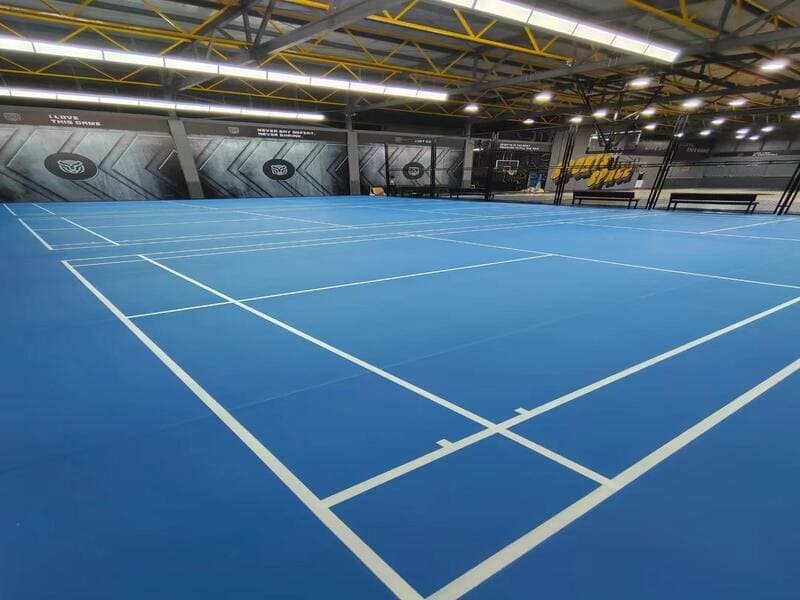
Numbers on a table only help so much though. Let me walk you through how to actually apply this to your own space.
How Do I Choose the Right Flooring for My Court?
Match the flooring to your subfloor, indoor or outdoor setting, sport mix, certification needs, and total budget, not just the upfront material cost.
Start with what’s under your feet now. Concrete, wood, and asphalt each pair with different materials; for example, PVC laid over fresh concrete needs a damp-proof membrane first, or moisture will damage the mat from below. Next, think about climate. An indoor, climate-controlled hall opens up more choices, while an outdoor court needs weather-resistant materials like PP tiles or acrylic. Then ask if the space is dedicated to badminton or shared with other sports; shared halls usually call for hardwood or rubber, while a dedicated badminton court does best with PVC. If you’re aiming for competitive play, confirm BWF certification requirements up front, since tournament venues need to meet these standards. Finally, look at total cost of ownership: material price, subfloor prep, installation labor, and maintenance over the years, not just the sticker price.
Once you’ve picked a material, getting it installed and maintained the right way is what makes it perform for years instead of months.
What Installation and Maintenance Practices Keep a Court Performing Well?
Proper subfloor prep, correct seam installation, and routine cleaning protect your investment and keep the surface performing consistently.
Before any mat goes down, test the subfloor for moisture and install a vapor barrier if needed; skipping this step is one of the most common causes of early mat failure I see in QC reports. Leveling matters too, since uneven spots create unstable footing during fast lateral movement. For PVC installation, you have two paths: portable setups use taped seams, which suit rented spaces or multi-use halls, while permanent installs use a full glue-down with chemically welded seams for a smooth, seamless surface. Day to day, stick to neutral pH cleaners only, since harsh chemicals break down the wear layer over time. Manage dust and moisture regularly to avoid slip hazards, and enforce a non-marking court shoe policy, since regular street shoes can scuff or tear the surface. It’s worth noting that PVC mats wear faster under heavy non-sport loads like chairs or equipment carts, not because the material is weak, but because it’s engineered for athletic footwork rather than static weight, so treating it that way protects your investment.
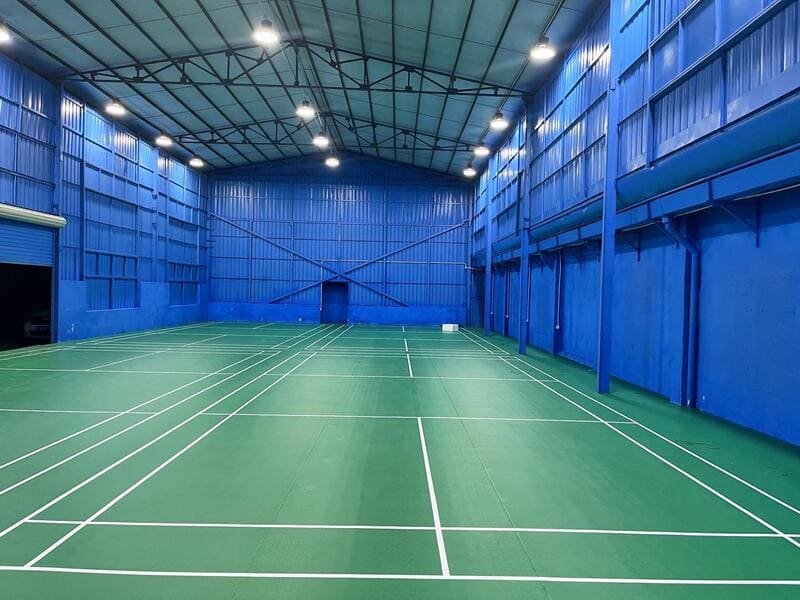
Good installation and upkeep are what separate a floor that lasts fifteen years from one that needs replacing in five.
Häufig gestellte Fragen
Can you lay PVC badminton mats directly over concrete?
Yes, but the concrete must be fully cured and dry, and a damp-proof membrane is usually needed to block rising moisture from damaging the mat.
How thick should a badminton court mat be?
Most commercial venues use 5.0mm to 7.0mm PVC mats, which balance shock absorption with a stable, responsive surface for fast footwork.
How much does it cost to install a standard badminton court floor?
Costs vary by thickness, certification level, and site prep, but PVC mats sit in the budget-to-mid-range tier, while hardwood systems require a premium investment due to material and labor costs.
Why are badminton court mats usually green or blue?
These colors give strong visual contrast against yellow and white shuttlecocks, which helps players track the shuttle’s flight path more easily during fast rallies.
How long does a PVC badminton floor last under daily commercial use?
A quality PVC mat typically lasts 8 to 15 years under regular commercial use, depending on maintenance and foot traffic levels.
Is PVC roll flooring or PVC tile flooring better for a home court?
PVC tiles are usually the better fit for home courts, since they install faster without special tools, while rolls suit larger commercial spaces where fewer seams matter more.
Schlussfolgerung
PVC mats suit dedicated play, hardwood suits multi-sport halls, and PP tiles suit budget outdoor courts.
Meine Rolle
I work as a quality control specialist in badminton court flooring manufacturing, inspecting production daily and verifying material performance against industry standards. My background covers custom and bulk flooring production, material engineering, and design optimization across multiple sports flooring applications.
Have a Project in Mind?
If you’re weighing flooring options for a club, school, or home court and want input on subfloor compatibility, thickness, or certification requirements, send me a message. I’m happy to walk through your specific site conditions and help you land on the right material.