


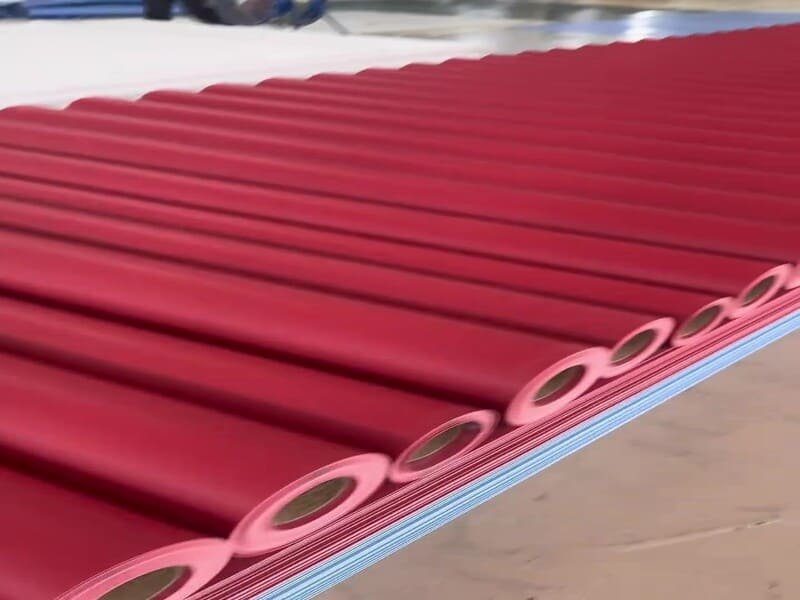
No single layout is best for every column. The best layout keeps seams away from the column, uses few relief cuts, avoids turning and heavy-traffic zones, and follows the manufacturer’s approved fitting and welding method.
Columns are one of the hardest details in PVC roll flooring. The sheet is wide and holds tension, and a column forces you to cut it into a tight shape. Seams near columns can open, weld rods can crack, and patterns can drift out of line. In hospitals, cleanrooms, and gyms, a small gap at the column base also lets water and dirt get under the sheet. [Insert personal story: a column seam job that went wrong and what you learned.] I always start with the same question: can the seam avoid the column? The table below shows how I decide.
| Situation | Une meilleure approche |
|---|---|
| Seam can avoid the column | Keep the field seam away from the column |
| Seam near the column is unavoidable | Keep it straight and do not end it at a sharp corner |
| Square or rectangular column | Scribe with care and keep relief cuts and extra seams low |
| Round column | Template the shape and use only the cuts needed for a relaxed fit |
| Hygienic or wet area | Use a manufacturer-approved flash coving and welded detail |
| Heavy rolling or pivoting traffic | Keep seams out of turning zones where you can |
| Active structural movement joint | Do not bridge it with sheet vinyl; use the specified joint detail |
The first choice is where the seam goes, so let me start with seam placement.
Where Should I Place the Seam Around a Structural Column?
Put the field seam away from the column whenever you can. If it must be near the column, keep it straight, avoid ending it at a sharp corner, and keep it out of major traffic paths and turning areas.
Seam placement comes before any fitting detail. Fewer seams mean fewer weld points to check. A seam away from heavy traffic and turning areas is also easier to maintain and sees less repeated stress.
Offset the Seam
When I plan a roll layout, I move the field seam away from the column face. This removes the sharp relief cut at the seam end. It also keeps the weld out of areas where wheels turn or carts pivot.
Plan Around Traffic and Pattern
Where practical, I avoid placing seams across major traffic paths or wheel-turning zones. I also check roll direction and pattern. Wood grain and directional graphics show a split seam clearly. A non-directional chip pattern hides it better. Always dry lay the sheet and match the pattern before you cut.
When the Seam Cannot Move
Sometimes the roll width puts a seam at the column. In that case I keep the seam straight and cut only what I need. I never add extra seams unless the fit needs them.
| Choix | Pourquoi cela aide-t-il ? | Watch For |
|---|---|---|
| Offset seam | Fewer cuts near the column | Roll width and waste |
| Seam kept off traffic paths | Less wheel crossing and turning stress | Pattern direction, room layout |
| Straight seam at column | Simple to groove and weld | Sharp relief cut at the end |
Once the seam location is set, you need to decide how to fit the sheet around the column itself.
How Should I Fit PVC Sheet Around Square and Round Columns?
Use a template or scribe for an exact fit, make only the cuts the sheet needs, and never stretch the material. Square columns need clean corners. Round columns need a smooth, relaxed wrap.
Fitting is a separate job from seam placement. Many people call it column scribing, column fitting, or sheet vinyl column detailing. A good fit has a tight edge, no puckering, and no stress in the sheet.
Square and Rectangular Columns
I copy the column shape with a scribe tool or butcher paper. Then I transfer it to the sheet before I cut. Sharp relief cut ends can become stress points if you overcut, stretch the sheet, or bond it poorly. Stop the cut at the column face and do not cut past it.
Round Columns
Round columns need an accurate template. Use only the cuts required to get a relaxed fit without stretching or puckering. The sheet should lie flat around the curve. If it puckers, the cut or the fit is wrong, and I fix that before I glue.
Scribe the Seam Gap
Do not use a standard gap from memory. Scribe the seam to the gap in the manufacturer’s instructions. Many commercial sheet systems need a very tight seam before grooving and welding.
| Column Type | Fitting Method | Risque principal |
|---|---|---|
| Square / rectangular | Scribe or template, short relief cuts | Overcutting at corners |
| Round | Template, only the cuts required | Puckering at the curve |
| Irregular | Paper template, dry fit first | Pattern mismatch |
Hygienic rooms add another detail at the column base, which is flash coving.
When Should I Use Flash Coving at a Column Base?
Use flash coving in hospitals, cleanrooms, laboratories, food processing areas, and commercial kitchens, where the floor-to-column joint must be easy to clean. Follow the manufacturer’s coving method and weld the joints as the system requires.
Flash coving turns the floor sheet up the column base. It is a detail for the edge of the floor, not a seam layout. I use it where hygiene matters.
What Coving Does
Coving makes a more continuous, cleanable transition from floor to column. It reduces open joints at the base. This helps cleaning crews and lowers the places where dirt and moisture can collect.
What Coving Does Not Do
Coving does not make the floor waterproof by itself. Performance depends on weld quality, wall and column terminations, the substrate, the adhesive, and the full wet-room system. Square columns also still need corner details, such as butterfly corners, fill pieces, or vertical welded joints.
What You Need
Coving needs a cove former and a capping strip. It also needs a skilled installer who follows the manufacturer’s detail. I advise clients to confirm the approved coving method early in the design.
| Objet | Objectif | Remarque |
|---|---|---|
| Profilé de courbe | Supports the sheet at the base | Use the approved profile |
| Bande de finition | Finishes the top edge | Match the system |
| Welded joints | Reduce open joints | Test weld first |
| Corner detail | Handles square column corners | May need fill pieces or vertical joins |
Even a good layout can fail if the base is not sound. So let me cover what goes wrong near columns.
What Causes Seam Problems Near Structural Columns?
Most problems come from slab moisture, poor bonding, bad fitting, sheet tension, or movement at a joint or crack. Find the real cause before you repair, because each cause needs a different fix.
I do not blame one cause for every failure. I check each possible cause in order.
Substrate Condition and Moisture
High slab moisture can cause the bond to fail. I check moisture before install with an in-situ relative humidity test such as ASTM F2170. Then I compare the result with the sheet and adhesive maker’s limit.
Movement at Joints and Cracks
Movement at structural joints, cracks, or edges near a column can affect the floor. Do not bridge an active structural movement joint with sheet vinyl unless the specified joint system is designed for it.
Fitting and Bonding
Overcutting, stretching the sheet, poor adhesive transfer, and trapped air all cause trouble at the column base. These are install problems, and good prep prevents them.
| Cause | Typical Sign | Ce que je vérifie |
|---|---|---|
| High slab moisture | Lifting, debonding | ASTM F2170 result vs. limit |
| Active joint or crack | Gap, split seam | Joint type and movement |
| Poor fit | Puckering, curling | Relief cuts and tension |
| Poor bonding | Soft spots, air pockets | Adhesive transfer, rolling |
When the causes are clear, the install order becomes easy to follow. Here is how I work.
How Do I Install and Weld PVC Sheet Around a Column?
Condition the sheet as the maker says, scribe a template, cut with care, bond with the approved adhesive, groove to the specified depth, weld, let it cool, then trim in two passes.
I follow the manufacturer’s data sheet at every step. Values differ by product, so I never rely on a fixed number from memory.
Step 1: Condition the Sheet and Prep the Base
Relax the flooring as the installation instructions say. Many commercial sheets need about 24 to 48 hours under site conditions. Test the slab and clean the column base.
Step 2: Scribe and Cut
Use a template or scribe tool. Cut with a hook blade and do not cut past the column face.
Step 3: Bond the Sheet
Use the adhesive approved for the substrate, traffic level, rolling load, and moisture condition. Make sure the adhesive transfers fully around the column base and other hard-to-roll areas. Roll the sheet to push out air.
Step 4: Groove and Weld
This step applies to weldable vinyl systems. Groove to the depth the maker specifies. For many homogeneous vinyl sheets this is about two-thirds to three-quarters of the thickness. On foam-backed sports PVC, do not cut into the foam layer. Some cushioned or heterogeneous systems use a different joining method, so check the product data first. Hand-groove tight corners with a tool approved for the system. Run a test weld first.
Step 5: Cool and Trim
Let the weld cool as the maker requires. Then trim in two passes: first with a trim plate, then flush with the floor. Machines can weld most of a straight seam, but I usually finish the last section near the column by hand.
| Étape | Détail essentiel | Erreur courante |
|---|---|---|
| Condition | Follow maker’s time | Cutting a tight, cold roll |
| Scribe | Template or tool | Cutting freehand |
| Bond | Approved adhesive, full transfer | Air pockets |
| Groove | Specified depth, weldable systems only | Cutting into foam backing |
| Trim | Cool first, two passes | Trimming a hot weld |
Some problems still show up after install. Let me explain how I handle them.
How Do I Fix Column Seam Failures the Right Way?
Find the cause first. Then correct the fit, re-groove, patch, or reweld as the manufacturer’s repair procedure says. Do not fill a failed heat-welded seam with general-purpose sealant.
A quick patch hides the problem and it comes back. I fix the cause before I fix the seam.
Puckering or Curling at the Base
If the sheet puckers before bonding, I stop and correct the fit or the relief cuts. I do not force or stretch the material. Use controlled heat only where the maker’s forming instructions allow it, because too much heat can scorch, blister, or distort PVC.
Weld Rod Cracking or Popping
A shallow groove, poor weld heat, or a stressed seam can cause this. I cut out the weld, re-groove to the correct depth, and reweld. I use a groove tool approved for the system.
Gap or Discoloration Near the Column
I check for contamination, adhesive failure, moisture, sheet tension, and substrate movement. Then I repair, patch, or reweld by the manufacturer’s procedure. [Insert personal story: a failed column seam you repaired on site.]
| Échec | Check First | Better Repair |
|---|---|---|
| Puckering | Fit and relief cuts | Refit; heat only if allowed |
| Rod cracking | Groove depth, weld heat | Re-groove and reweld |
| Gap or discoloration | Moisture, bond, movement | Repair per maker’s procedure |
Here are the questions I hear most from installers and buyers.
FAQ
Can I put a seam directly through a structural column?
Yes, it is possible, but I avoid it when the seam creates a sharp cut or falls in a high-stress area. The final choice depends on roll width, pattern, traffic, and the manufacturer’s detail. If the seam must meet the column, keep it straight and stop the relief cut at the column face.
Should PVC sheet flooring be cut tight around a column?
The sheet should fit closely without forcing, stretching, or tension. A relaxed fit matters more than an extremely tight cut. Before welding, scribe the seam gap to the maker’s value, since many commercial systems need a very tight seam.
Do all PVC floors around columns need heat welding?
No. Many commercial sheet vinyl systems use welded seams, but not every product is joined the same way. Foam-backed and cushioned systems may need a different method. Always check the product data sheet for the approved joining method and groove depth.
Conclusion
Keep seams away from columns, cut only what the sheet needs, scribe with care, and follow the manufacturer’s method for welding, coving, and repairs.
A propos de l'auteur : I am an installation and engineering lead with years of hands-on experience in custom and bulk PVC roll flooring manufacturing. I work on seam design, heat welding, and layout optimization for hospitals, cleanrooms, gyms, and commercial projects. I help clients solve design problems early, before they turn into costly site failures.
Planning a project with structural columns? Send me a private message with your column type, space, and floor plan. I will help you plan the seam layout and welding details before you order.