


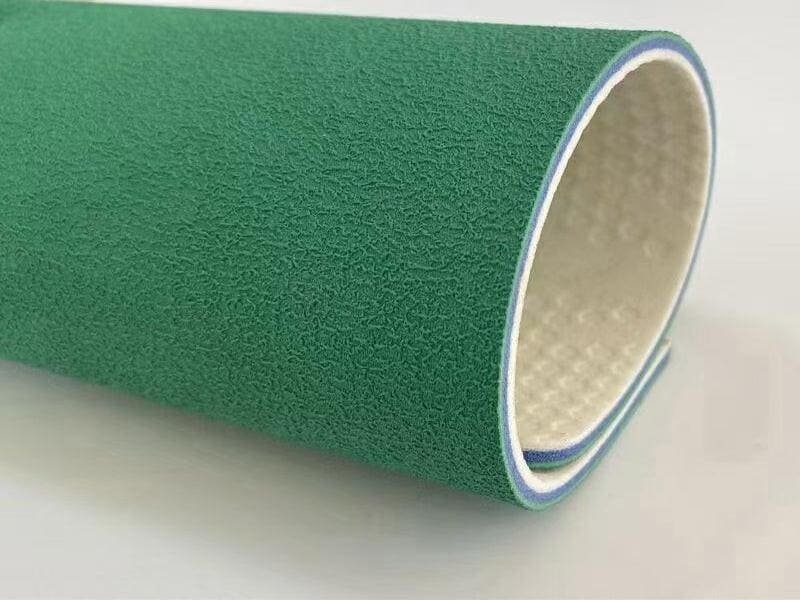
Yes. Sports-grade PVC/vinyl flooring is suitable for indoor hockey when the system provides smooth, predictable ball movement, adequate grip, and enough shock absorption. FIH guidance names vinyl as one of the surface types well suited to indoor hockey, and recommends new indoor sports floors follow EN 14904.
I have spent years on the production side of PVC sports flooring, and "indoor hockey" is a term that trips up a lot of buyers. In the formal sport sense, Indoor Hockey is the FIH-governed game played on a smaller court with side boards. It is not the same as floorball, and it is not the same as roller or inline hockey. Each of these has its own ball, its own footwork pattern, and its own flooring demands. When someone asks me if PVC "works for hockey," my first question back is always: which hockey do you mean?
Not every PVC floor is suitable, either. Indoor hockey calls for a relatively smooth sports-grade surface, not a heavily embossed commercial vinyl meant for hallways or retail floors. The full flooring system matters more than any single number on a spec sheet. Ball roll, friction, shock absorption, dimensional stability, subfloor condition, and the manufacturer’s approved use all count more than the fact that a product happens to be made from PVC. For higher-level international competition, the floor’s elastic system type also matters — more on that below.
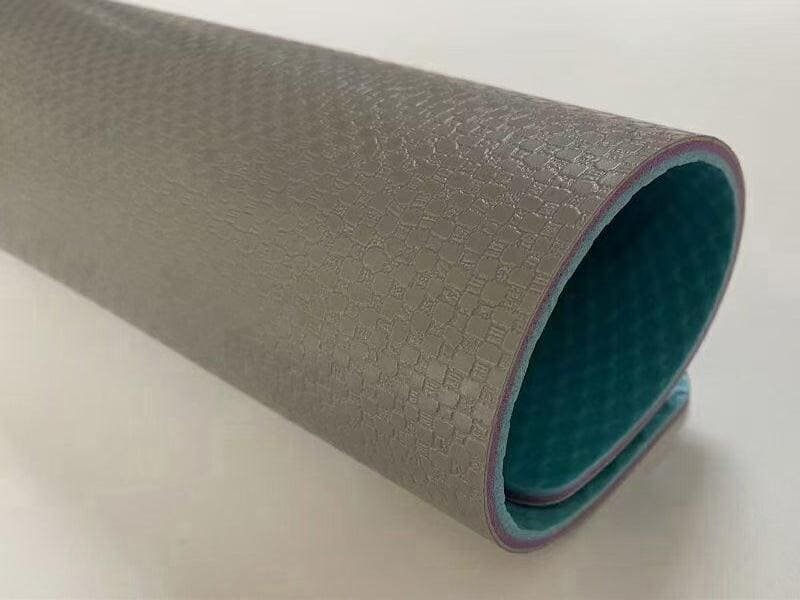
If you mean floorball or inline/roller hockey rather than FIH Indoor Hockey, the requirements shift again. I will cover that separately further down. First, let’s look at what FIH-style indoor hockey actually needs from a floor.
What Does Indoor Hockey Flooring Need to Perform Well?
Indoor hockey flooring needs a surface that lets the ball roll fast, smoothly, and predictably, offers safe player grip, and gives enough shock absorption to protect joints — ideally in line with EN 14904.
| Requisito | Por qué es importante | Reference Point |
|---|---|---|
| Ball roll and surface consistency | The ball should move quickly and smoothly, without bobbling or dragging | FIH facility guidance |
| Player grip | Enough traction to run, stop, and turn without excess slide or over-gripping | Balanced friction, not maximum friction |
| Absorción de impactos | Reduces joint and impact stress over long sessions | EN 14904 (Europe); ASTM F2772 may also be referenced in North American projects |
| Surface texture | Should stay smooth rather than heavily embossed, so the ball is not disrupted | FIH facility guidance |
From my time on the production floor, texture is where a lot of buyers get it backwards. FIH guidance actually points toward a smooth surface rather than a heavily textured one, because embossing that is too aggressive interferes with ball roll and player comfort. The goal is not maximum grip. It is a balance: enough traction for footwork, without a rough surface dragging on the ball or over-gripping a player’s shoe.
Shock absorption is real, but it should not be treated as "more is always better." A very soft, highly cushioned floor can absorb impact well but also slow the game down and affect ball response. EN 14904 itself does not judge a floor on one shock-absorption number alone — it covers a full set of properties including friction, vertical deformation, rolling load, wear, and indentation. For projects in Europe, EN 14904 is the standard I point clients toward first. ASTM F2772 is a useful reference for North American multi-purpose sports floors, but I would not treat one Class rating as automatically superior to another without looking at the whole system.
Now let’s look at what to check in the product itself, rather than chasing one spec number.
What Should You Check on a PVC Hockey Flooring Spec Sheet?
Do not judge suitability by wear-layer thickness alone. Check the complete system’s abrasion resistance, dimensional stability, indentation resistance, surface texture, elastic system type, and whether the manufacturer approves it for indoor hockey.
| Artículo | What Matters |
|---|---|
| Wear layer / surface construction | Thickness varies a lot by product line and should not be used as the sole indicator of suitability |
| Backing and shock absorption | Foam or resilient backing, not the surface treatment, is what mainly provides cushioning |
| Tratamiento de superficies | PU/PUR treatments mainly support durability and cleaning, not shock absorption |
| Refuerzo | Fiberglass mesh is common for dimensional stability, but is not a mandatory requirement — check tested stability instead |
| Elastic system type | Point-elastic, area-elastic, or combined-elastic — matters more as competition level rises |
| Certificaciones | Fire classification and indoor-air emissions documentation, evaluated separately from sports-performance standards |
I want to correct something I used to repeat myself: quoting a fixed wear-layer range like "1.2mm to 2.0mm" as a buying rule is misleading. Some certified EN 14904 sports floors use wear layers well under 1mm and still perform very well in real competition use, because the backing and full construction carry the performance, not the wear layer number alone. If a supplier only talks about wear-layer thickness and nothing else, ask them for the system’s tested dimensional stability, indentation resistance, and force reduction data instead.
The same correction applies to PUR. It is a surface treatment that helps with cleaning and long-term durability, not the layer responsible for shock absorption. That job belongs to the foam or resilient backing and the overall build of the floor.
Does the elastic system type matter? Yes, especially for higher-level competition. Foam-backed PVC sheet flooring is typically a point-elastic system. FIH notes that point-elastic, area-elastic, and combined-elastic floors are all successfully used for Indoor Hockey, but recommends combined- or area-elastic floors for international matches whenever possible. This does not exclude point-elastic sports vinyl — it means the intended competition level should factor into how the floor is specified. For school, club, and multi-purpose facilities, a properly specified point-elastic sports vinyl system can still be a suitable and cost-effective option.
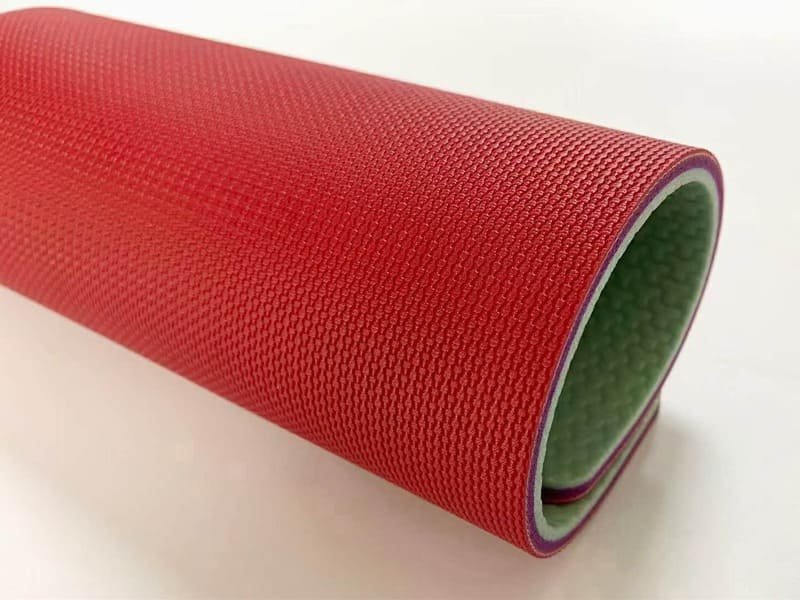
Reinforcement mesh is another item I get asked about often, and I want to be fair here: it is common and useful, but it is not a pass/fail requirement on its own. What actually protects a court over years of lateral movement is tested dimensional stability, not the presence of one specific reinforcement layer.
With the spec sheet basics covered, let’s look at how PVC compares with the other flooring types used in indoor sports halls.
How Does PVC Compare to Other Indoor Hockey Flooring Options?
PVC/vinyl, sprung timber, and polymeric/PU systems are all recognized by FIH as suitable for indoor hockey. Each has a different strength, and no single one is automatically the best choice for every project.
| Superficie | Typical Strength | Consideración principal |
|---|---|---|
| Sports PVC/Vinyl | Predictable ball roll, cushioning options, easy maintenance | Must be a sport-rated system, not general commercial vinyl |
| Sprung Timber | Area-elastic response, long track record in sport | Needs moisture control and regular maintenance |
| Polymeric/PU (poured) | Seamless system, customizable performance | Installation conditions and curing time matter |
| Baldosas encajables de PP | Portable, easy to replace sections | Joint profile and ball behavior need checking |
I try to avoid ranking these as "PVC is always cheaper" or "PU is always more durable," because it depends heavily on the specific product and project. Prefabricated PVC rolls can also reduce on-site curing time compared with poured polyurethane systems, although installation time still depends on substrate preparation, adhesive requirements, and the specific flooring system. If a facility already has a well-maintained sprung timber floor performing well, there is no need to force a switch just because PVC is available.
Choosing the surface type is one decision. Getting it installed and maintained correctly is a separate one, and just as important.
How Should PVC Hockey Flooring Be Installed and Maintained?
Installation method should follow the specific flooring system and manufacturer instructions. Proper subfloor preparation, correct seam treatment, and manufacturer-approved cleaning are what keep the floor performing over time.
Instalación básica
- Subfloor preparation: test moisture, level the surface, and address anything that could telegraph through the new floor
- Substrate approval: confirm with the manufacturer whether the existing subfloor — concrete or, in some cases, an existing wood floor — is approved, structurally sound, flat, dry, and stable; extra underlayment may be needed
- Seam treatment: for permanent sheet-vinyl systems, seams are commonly hot-welded according to the manufacturer’s instructions; some proprietary loose-lay or adhesive-free systems use different fixing methods, so always follow the specific product’s guidance
Ongoing Maintenance
- Routine cleaning: use manufacturer-approved cleaning products and equipment; neutral-pH cleaners are commonly specified for sports vinyl, while aggressive chemicals or abrasive pads should be avoided unless explicitly approved
- Reparaciones: localized seam or surface repairs may be possible depending on the flooring system; damaged sections should be repaired or replaced using the manufacturer’s approved method
I used to say hot-welded, fully-adhered installation was the only correct method for a hockey court, and I want to correct that. It is common and it works well for many permanent sheet-vinyl systems, but manufacturers also offer approved loose-lay and adhesive-free systems for certain projects. The right method depends on the specific product, not a single universal rule. What I will not compromise on is subfloor prep — skipping a moisture test is still the most common cause of bubbling and early failure I see in the field.
What About Floorball and Roller/Inline Hockey?
Floorball is commonly played on sports vinyl and generally suits PVC well. Roller and inline hockey need a more compact, low-indentation surface specifically approved for wheel sports, rather than a soft cushioned product.
Floorball uses a light plastic ball, and sports PVC handles that well because it supports smooth, even rolling. For organized competition or federation-specified projects, check the event or federation requirements and whether the flooring holds the relevant IFF certification or meets the required sports-floor standards, rather than assuming any PVC sports roll is acceptable.
Roller and inline hockey is a different challenge. The deciding factor is not whether a product is labeled homogeneous or heterogeneous — that label alone does not tell you whether a floor can handle wheels. What matters is whether the surface has a compact, low-indentation construction that a manufacturer specifically rates for rolling sports. A soft, deeply cushioned floor built for comfort underfoot can wear faster or scuff under repeated wheel contact, regardless of its construction type.
Preguntas frecuentes
How long does PVC sports flooring last under indoor hockey usage?
There is no single hockey-specific lifespan. Actual service life depends on traffic intensity, footwear or wheel use, maintenance routine, installation quality, and the specific product’s warranty. Many commercial sports-vinyl products carry warranties in the 10 to 15 year range, but a warranty period should not be read as a guaranteed expected lifespan.
Can you use roller skates on regular PVC sports floors without damaging them?
Not always. Standard cushioned PVC built for general indoor sports can scuff or suffer wheel wear under roller or inline skates. For roller hockey, choose a compact, low-indentation product that the manufacturer specifically approves for wheel sports.
How much does indoor hockey PVC flooring cost per square meter/foot?
Cost depends on the construction, backing, certifications, and installation method, and it varies by hockey type. A floorball-oriented product and a roller-hockey-rated product are priced differently, so quotes should be based on your specific use case, not a generic "hockey flooring" category.
Can PVC flooring be installed over concrete or old hardwood?
Often, yes, but the existing subfloor must be structurally sound, flat, dry, and stable, and approved by the flooring manufacturer. An old wood floor needs closer evaluation than concrete — movement, unevenness, or old coatings can require additional underlayment or preparation before installation.
Conclusión
Match sports-grade PVC to your specific hockey type and competition level, follow the manufacturer’s installation guidance, and the floor will perform for years.
Sobre el autor: I work in PVC flooring manufacturing, focused on custom and bulk production for sports and commercial facilities. My background covers material construction, surface engineering, and design optimization for demanding indoor applications like hockey and multi-purpose sports halls. I work with facility owners and product teams early in the design stage to match flooring specs to the actual sport and competition level, not just a generic category.
Working on an indoor hockey flooring project? Message me directly, and I can help you work through the right spec for your specific court.