


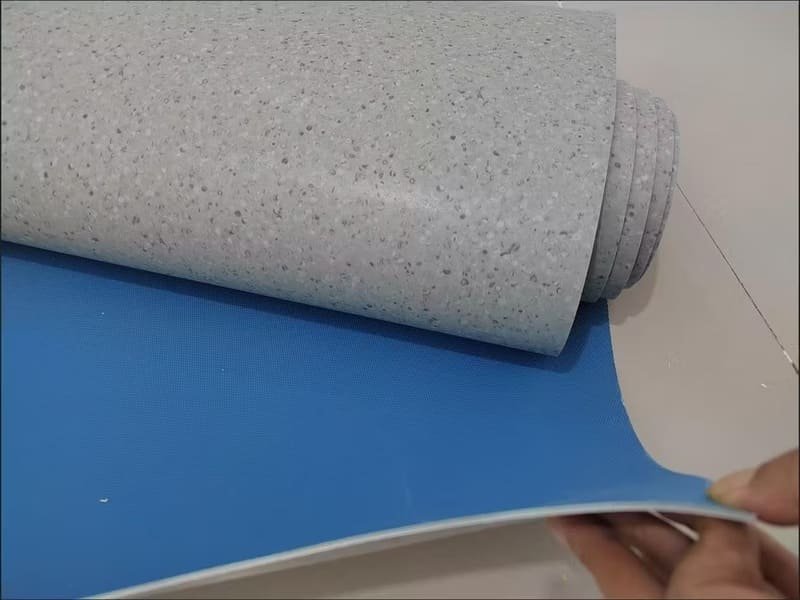
For a standard room, order about 10% extra PVC flooring. Simple rectangular rooms may need 5% to 8%. Diagonal and herringbone layouts are often estimated at 15% to 20%. Sheet vinyl is different: you calculate by roll width, seams, and pattern repeat.
I have worked in PVC flooring manufacturing for years, with a focus on custom and bulk production. One common problem I see is a buyer who orders the exact square footage and then runs out of planks two rows from the finish. A reorder may come from a different production batch, and the shade may not match. This guide covers three product types: LVP (luxury vinyl plank), LVT (luxury vinyl tile), and sheet vinyl. Every percentage here is an estimate, not a fixed industry rule. Polyflor’s LVT guidance, for example, suggests about 5% for a plain rectangular room with few obstacles and about 10% for complex patterns, and it says the real figure depends on room shape, layout, and obstacles. For commercial rolls, sports PVC flooring, or special sizes, calculate from the roll width, the project drawings, and the product’s installation guide.
Why Do You Need Extra PVC Flooring?
You need extra PVC flooring for installation waste and for a repair reserve. Installation waste covers cuts, obstacles, and mistakes. A repair reserve is spare material you keep for damage years later.
People often put these two things in one bucket, but they are not the same. Installation waste is material you lose during the job. Some offcuts can start the next row, but many cannot be reused. A repair reserve is full planks or unopened boxes that you set aside after the job is done. If you order 10% extra, you will not always have 10% left in full planks for repairs. Think about both needs before you order.
What Causes Installation Waste?
| Causa | ¿Qué ocurre? |
|---|---|
| End-of-row cuts | The leftover piece from one row is too short to start the next row |
| Obstacles and complex shapes | Corners, pillars, door jambs, and vents need custom cuts |
| Human error | Measuring mistakes, bad cuts, or damage during click-locking or gluing |
What Is a Repair Reserve?
A repair reserve is matching spare material from the same production batch. You keep it for future repairs, such as replacing a scratched or damaged plank. It is also useful if the product or colour is discontinued later. For water damage, a new plank is not enough on its own. You must also fix the moisture source and check the subfloor.
Keep spare planks or unopened cartons in a clean, dry storage area, and follow the manufacturer’s storage instructions. Retain the product labels and purchase records for future reference.
What Waste Percentage Should You Choose for Your Room?
Start with 5% to 8% for simple rectangular rooms, 8% to 10% for average rooms, and 10% to 15% for rooms with many doorways or recesses. Diagonal layouts start near 15%. Herringbone is often estimated at 15% to 20%.
These ranges are planning estimates, not manufacturer-approved waste allowances. Check complex layouts against a detailed cutting plan and the product’s installation guide. Judge the difficulty of each cut, not just the number of features. Two hard obstacles can create more waste than three simple doorways.
| Diseño | Estimated Waste | Typical Conditions |
|---|---|---|
| Simple, straight lay | 5% to 8% | Rectangular room, few obstacles, experienced installer |
| Average, straight lay | 8% to 10% | Closet, one or two doorways, standard baseboards |
| Irregular, straight lay | 10% to 15% | L-shaped room, several recesses, large cabinet runs |
| 45° diagonal | About 15% and up | Angled cuts along every wall |
| Herringbone or complex pattern | Often 15% to 20%, or by layout calculation | Depends on plank size, border design, and room shape |
Why Does a Diagonal Layout Create More Waste?
In a 45° diagonal layout, most planks along the walls need an angled cut. Many of the offcuts are small triangles, and the angle is often wrong for the next row.
Why Does a Herringbone Layout Create More Waste?
Herringbone uses planks in a zigzag pattern, so it follows a different logic. Waste depends on the plank size, the edge or border design, and the exact room shape. Herringbone layouts may need a higher allowance, often estimated at 15% to 20%, but the final quantity should come from the actual layout. Ask for a layout drawing before you order.

How Do You Calculate How Much PVC Flooring to Order?
Measure the actual installation area and multiply it by 1.05 to 1.20 for waste. Add any repair reserve, then divide by the box coverage. Round up to the next full box. Never round down.
The measuring step is where most errors start. Follow these four steps.
Step 1: Measure the Floor Area
Length × Width = Base Square Footage. Split an irregular room into rectangles and add the areas.
Step 2: Calculate the Actual Installation Area
Count only the area where you will lay the floor. Include closets and alcoves if they get the same flooring. Include doorways if the floor runs through to the next space. Exclude areas where no flooring will be installed, such as beneath fixed cabinets. For floating floors, check the manufacturer’s requirements for clearance around permanent fixtures.
Step 3: Apply the Waste Multiplier and Add a Repair Reserve
500 sq. ft. × 1.10 = 550 sq. ft. to order for installation waste.
| Waste Percentage | Area to Order |
|---|---|
| 5% | 525 sq. ft. |
| 8% | 540 sq. ft. |
| 10% | 550 sq. ft. |
| 15% | 575 sq. ft. |
| 20% | 600 sq. ft. |
If you also want spare flooring for future repairs, calculate that reserve separately from installation waste. Add the spare planks or cartons before you round up the final order quantity. The right amount depends on the product, the project size, and your own needs.
Step 4: Convert to Boxes
Divide the required area by the coverage stated on the carton, and round up to the next full carton. For example, 550 ÷ 24.5 = 22.45, so you need 23 cartons. That gives 563.5 sq. ft. in total.
Rounding up may leave some unused flooring, but it does not guarantee a sufficient repair reserve. Actual waste may be lower or higher than your estimate. If you want to keep one full carton as a repair reserve, add it before you round: (550 + 24.5) ÷ 24.5 = 23.45, so order 24 cartons.
How Does the PVC Flooring Type Change Your Extra Material?
Waste depends on the installation method and the product format. Click-lock and glue-down floors depend on product size and perimeter cuts. Sheet vinyl depends on roll width, seams, and pattern repeat.
The installation method and the layout usually matter more to waste than whether the product is sold as LVP or LVT. LVT can be glue-down, loose-lay, or rigid-core click, and planks can be installed in more than one way. A glue-down product with a complex pattern can produce many offcuts. A click-lock floor in a simple room can produce few.
| Flooring Format / Method | Main Factors Affecting Waste |
|---|---|
| Click-lock vinyl planks or tiles | End-joint spacing, plank or tile size, perimeter cuts |
| Glue-down vinyl planks or tiles | Product size, layout pattern, perimeter cuts |
| Vinilo en rollo | Roll width, seams, room dimensions, pattern repeat |
How Do You Order Sheet Vinyl?
Sheet vinyl uses a different method from planks and tiles. Check the available roll width and compare both installation directions before you decide how many sheets you need. A suitable roll width and direction may let one piece cover the room. If seams are necessary, plan the seam position, the trimming allowance, and the pattern matching. Sheet vinyl can be seamed, but seams need accurate cutting and proper sealing.
Trimming allowances come from the manufacturer. Congoleum’s guide, for example, adds 3 inches to the length of the first sheet for its products, and later sheets need extra length for pattern matching. Follow your product’s guide for the exact figure.
What Factors Should You Check Before Ordering?
Check the production batch, the pattern repeat, the plank direction, and the supplier’s return policy. Each one can change the quantity you need or the risk you take.
Each point below is easy to check at the order stage.
Production Batch and Shade Variation
Colour, texture, and gloss can change slightly between production batches. Buy the full amount for the project in one order. Check that every box shows the same batch number. Keep the labels and order papers. Make sure your repair reserve comes from the same batch too.
Plank Direction
Decide the direction before you calculate the final quantity. Look at the longest wall, the main light source, the adjoining rooms, the doorways, and the width of the last row. Compare the layouts, and pick the one that gives fewer offcuts without hurting the look.
Pattern Repeat and Return Policy
For patterned sheet vinyl, you may need extra material to align the design across seams. For patterned planks or tiles, consider the specific layout and matching requirements. Ask also if the supplier accepts unopened cartons back. If so, ordering a little more carries less financial risk.
| Comprobar | Por qué es importante |
|---|---|
| Número de lote | Reduces the risk of shade variation |
| Plank direction | Changes cut count and last-row width |
| Pattern repeat | May add length for matching |
| Return policy | Lowers the cost of over-buying |
How Can You Reduce PVC Flooring Waste?
Reuse offcuts that meet the joint rules, dry fit the first rows, and use the cutting tools the manufacturer recommends. These steps cut avoidable errors and make better use of offcuts.
These practices do not guarantee a fixed saving.
Reuse Offcuts the Right Way
Use the cut-off from one row to start the next row, but only if it meets the minimum plank length and joint spacing. The required end-joint stagger varies by product, so always follow the manufacturer’s instructions.
Dry Fit a Few Rows First
Plan the layout and dry fit a few rows before installation. Check the first and last row widths, the doorways, and the awkward corners before you make permanent cuts.
Use the Right Tools
Use the cutting tools recommended for your flooring product. Depending on its construction, this may be a sharp utility knife, a flooring cutter, or a suitable saw blade. Make test cuts when needed to reduce edge damage and wasted material.
Conclusión
Start with 10% for a standard room, adjust for layout and product type, and confirm with the installation guide. Keep spare boxes for repairs.
If you are planning a project and want help with quantity, layout, or material choice, enviarme un mensaje privado. Share your floor plan and product type, and I will help you check the numbers.