


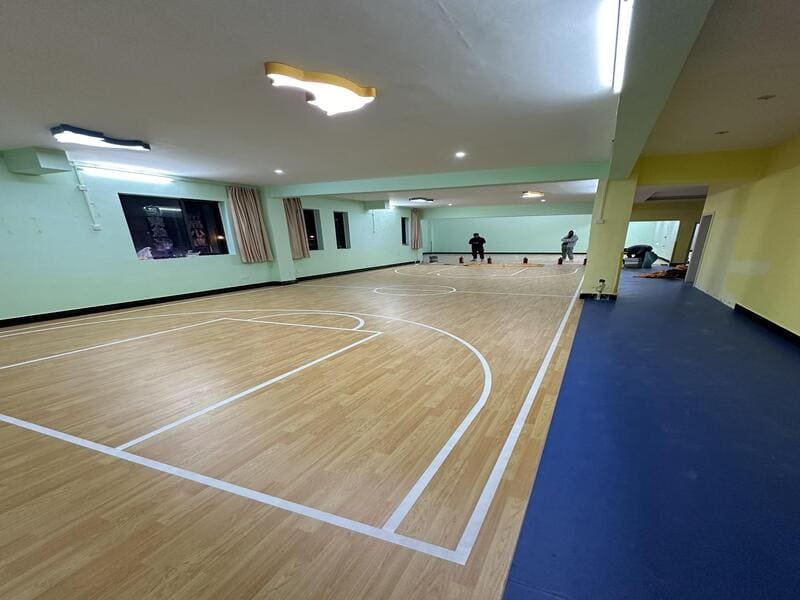
ASTM F2772 Class 3 or Class 4 is best for most indoor sports floors. Class 3 offers balanced multi-purpose performance, while Class 4 provides greater protection for sports with frequent jumping and hard landings.
Shock absorption affects athlete comfort, fatigue, joint loading, and long-term floor performance. A sports floor that is too hard may transmit more impact to the ankles, knees, hips, and lower back. A floor that is too soft may affect stability, ball rebound, rolling equipment, and permanent indentation.
In my indoor sports flooring development work, I never select a floor from its shock absorption percentage alone. I also review vertical deformation, ball rebound, surface friction, foam density, indentation recovery, rolling-load resistance, and installation structure.
For school gyms, community sports halls, basketball courts, volleyball courts, and other multi-purpose facilities, ASTM F2772 Class 3 or Class 4 is usually the most practical range.
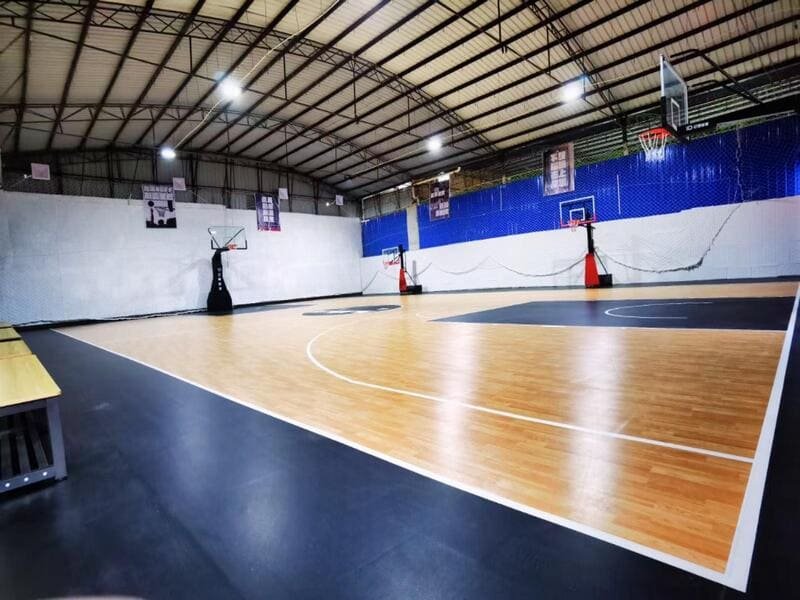
The final rating should match the primary sport, user age, training intensity, equipment load, budget, and required testing standard.
What Does Shock Absorption Mean?
Shock absorption, also called force reduction, shows how much impact force a sports floor reduces compared with a rigid reference surface. A higher percentage normally means greater cushioning under the standard test conditions.
ASTM F2772 is commonly used for indoor sports flooring in North America. It divides force reduction into five performance classes.
| ASTM F2772 Класс | Сокращение силы | General Performance |
|---|---|---|
| Класс 1 | 10% – 21% | Very firm surface with limited cushioning |
| Класс 2 | 22% – 33% | Умеренная амортизация |
| Класс 3 | 34% – 45% | Balanced sports and multi-purpose performance |
| Класс 4 | 46% – 57% | High impact protection |
| Class 5 | 58%+ | Very high cushioning for specialized systems |
Class 3 is a strong starting point for facilities that combine sports with assemblies, tables, stages, and other activities. Class 4 is more suitable when repeated jumping, intensive training, and athlete protection are the main priorities.
EN 14904 is widely used in European and international indoor sports projects. It classifies sports floors according to their construction and deformation behavior, such as point-elastic, area-elastic, combined-elastic, and mixed-elastic systems.
Примечание: ASTM and EN class numbers should not be directly exchanged. A Class 4 result under ASTM F2772 does not automatically equal an EN Class 4 system.
Which Rating Is Best for Different Indoor Sports?
Class 3 is suitable for most multi-purpose sports halls. Class 4 is usually better for basketball, volleyball, aerobics, and other activities that involve repeated jumping and landing.
| Приложение | Suggested ASTM Range | Main Requirement |
|---|---|---|
| K-12 school gym | Класс 3 | Safety, stability, and multi-purpose use |
| Community sports hall | Class 2 – Class 3 | Comfort and resistance to equipment loads |
| Basketball court | Upper Class 3 – Class 4 | Landing protection and ball response |
| Volleyball court | Класс 4 | Repeated jumping and diving |
| Badminton court | Класс 3 | Fast movement and controlled cushioning |
| Pickleball court | Class 2 – Class 3 | Firm footing and joint comfort |
| Group fitness area | Class 3 – Class 4 | Fatigue and impact reduction |
| Senior activity area | Class 3 – Class 4 | Comfort with controlled stability |
| Martial arts area | Specialized mat system | Fall and body-impact protection |
Multi-Purpose School Gyms
For a school gym, I normally begin with Class 3. This range provides useful cushioning without making the floor too soft for tables, chairs, portable stages, examinations, assemblies, and physical education equipment.
A Class 4 system may also be suitable when sports use is the main purpose. However, the floor must have enough resistance to static loads, rolling equipment, and permanent indentation.
When a facility uses retractable bleachers or heavy staging, I may recommend reinforced zones, load-distribution boards, or protective floor covers.
Basketball and Volleyball Courts
Basketball and volleyball create frequent vertical impacts. Players jump, land, stop, accelerate, and change direction many times during a game or training session.
For basketball, I normally consider the upper part of Class 3 or Class 4. The system must reduce impact without creating excessive deformation or weak ball rebound.
For volleyball, Class 4 is often a suitable starting point because athletes perform many jumps, dives, and hard landings. The floor still needs stable foot support and consistent performance across the entire court.
Pickleball and Racquet Sports
Pickleball, badminton, and other racquet sports require fast lateral movement and controlled stopping. Players need joint comfort, but they also need a firm and predictable surface.
Class 2 or Class 3 is often more suitable than a very soft Class 4 or Class 5 system. For older users, the upper part of Class 3 may provide more comfort while keeping the floor stable.
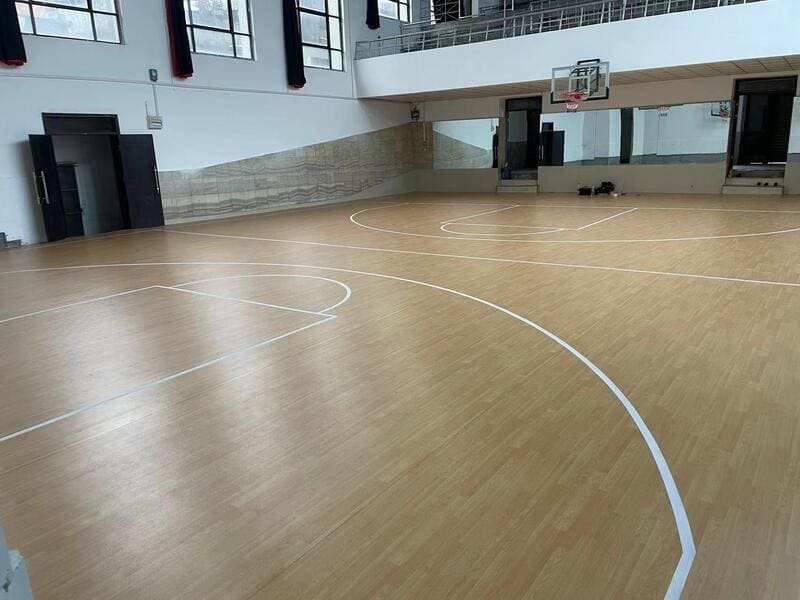
The sport determines the starting range, but the complete floor construction determines whether the system will perform correctly.
Is Higher Shock Absorption Always Better?
No. Excessive shock absorption may increase vertical deformation, reduce movement stability, affect ball rebound, and create problems under tables, bleachers, stages, or rolling equipment.
Shock absorption must be evaluated together with other performance properties.
| Характеристики объекта недвижимости | Почему это важно |
|---|---|
| Force reduction | Controls impact cushioning |
| Vertical deformation | Controls how far the floor moves |
| Ball rebound | Affects basketball and other ball sports |
| Surface friction | Supports safe stopping and turning |
| Indentation recovery | Reduces permanent furniture marks |
| Rolling-load resistance | Protects the floor under mobile equipment |
| Performance uniformity | Keeps the court response consistent |
A well-designed sports floor absorbs impact and returns to its original shape quickly. A poorly designed foam layer may achieve a high initial force-reduction result but lose resilience after repeated compression.
During product development, I may adjust the foam density, cell structure, backing thickness, reinforcement layer, wear-layer stiffness, or total product thickness. The goal is not simply to create a softer floor — it is to provide controlled cushioning without reducing stability.
Two PVC sports floors with the same thickness may have very different shock absorption results. The difference may come from foam density, cell size, reinforcement structure, surface stiffness, or backing design.
For this reason, buyers should request test results for the complete installed flooring system, not only the foam backing or underlayment.
How Do Athlete Age and Usage Affect the Rating?
Children, older adults, competitive athletes, and high-frequency users may benefit from greater shock absorption, but the flooring must remain stable under their weight and movement patterns.
Young athletes have developing joints and may spend long periods running, jumping, and training. Class 3 normally provides a practical balance between cushioning and movement control.
Teenagers and competitive athletes often create higher dynamic loads because they move faster, jump higher, and train more frequently. Upper Class 3 or Class 4 may be more suitable for these users.
Older adults may benefit from additional cushioning, especially during repeated exercise. However, excessive floor movement may affect balance and quick foot placement. The floor should provide impact reduction with controlled vertical deformation.
Body weight also affects performance. A heavier athlete compresses a point-elastic foam layer more deeply. If the foam is too soft, it may bottom out and provide less protection than expected.
Usage frequency is also important. A public sports facility operating for twelve hours per day requires stronger foam recovery and fatigue resistance than a private court used several times per week.
For high-use projects, I review dynamic fatigue resistance, compression recovery, foam-density tolerance, layer bonding, and long-term dimensional stability.
Is Class 4 Worth the Higher Cost?
Class 4 is worth considering for competitive basketball, volleyball, aerobics, and high-use facilities. Class 3 usually offers better value for general multi-purpose halls.
A Class 4 system may use thicker cushioning, multi-density foam, stronger reinforcement, or a more complex supporting structure. These features may increase material and installation costs.
There is no fixed rule that Class 4 always costs 20% or 30% more. The price difference depends on:
- Total flooring thickness
- Cushion-layer construction
- Reinforcement materials
- Подготовка основания
- Installation method
- Moisture-control requirements
- Local labor costs
- Testing and certification requirements
I evaluate the cost over the complete service life of the floor. A cheaper product may become expensive if it develops permanent dents, loses resilience, creates bubbles, or requires early replacement.
A high-cushion system may also be a poor investment when a facility is mainly used for exhibitions, meetings, tables, stages, or heavy equipment.
For multi-purpose projects, engineering optimization may provide a better result than simply increasing the shock absorption rating. Possible solutions include dual-density foam, fiberglass reinforcement, reinforced bleacher zones, protective boards, and load-distribution panels.
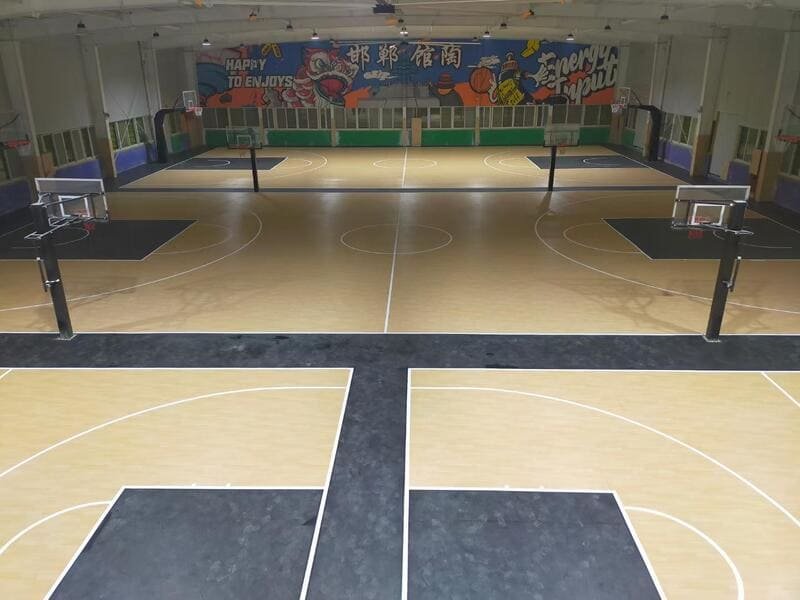
How Can You Verify the Shock Absorption Rating?
Request a third-party test report for the complete installed flooring system. The report should match the exact product thickness, backing, installation method, and supporting structure used in your project.
Shock absorption is measured with a mechanical impact device commonly called an artificial athlete. The device applies a controlled impact and records the force transmitted through the flooring system.
The report must cover the complete construction. A test performed only on the foam backing cannot prove the performance of the final installed floor.
Check for these warning signs:
| Warning Sign | Основной риск |
|---|---|
| No testing standard is listed | The result cannot be compared reliably |
| Only the cushion layer was tested | The complete system performance is unknown |
| Product thickness is missing | The tested construction is unclear |
| The report uses another product name | The supplied floor may be different |
| No vertical deformation result | The floor may be too soft |
| No ball rebound result | Ball-sport performance is uncertain |
| No load-resistance information | Equipment may damage the floor |
Ask the manufacturer these questions:
- Was the complete installed flooring system tested?
- Which edition of ASTM F2772 or EN 14904 was used?
- Does the test report match the supplied product thickness?
- Was the test completed by an independent laboratory?
- What is the vertical deformation result?
- What is the basketball rebound result?
- Can the floor support bleachers and rolling equipment?
- How does the cushion layer perform after repeated loading?
A reliable manufacturer should connect every technical claim to a clear product structure, test method, and quality-control process.
How Should You Make the Final Choice?
Choose Class 3 for balanced multi-purpose performance and Class 4 for frequent high-impact sports. Then verify deformation, ball rebound, friction, load resistance, and certification.
Use this selection process:
- Identify the primary sport.
- Review how many hours the floor will be used each day.
- Consider athlete age, body weight, and training intensity.
- List all tables, stages, bleachers, and rolling equipment.
- Confirm whether ASTM F2772 or EN 14904 is required.
- Select a suitable shock absorption range.
- Review the complete third-party test report.
- Confirm that the installed system matches the tested construction.
For most indoor sports flooring projects, I recommend ASTM Class 3 as the starting point. It provides useful cushioning while maintaining firm movement and multi-purpose performance.
I move toward Class 4 when the facility is mainly used for competitive basketball, volleyball, group fitness, or repeated high-impact training.
The best sports floor is not the product with the highest shock absorption number. It is the system that balances athlete protection, sports performance, equipment resistance, durability, and project cost.
Заключение
ASTM Class 3 or Class 4 provides the best shock absorption balance for most indoor sports floors.
Об авторе
I am an Indoor Sports Flooring technical research and development engineer with practical experience in PVC sports flooring design, cushion-layer development, manufacturing-process improvement, performance testing, and complete system optimization.
I provide engineering optimization, design consultation, and technical cooperation for custom and bulk indoor sports flooring projects. My work focuses on matching material structure with shock absorption, ball response, load resistance, durability, installation conditions, and project budgets.
Need help selecting the correct shock absorption rating for your indoor sports flooring project? Send me a private message with your sport, facility size, user group, subfloor condition, and required standard. I will help you review the specification and recommend a suitable flooring structure.