


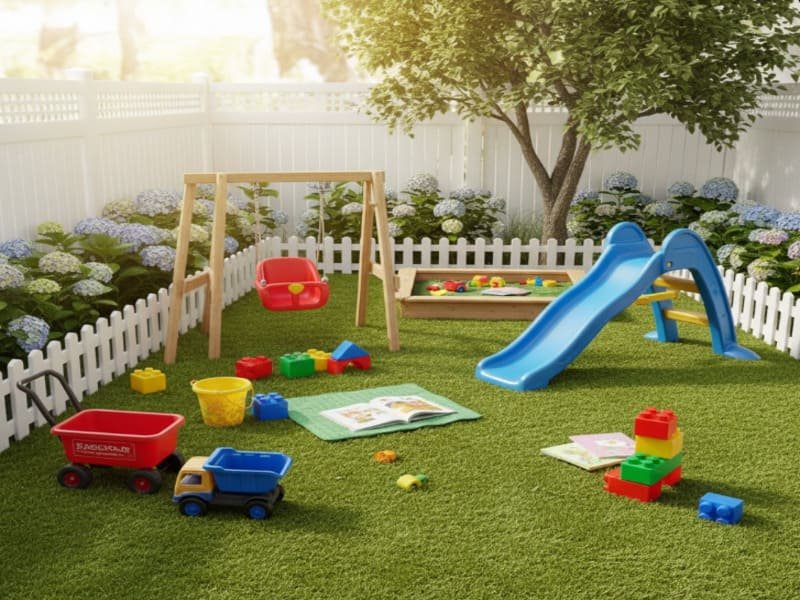
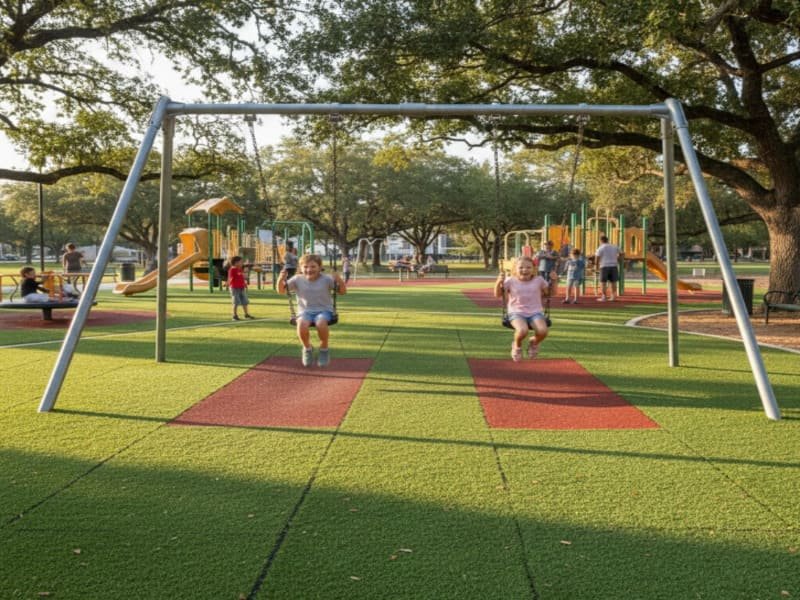
Shock pads are installed under artificial grass to meet critical fall height safety standards, protect the turf backing from abrasive sub-bases, and ensure efficient vertical drainage. They function as a mandatory suspension layer that transforms a decorative carpet into a safe, durable, and high-performance system for sports and play.
As a Quality Control Specialist, I often describe shock pads as the "chassis" of your lawn. The grass is the bodywork—it looks good—but the pad handles the road. Without it, you are essentially laying a carpet on concrete. From a technical standpoint, the primary function is impact attenuation. We measure this using an accelerometer to determine the G-max and HIC (Head Injury Criterion) values.
If you skip this layer, the energy of every footstep or fall is returned directly to the body. Furthermore, the shock pad acts as a crucial barrier. In my friction tests, artificial turf installed directly on crushed stone shows significant backing degradation within 2–3 years due to the abrasive aggregate grinding against the latex. A shock pad eliminates this friction, effectively doubling the structural lifespan of your turf.
Now that we have defined the core function, discerning clients usually ask: "Why this specific material? Why not just use rubber or sand?" Let’s look at the materials.
Why Choose Foam Over Rubber or Just Infill?
Cross-linked foam (XPE/EPE) is superior to rubber or bonded foam because it is non-porous, lightweight, and dimensionally stable. Unlike rubber, which can harden and smell in heat, or bonded foam that acts like a sponge, XPE foam offers consistent shock absorption without retaining water or odors.
In the lab, we subject different materials to accelerated aging and water immersion tests. The results highlight why we advocate for XPE/EPE foam over other market options:
| Tipo de material | Prós | Cons (QC Perspective) |
|---|---|---|
| XPE/EPE Foam (Our Standard) | Closed-cell (waterproof), consistent density, lightweight, easy install. | Requires expansion gaps during installation. |
| Borracha reciclada (SBR) | Cheap, durable. | Heavy to install. Can leach chemicals. Retains heat and smells like "burnt tires" in summer. |
| Bonded Foam (Rebond) | Soft, utilizes recycled waste. | High Failure Rate: Acts like a sponge. Absorbs water/urine, freezes in winter, and degrades quickly. |
| Sand/Rubber Infill Only | Lowest initial cost. | Unstable: Migrates with rain/play. Hardens over time (compaction), losing safety properties. |
From a chemical engineering perspective, the "closed-cell" structure of our foam is the game-changer. It means the material physically cannot absorb liquid. Rubber granules or open-cell foams trap moisture, leading to bacterial growth—a nightmare for pet owners.

Understanding the material science justifies the quality, but I know the next question on your mind is about the budget. Is this extra layer financially standard?
Is It Worth the Investment? (Cost Analysis)
Yes, while shock pads add approximately $10–$25 per square meter to your initial project cost, they extend the turf’s lifespan by 3–5 years. This lowers the "Total Cost of Ownership" by preventing early turf replacement and avoiding expensive injury liabilities on playgrounds.
Let’s break down the economics. Many of my clients initially hesitate at the upfront cost.
- 10mm Pads: Generally add roughly $10–$15 per sqm.
- 25mm Safety Pads: Generally range from $18–$25 per sqm.
However, you must calculate the ROI a longo prazo:
- Turf Preservation: Replacing a synthetic lawn is expensive (labor + disposal + new material). By protecting the backing from the sub-base, the pad prevents the "grinding effect," adding years to your lawn’s life.
- Infill Savings: With a shock pad, you need significantly less rubber or sand infill on top of the grass to achieve the same softness. This saves on heavy bag transport and top-up maintenance.
- The "Safety Tax": For playgrounds, the cost of a pad is negligible compared to the liability of a child suffering a concussion on a non-compliant surface.
As a QC professional, I see the "cheap" installations fail. The turf wrinkles and wears thin in high-traffic zones. The "expensive" system with a pad looks new for a decade.
Now that the budget is approved, let’s look at the hidden engineering benefit that keeps your lawn hygienic.
Why Drainage Matters: The Hidden Benefit?
High-quality shock pads feature a matrix of holes and channels that ensure vertical drainage rates exceeding 1000mm/hr. This prevents water stagnation and mold, acting as a flow-through layer that is far superior to compacted soil or stone dust alone.
In our manufacturing process, we punch drainage holes and cut lateral channels into the foam. This is not for aesthetics; it is fluid dynamics.
When you install turf directly on a compacted stone base, the base must be packed hard to be stable. Unfortunately, hard-packed stone drains slowly.
A shock pad creates a "cavity" or separation layer. Even if the sub-base is slow to drain, the water can flow horizontally through the pad’s channels to the edges.
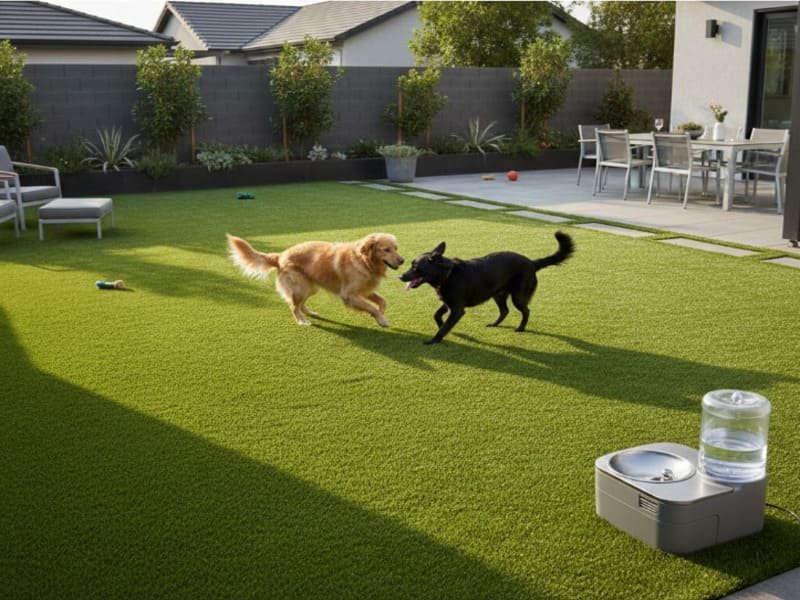
- For Pet Owners: This is critical. Urine needs to flush através de the system instantly. If it sits between the turf and the stone, uric acid crystals form, and the smell returns every time it gets humid. A pad ensures a clean flush every time it rains or you hose it down.
We have covered the cost, the material, and the drainage. Now, let’s quickly cover the installation to show it is not rocket science.
Are They Easy to Install?
Modern shock pads utilize a puzzle-lock system designed for DIY installation without heavy machinery. The most critical step is leaving a 2-3cm expansion gap around the perimeter to accommodate thermal expansion, preventing the surface from rippling on hot days.
You do not need to be a certified contractor to lay these, but you do need to follow physics.
- The Sub-base: It must be flat. The pad is flexible; it will mirror any bumps in the ground.
- The Interlock: The puzzle tabs keep the system unified. We recommend taping the joints with geotextile tape to stop them from drifting while you drag the heavy turf over them.
- The Golden Rule (QC Warning): Thermal Expansion. Polyethylene expands when hot. If you install the pads tightly against a wall in the morning (15°C), and the sun hits them at noon (35°C), they have nowhere to go but up. This creates ripples. Always leave a gap!
Before we wrap up, let’s address the final few technical questions I get on the factory floor.
FAQ: Common Questions About Shock Pads?
Shock pads are not designed for vehicular traffic as heavy loads will crush the foam cells. They do not absorb water due to their closed-cell structure, and high-quality pads possess "shape memory" to recover thickness after foot traffic compression.
Can I drive on it?
No. While our pads have high compressive strength for dynamic loads (running/jumping), the static rolling load of a 2-ton vehicle will permanently deform the cell structure.
Does thickness equal softness?
Not always. Density plays a huge role. A 10mm high-density pad might feel harder than a 25mm low-density pad. However, for Altura crítica de queda (CFH), thickness is the primary driver.
- 25mm = Approx 1.3m – 1.5m Fall Height.
- 45mm = Approx 2.0m+ Fall Height.
Will it flatten over time?
We test for "Compression Set." A quality XPE pad will recover 95%+ of its original thickness after heavy use. Cheap packing foam will stay flat. Ensure your supplier provides a datasheet verifying the Compression Set is <5-10%.
We have analyzed the safety data, the material science, and the financial logic. It is time to secure your project.
Conclusão
Shock pads are the "insurance policy" for your artificial grass. They guarantee safety compliance, solve drainage issues, and lower long-term costs. Don’t build a premium lawn on a budget foundation.
Unsure which thickness fits your budget and safety needs? Contact our engineering team today for a free quote and a sample pack to feel the difference yourself.