


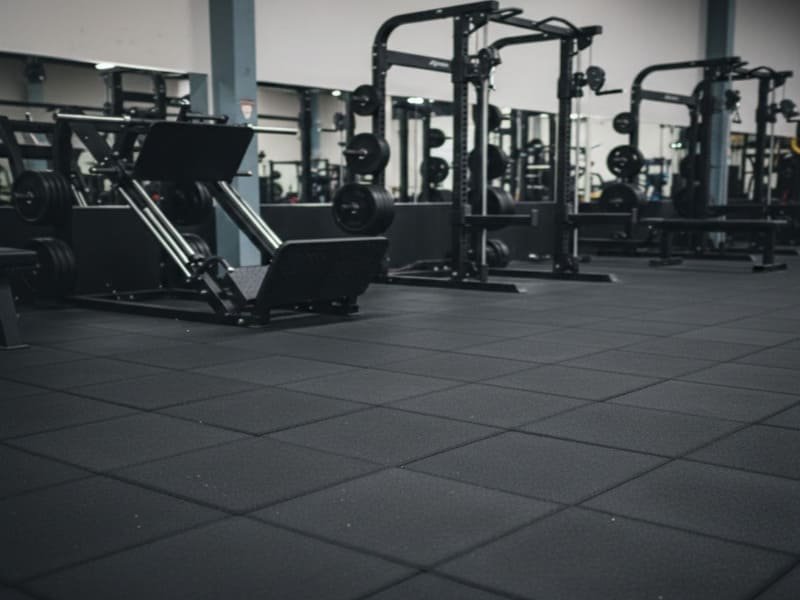
Short Answer: No, cold weather will not ruin your rubber flooring. However, it will cause the mats to shrink (creating gaps) and feel harder. It is safe to use in unheated garages down to -20°C, provided you do not install or glue it while it is frozen. Acclimatization is the key to success.
TL;DR: The "Quick Answer" for Busy Gym Owners
If you are standing in your freezing garage right now wondering if you’ve made a mistake, here is the bottom line:
| Cenário | Will it Survive? | Nível de risco |
|---|---|---|
| -10°C to -20°C Unheated Garage | SIM | ✅ Safe. It will get hard, but won’t break. |
| Installing Cold (No Acclimatization) | NÃO | ❌ High Risk. It will buckle/bubble when summer comes. |
| Vulcanized Rubber Rolls | SIM | ✅ Best Choice. Least porous, handles moisture best. |
| Cheap Low-Density Crumb Rubber | MAYBE | ⚠️ Medium Risk. Can become brittle/crack under heavy drops. |
| Filling Gaps with Caulk | NÃO | ❌ Don’t do it. The gaps will close naturally in summer. |
Why Does Rubber Flooring Shrink and Harden in Winter?
Rubber is a polymer that reacts to thermodynamics: cold causes linear contraction (gaps) and increases density (hardness). This is a physical reaction, not a defect. High-quality rubber will return to its original state when temperatures rise, acting like a "living" material that breathes with the seasons.
The Science: What Happens to Rubber in Freezing Temps?
As a quality control engineer, I often field calls from panicked gym owners in January asking, "Why is my floor shrinking?" To reassure you, we must look at the material science. Rubber obeys the Coefficient of Linear Linear Thermal Expansion. When the ambient temperature drops, the polymer chains pack tighter together to conserve energy.
In practical terms, a 20-foot run of rubber flooring can shrink by approximately 1/4 inch to 1/2 inch when temperatures drop from 70°F (21°C) to 30°F (-1°C). This is why those annoying gaps suddenly appear between your previously tight mats. It is not that the product is "defective" or "cheap"; it is simply physics at work.
Secondly, we observe a change in Durómetro (Dureza). Cold rubber becomes denser. If you are using a standard Shore A 65 rubber mat, it might feel like a Shore A 75 or 80 in freezing conditions. This means the floor becomes less pliable. While high-quality vulcanized rubber retains enough elasticity to resist cracking, lower-grade bonded crumb rubber (often held together with cheap polyurethane binders) can become brittle. Under extreme stress, such as dropping a 200lb barbell, low-grade rubber in a frozen state has a higher risk of micro-fracturing because the binder loses its flexibility.
Now that we know the "why," let’s look at the specific problems you will face and how to distinguish normal behavior from actual failure.
What Are the Real "Pain Points" You Will Face This Winter?
The three biggest issues are "Gapping" (mats pulling apart), "Curling" (edges lifting due to uneven heat), and the "Sweating Slab" (condensation trapped underneath). These are manageable nuisance issues, not permanent failures, provided you manage moisture correctly.
Key Challenges & Pain Points in Cold Climates
In my years of inspecting gym fit-outs in northern climates, I have categorized the three main failure modes that occur during winter. Understanding these will help you diagnose if your floor is failing or just reacting normally.
1. The "Gapping" Phenomenon
This is the number one complaint. You installed your mats tight in September, but by December, they look like a separated jigsaw puzzle. This is linear shrinkage. Dirt, chalk, and debris inevitably get trapped in these gaps. Pro Tip: Do not fill these gaps with permanent filler! If you do, when summer arrives, the mats will expand and have nowhere to go, causing them to buckle upwards.
2. Curling Edges
This is a more subtle issue caused by uneven thermal dynamics. If your concrete slab is extremely cold (ground temperature) but you heat the air in the room quickly with a space heater, the top surface of the rubber expands while the bottom remains contracted. This stress causes the corners or edges to curl upward, creating a significant tripping hazard.
3. The "Sweating Slab"
This is the most dangerous issue for long-term durability. When you heat a cold garage gym, the warm air holds moisture. When that air hits the cold rubber or the cold concrete slab underneath, it condenses. I have pulled up mats in the spring to find black mold growing underneath because moisture was trapped between the rubber and the concrete all winter. This degrades the air quality of your gym and can slowly break down the binders in recycled rubber mats.
The physical changes are annoying, but the real disaster often happens before the gym even opens, during the installation phase.
Can You Install Rubber Flooring in a Freezing Room?
NO, unless you acclimatize. You must let the rubber sit in the room for 48 hours before cutting. If you cut cold rubber to fit a wall, it will expand and buckle when the room warms up. Avoid water-based glues as they will freeze and fail.
Installation Nightmares: The "Golden Rule" of Winter Install
As a quality control engineer, I cannot stress this enough: Acclimatization is not optional. I have seen countless DIY installations fail because the owner received a shipment of cold rubber rolls, unrolled them immediately, cut them to fit the walls, and glued them down.
Here is the engineering reality: If you cut a rubber roll when it is at 30°F (-1°C), it is in its most contracted state. When spring arrives and the room hits 70°F (21°C), that rubber vontade expand. Since you cut it to fit perfectly against the wall, it has nowhere to go. The result is buckling or "bubbling" in the middle of the room. You must unroll the rubber and let it sit in the room for at least 48 hours to reach an equilibrium temperature before you make a single cut.
Furthermore, adhesive selection is critical. Standard acrylic or water-based pressure-sensitive adhesives (PSAs) contain water. In an unheated room, the water in the glue can freeze before the adhesive cures, destroying the bond. If you must glue in the cold, you need a Polyurethane (PU) adhesive. PU cures via moisture reaction, not evaporation, and is generally more stable in lower temperatures. However, for most cold climate gyms, I recommend avoiding glue entirely and using double-sided tape or a dry-lay installation to allow the floor to "float."
Once installed, does the cold affect your actual lifting? Let’s look at performance.
Is It Dangerous to Lift on Frozen Rubber?
Generally, no. The coefficient of friction remains high (non-slip) unless frost forms. Shock absorption is slightly reduced, but stability for heavy lifts like squats actually improves because the rubber is firmer and less compressible.
Performance & Safety: Training in the Cold
From a performance standpoint, cold rubber offers a trade-off. We verify the Coefficient of Friction (COF) in our labs, and dry rubber generally maintains its grip even when freezing. However, the danger arises from the "sweating" mentioned earlier. A thin layer of frost or condensation on rubber turns it into an ice rink. You must verify the surface is dry before doing dynamic movements like box jumps.
Relativamente a Absorção de choques, the physics of the material changes. Because the rubber hardens (durometer increase), the "bounce" or energy restitution is lower.
- For Olympic Weightlifting: The bar might not bounce as high when dropped. The acoustic signature will also change—the "thud" will sound sharper and louder.
- For Powerlifting: This is actually a benefit. When you are squatting or deadlifting heavy loads, you want a floor with zero compressibility. The cold, harder rubber provides an incredibly stable platform, reducing the energy leak you might feel on softer, warmer mats.
While the rubber protects your concrete effectively in the cold, we must ensure we are using the right type of rubber to begin with.
How Do You Choose the Right Flooring for Cold Climates?
Choose vulcanized rubber rolls over interlocking tiles. Vulcanized rubber is non-porous (waterproof) and rolls have fewer seams than tiles, reducing the number of gaps that will open up when the temperature drops.
Best Practices: How to Winter-Proof Your Gym Floor
If you are designing a gym for a location like Minnesota, Alberta, or Northern Europe, your product selection strategy must be different than a gym in Florida.
1. Vulcanized vs. Recycled Crumb
I strongly recommend Borracha vulcanizada for extreme climates. Recycled crumb rubber is porous; it is made of granules glued together. Water can seep into the pores, freeze, and expand, potentially breaking the bonds over years of cycles. Vulcanized rubber is non-porous and chemically cross-linked, making it impervious to water and freeze-thaw cycles.
2. Rolls vs. Tiles
Use rolls. Interlocking tiles rely on tabs to hold together. When tiles shrink in the cold, the tabs pull apart, and the interlock can fail. Rolls have fewer seams and are heavy enough (especially 8mm or 10mm thickness) to lay flat under their own weight.
3. The "Floating" Method & Gap Management
Do not glue the floor down. Use a "floating" installation where you tape the seams of the rolls together using high-strength carpet tape or use connector dowels (for tiles).
- Gestão de lacunas: Apply black duct tape on the parte inferior of the mats along the seams. This holds the mats together while allowing the entire "raft" of flooring to move slightly.
- Expansion Joints: Leave a slightly larger gap (1/4 inch) at the walls than you would in summer. This accounts for the expansion that will happen when the weather warms up.
Finally, let’s address maintenance, because cleaning in winter is tricky.
How Do I Clean My Gym Floor Without Turning It Into an Ice Rink?
Avoid wet mopping; use a damp microfiber mop to prevent ice formation. When using space heaters, never place them directly on the rubber surface, as localized heat can cause permanent deformation or melting.
Maintenance Tips for Cold Weather
Maintenance in a cold environment requires a different approach than standard commercial cleaning.
Cleaning Strategy
Stop using a bucket and mop with excess water. In an unheated garage, that water will not evaporate quickly. It will sit on the surface, seep into seams, and freeze.
- Ação: Use a microfiber mop that is merely damp (mist it with a neutral pH cleaner). You want the moisture to flash-dry almost instantly. If you have salt stains from winter boots, use a specific salt-neutralizing cleaner, but vacuum up the liquid immediately with a wet-vac.
Heater Safety
I have analyzed failed rubber samples that "melted." This almost always happens because a user placed a high-output space heater or infrared heater directly on the mat.
- The Science: Rubber is an insulator. If you blast heat at one spot, the heat gets trapped in the rubber and cannot dissipate into the concrete below. This localized heat build-up can degrade the polymer.
- Recomendação: Always place heaters on a stool or non-flammable block, or use fan-forced heaters that circulate air rather than heating the floor directly.
Let’s wrap up with the specific questions I get asked every single winter.
FAQ: Your "Panic" Questions Answered
Yes, you can leave mats outside. No, don’t fill the gaps with caulk. The rubber is fine, it’s just reacting to physics. Keep it dry, keep it clean, and wait for summer for the gaps to close.
FAQ (Frequently Asked Questions)
Can I leave rubber mats outside in the snow?
Yes. High-quality SBR (Styrene-Butadiene Rubber) and EPDM rubber are chemically stable in freezing temperatures. The cold will not damage the molecular structure. However, be aware that sunlight (UV rays) causes more damage than snow. If storing outside, cover them with a tarp to prevent UV degradation.
Will my rubber flooring crack if I drop a weight on it in -10°C?
It is highly unlikely if you are using proper gym flooring (8mm+ thickness). We test rubber impact resistance. While the rubber is harder at -10°C, it still possesses enough elongation properties to absorb the shock. However, if you are using very thin (3mm-4mm) or low-density rubber, the risk increases.
How do I fix gaps that appeared this winter?
Do not fill them with putty or caulk! As mentioned, this is thermal contraction. If you fill the gaps now, when summer comes, the mats will expand and the filler will be pushed out or the mats will buckle. The best fix is to kick the mats back together and apply tape to the underside, or simply accept that slight gaps are a seasonal behavior of the material.
Does rubber flooring insulate the room?
Rubber has a low R-value (insulation value), so it doesn’t "insulate" like fiberglass in a wall. However, it acts as an excellent Thermal Break. It prevents the conduction of body heat into the freezing concrete slab. Standing on rubber feels significantly warmer than standing on bare concrete because you stop losing heat through your feet.
Conclusão
Don’t let the cold stop your training. Rubber flooring is resilient, tough, and perfectly capable of handling freezing temperatures if you respect its properties. Expect some shrinkage, avoid winter installation if possible (or acclimatize religiously), and keep moisture in check. Your floor will survive the winter just fine.
Still unsure if your current setup can handle the cold?
You don’t have to guess. Reach out to our engineering team—we can look at your specific garage or warehouse specs and recommend the exact thickness and density you need. Ask for a free "Cold Climate Sample Kit" to test the material yourself.