


TL;DR — The Quick Answer
Pour most homeowners, Modular Polypropylene Tiles are the best overall choice due to excellent l'absorption des chocs, drainageet low maintenance.
- Best for Families & Safety: Modular Suspended Tiles
- Best for Pro Performance: Acrylic over Concrete
- Best for Low Budget: Polished Concrete (with sealer)
- Best for Rainy Climates: Modular Tiles (Open Grid)
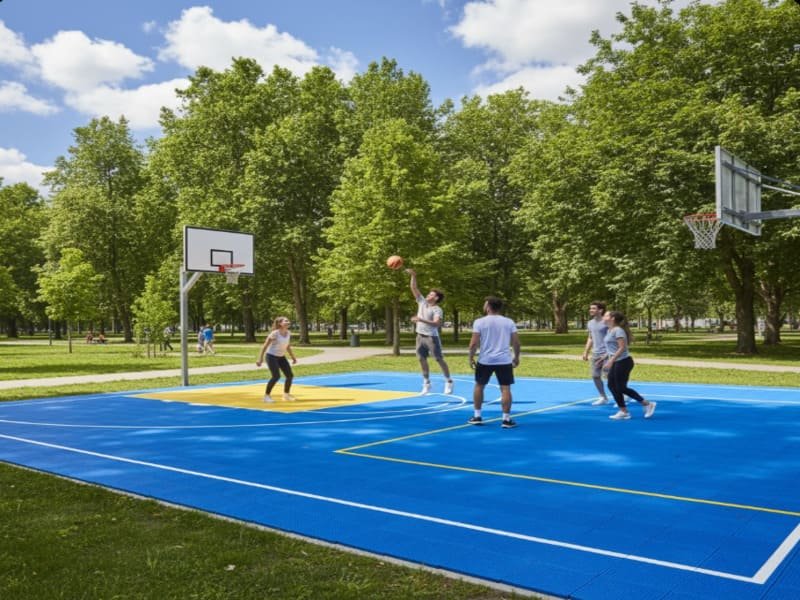
The best surface ultimately depends on your goals: Modular Polypropylene Tiles offer superior safety and durability for residential courts, while Acrylic Surfacing over Concrete delivers the professional-grade ball response used in competitive environments. To choose correctly, you must balance protection des articulations, local climateet budget.
Based on my engineering experience in court materials, selecting a court surface is not about color—it’s about physics, material resilience, and long-term performance. In manufacturing, we evaluate vertical deformation (shock absorption), ball rebound, and friction. A common homeowner mistake is focusing only on aesthetics while ignoring UV stability, thermal expansion, and drainage capability.
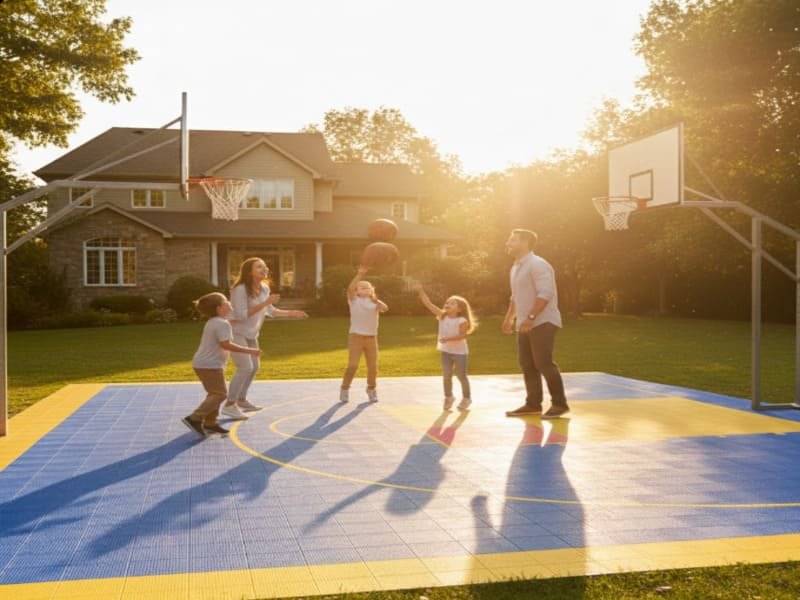
For backyard setups, I recommend modular tiles because they function as a floating system—they sit above the base, so even if concrete shifts or cracks, the tiles remain unaffected. For players who demand a true NBA feel, acrylic over a vapor-sealed concrete slab offers unmatched consistency, though it requires more maintenance.
Quick Guide: Best Surface by Scenario
| Scénario | Best Surface Recommendation | Pourquoi |
|---|---|---|
| Backyard Family Court | Modular Suspended Tiles | Best shock absorption; drains instantly after rain |
| Formation professionnelle | Acrylic over Concrete | Consistent bounce & high traction |
| Tight Budget (<$5k) | Raw Concrete (Sealed) | Lowest cost; long lifespan |
| Rainy / Humid Climate | Modular Tiles (Open Grid) | No puddles; mold-resistant |
| Freeze/Thaw Zones | Carreaux modulaires | Handles expansion without cracking |
| Community Park | Asphalte | Cost-effective for large areas |

What Key Factors Must You Consider Before Choosing?
To select the optimal surface, focus on six engineering metrics:
1. Traction (Coefficient of Friction)
Surfaces must offer enough grip for quick stops—but not so much that they cause ankle injuries. High-quality surfaces maintain consistent grip even when dusty.
2. Shock Absorption (Force Reduction)
Concrete = 0% force reduction.
Quality modular tiles = 10–30%, meaning less impact traveling into knees and lower back—critical for kids and older players.
3. Climate Resilience
Materials expand and contract with temperature. Non-UV-stabilized surfaces become brittle or chalky. Freeze–thaw cycles can crack rigid coatings.
Top Contenders: In-Depth Engineering Review
A. Modular Suspended Tiles (The Engineer’s Choice for Homes)
Interlocking polypropylene (PP) tiles that snap together over a hard base.
Engineering Insight:
We use high-impact PP copolymers for the ideal balance of ball response and flexibility. Suspended legs create vertical cushioning and improve noise control.
Pour :
- Superior drainage
- Joint protection
- Installation par le bricoleur
- Covers cracks in concrete
Cons :
- Slight hollow sound
- Higher upfront material cost

B. Acrylic Surfacing (The Professional Standard)
A multi-layer coating with silica sand applied over concrete.
Engineering Insight:
Sand mesh size controls traction and surface “speed.” Acrylic requires a flawless base because cracks telegraph through the coating.
Pour :
- Professional aesthetics
- Excellent ball bounce
- Custom colors
Cons :
- Minimal shock absorption
- Moisture can cause bubbles
- Nécessite une installation professionnelle
C. Concrete & Asphalt (The Basic Surfaces)
Béton : rigid, durable, reliable ball bounce
Asphalte : flexible, cheaper, but oxidizes under UV and becomes brittle
Pour :
- Low initial cost
- Long lifespan
Cons :
- Hard on joints
- Slippery when wet (concrete)
- Cracks more easily (asphalt)
Head-to-Head Comparison Table
| Fonctionnalité | Béton | Asphalte | Carreaux modulaires | Acrylic System |
|---|---|---|---|---|
| Coût initial | Low ($) | Low ($) | Medium ($$) | High ($$$) |
| Absorption des chocs | 0% | ~5% | 20-30% | ~5–10% |
| Maintenance | Faible | Haut | Faible | Moyen |
| Durée de vie | 30+ Years | 10–15 Years | 15–20 Years | 5–8 Years |
| Ami des bricoleurs | Non | Non | Oui | Non |
| Rebond de la balle | Excellent | Bon | Bon | Excellent |
What Is the Real Cost Breakdown Per Square Foot?
Approximate cost ranges (varies by region):
- Dalle en béton : $4–$8 / sq ft
- Asphalte : $3–$6 / sq ft
- Modular tiles: $3.50–$5.50 / sq ft
- Acrylic system: +$4–$8 / sq ft (on top of base)
Cost Tiers
- Entry Level: Raw Concrete
- Mid-Range: Asphalt + Seal Coat
- Upper-Mid: Concrete Base + Modular Tiles
- Premium: Post-Tensioned Concrete + Cushioned Acrylic
Modular tiles often save money long-term because they’re a finished product requiring almost no maintenance.
Foire aux questions (FAQ)
Can I install a court on grass or dirt?
No. Soil is unstable and shifts under load. You need concrete, asphalt, or compacted crushed stone as a rigid sub-base.
How thick should the concrete slab be?
4 inches, reinforced with rebar or mesh. Use 4000 psi concrete to prevent cracking.
Are modular tiles slippery when wet?
Quality tiles have textured patterns to increase traction. Their open-grid design drains water instantly.
How long does each surface last?
- Béton : 30+ years
- Asphalte : 12–15 years
- Modular Tiles: 15–20 years
- Acrylic: 5-8 ans
Conclusion & Final Verdict
There is no universally perfect surface—only the perfect surface for your needs.
Choisir Carreaux modulaires if:
- You want a family-friendly backyard court
- You care about joint safety
- You need excellent drainage and low maintenance
Choisir Acrylique if:
- You are a competitive player
- You need precise ball response and high traction
- You can maintain the surface every 5–7 years
Choisir Béton if:
- Budget is the top priority
- You are willing to sacrifice comfort for durability
Ready to Build Your Dream Court?
Don’t guess—use engineering-backed specifications.
👉 [Contact Us for a Free Quote & Sample Kit]
Experience the quality of our high-impact flooring tiles firsthand.
A propos de l'auteur
I am a Production Process Engineer with over 10 years of experience in manufacturing sports flooring systems. I specialize in polymer material formulation and injection molding for outdoor applications, optimizing the balance between athletic performance, safety, and durability.