


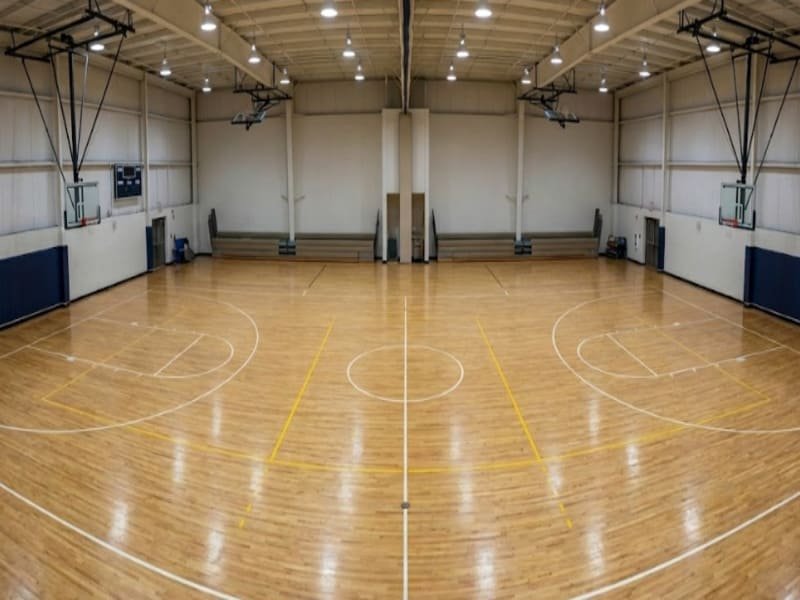
The intersection of sports and art in gymnasium flooring balances aesthetic impact with engineering constraints. While custom designs enhance brand identity and athlete motivation, they must be implemented using low-risk technologies like water-jet inlays or digital PVC printing to ensure the floor remains safe, durable, and cost-effective.
In my role as a Quality Control Manager, I see two types of gym floor designs: those that look good on Instagram but fail in six months, and those engineered to last. The problem isn’t the art; it’s the execution. Facility owners often ask me, "Can I paint a giant mural on the lifting platform?" My answer is technically "yes," but operationally "no"—unless you want to repaint it every month. True success comes from understanding the Design-Cost-Risk triangle. We are not just decorating; we are embedding functional art into the material itself. Whether it is a high school basketball court needing a center logo or a boutique studio requiring specific mood lighting via floor colors, the goal is to satisfy the visual search intent without compromising the Coefficient of Friction (slip resistance) or the maintenance budget. This article moves beyond theory to the practical realities of costs, specific application scenarios, and technical risk management.

To understand how to execute this correctly, we must first look at where these designs add the most value. Let’s break this down by specific facility type.
How Should Different Venues Apply Artistic Flooring? (Use-Cases)
Different venues require specific design strategies: Schools maximize team spirit with central logos on PVC or wood; commercial gyms use lighting and solid color blocking to define premium zones; and functional training centers rely on inlaid markings in rubber for durability and workout guidance.
We cannot apply a "one size fits all" approach to design. Based on my experience supplying diverse sectors, here is the breakdown of what works best for specific applications:
- School & University Gyms (The "Spirit" Case):
- Goal: Intimidation factor for visiting teams and pride for home students.
- Best Practice: Large central logos. We use Maple-look PVC with the school logo digitally printed sous the wear layer. This captures the traditional look without the high maintenance of real wood.
- Commercial & Boutique Gyms (The "Atmosphere" Case):
- Goal: Customer retention and premium feel.
- Best Practice: Visual zoning. Instead of walls, use a shift in floor color (e.g., Dark Grey for cardio, Black for weights). This opens up the space while keeping it organized.
- CrossFit & Functional Areas (The "Tool" Case):
- Goal: Efficiency and coaching aid.
- Best Practice: Functional markings. We use Water-Jet Cut Rubber to permanently embed agility ladders, meter markers for sled pushes, or box jump targets. This turns the floor into a piece of equipment.
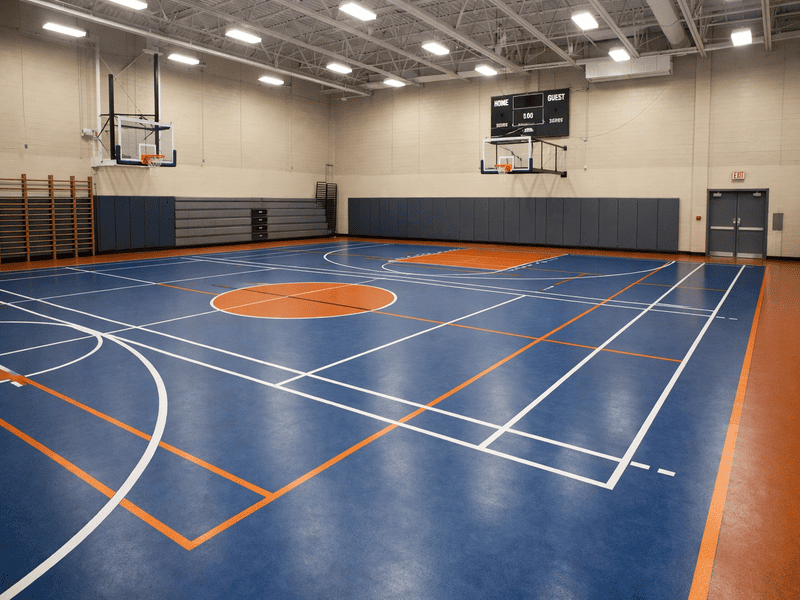
Knowing ce que to design is one thing, but as a project manager, you need to know what it costs and where the risks lie.
What Are the Real Costs and Risks of Custom Flooring?
Custom flooring typically commands a 15-30% premium over standard materials, but the investment reduces long-term maintenance costs compared to painting. The primary risk lies in choosing surface-applied treatments (high failure rate) versus integrated manufacturing methods like inlays (low failure rate).
Let’s have an honest conversation about money and risk. I often see clients try to save money by painting their existing rubber floors. This is a "High Risk / High Maintenance" strategy. Rubber expands and contracts; paint does not. It volonté crack. As an engineer, I advise assessing the "Total Cost of Ownership."
Below is a risk/cost analysis I use to guide clients:
| Design Method | Impact sur les coûts | Risk Level | Durabilité | My Verdict |
|---|---|---|---|---|
| Surface Painting | Faible ($) | Haut | Poor (<1 year) | Avoid. High maintenance; looks cheap quickly. |
| Vinyl Stickers | Faible ($) | Haut | Poor (Peels up) | Avoid. Trip hazard; safety risk. |
| Digital Print (PVC) | Moyen ($$) | Faible | High (10+ years) | Recommended. Best for complex graphics/logos. |
| Water-Jet Inlay (Rubber) | Haut ($$$) | Faible | Extreme (Life of floor) | Recommended. Best for heavy weight zones. |
The "Safe Bet" is always integrated manufacturing. You pay more upfront, but you never pay for repairs.
Once you have justified the budget and minimized the risk, you need to understand the material technology that makes these low-risk options possible.
Which Material Technologies Enable Safe Artistic Expression?
PVC flooring utilizes rotogravure printing for intricate, photorealistic designs protected by a wear layer, while rubber flooring relies on EPDM color blending and precision water-jet cutting to create seamless, solid-color patterns that withstand heavy impact without fading.
From a manufacturing standpoint, the "canvas" dictates the method.
For PVC (Vinyl): We use a process called Rotogravure Printing. This allows us to print high-resolution images (like stone, wood, or custom graphics) on a film layer. Crucially, we then laminate a pure PVC wear layer (ranging from 0.5mm to 1.2mm) on top. This means the athlete’s shoe never touches the ink. The friction is provided by the surface embossing, not the print, ensuring safety.
For Rubber (EPDM/SBR): We cannot print effectively on recycled rubber. Instead, we use Mass Pigmentation ou Inlay Technology. If you want a red circle in a black square, we cut the circle from a red tile and the hole from a black tile using a high-pressure water stream (Water-Jet). We then bond them together using an aliphatic binder. This creates a mechanical bond. It is not a picture on the floor; it is the floor. This is the only way to ensure heavy dumbbells don’t destroy the design.

We have covered the "Where," the "How Much," and the "What." Now, how do you actually execute this?
How Do You Start? A Project Execution Checklist
To successfully implement a custom floor, follow a structured workflow: define the functional zones, select the appropriate material-specific design method (Inlay vs. Print), secure high-resolution vector files, and request a factory proof or prototype to verify color accuracy and scale before mass production.
To avoid the "I didn’t think it would look like that" moment, I recommend following this engineering checklist before you sign a purchase order. This framework reduces errors in the production phase:
- Zone Definition: Do not just decorate; designate. Mark out where heavy weights go (Rubber) vs. where group classes happen (PVC).
- Feasibility Check:
- Complex Logo with Gradients? -> Must use PVC Digital Print.
- Simple 2-Color Logo? -> Can use Rubber Inlay.
- File Readiness: Ensure your designer provides
.AIou.EPSvector files. We cannot cut or print from a.JPGscreenshot. - The "Sample Rule": Always demand a "Strike-off" or physical sample. Digital colors look different on a screen than they do on matte rubber or glossy PVC.
- Installation Plan: Custom floors are puzzles. Ensure your installer has the layout map (we provide these with the shipment) to assemble the numbered tiles correctly.

With this checklist, you can approach the design process with confidence, knowing you are basing decisions on engineering logic, not just aesthetics.
Conclusion
Great gym design is where engineering meets emotion. It does not have to be risky or exorbitantly expensive if you choose the right method for the right application. By prioritizing inlaid rubber and sub-surface printed PVC, you build a facility that inspires athletes and stands the test of time.
Mon rôle
I am a Quality Control Manager and Engineer specializing in sports flooring manufacturing. My daily work involves testing wear layers, calibrating water-jet cutters for precision inlays, and helping clients value-engineer their designs to balance durability with visual impact.
Appel à l'action
Do you have a design idea but aren’t sure if it’s "production-ready"? My team can review your concept and provide a Feasibility & Risk Assessment along with a material sample. Contact us today to see how we can turn your vision into a durable reality.