


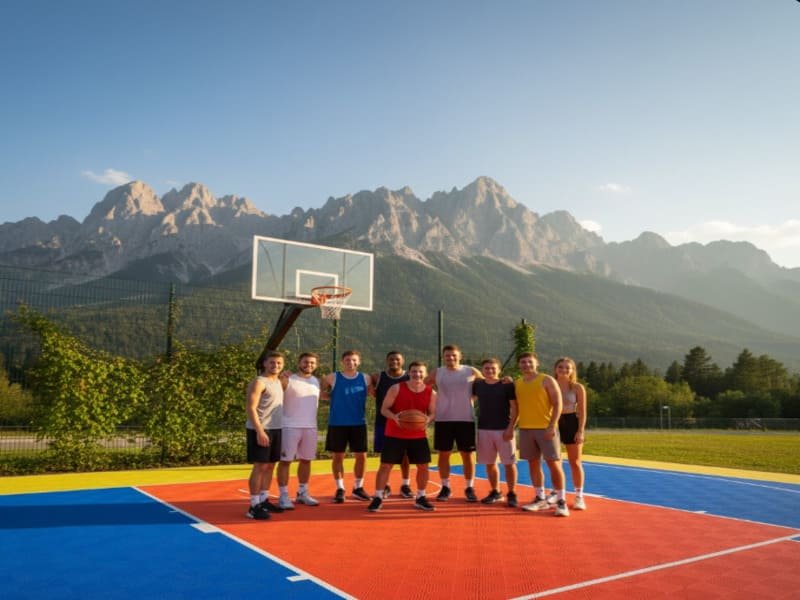
La meilleure surface pour la plupart des courts extérieurs résidentiels est tuiles modulaires en polypropylène (PP) à emboîtement en raison de leur capacité de drainage supérieure, de leur capacité d'absorption des chocs et de leur faisabilité en matière de bricolage. Cependant, revêtement acrylique sur le béton offre les meilleures performances pour le jeu de compétition, tandis que le béton ordinaire reste l'option la plus durable et la plus économique.
L'ingénierie derrière le rebond parfait
Choisir la bonne surface n'est pas seulement une question d'esthétique, c'est aussi une question de physique de la réponse de la balle et de mécanique de la durabilité du matériau. Au cours de mes années de conception de processus de fabrication de surfaces sportives, j'ai appris que la "meilleure" surface dépend entièrement de l'interaction entre la dureté du matériau et l'environnement local. Les terrains de plein air sont confrontés à des défis que le bois dur d'intérieur ne rencontre jamais : Le rayonnement UV, la dilatation thermique et la pression hydraulique de la pluie.
Du point de vue de la production, nous évaluons ces surfaces sur la base de trois paramètres techniques : le coefficient de friction (traction), la réduction de la force (absorption des chocs) et le rebond vertical de la balle. La réduction de la force joue un rôle essentiel dans la protection des genoux et des chevilles lors des jeux répétitifs en plein air. C'est pourquoi les systèmes d'amortissement des chocs sont de plus en plus recommandés pour les tribunaux résidentiels et les tribunaux pour enfants, comme nous l'expliquons en détail dans l'analyse des systèmes d'amortissement des chocs dans les tribunaux résidentiels et les tribunaux pour enfants. les avantages d'un revêtement de sol de basket-ball absorbant les chocs.
- Béton : Il offre une valeur de rebond de près de 100% par rapport à une référence solide, mais il n'a aucune réduction de force, ce qui signifie que vos articulations absorbent chaque impact.
- Carreaux modulaires : Ils sont moulés par injection et dotés d'un système de suspension. Elles offrent généralement une réduction de force de 20-30%, ce qui réduit considérablement le risque de tendinite rotulienne, mais elles amortissent légèrement le son et le rebond de la balle.
- Revêtements acryliques : Ils reposent sur du sable de silice mélangé à la résine. La granulométrie détermine l'adhérence. Si le sable est trop fin, il est glissant lorsqu'il est mouillé ; s'il est trop grossier, il déchiquette les ballons de basket et les chaussures.
"Lorsque je donne des conseils sur le développement de produits, je rappelle toujours à mes clients que la qualité de la surface dépend de celle de la base. Aucune fabrication haut de gamme ne peut réparer une fondation qui se fissure".
Il convient donc d'approfondir les options spécifiques qui s'offrent à vous.
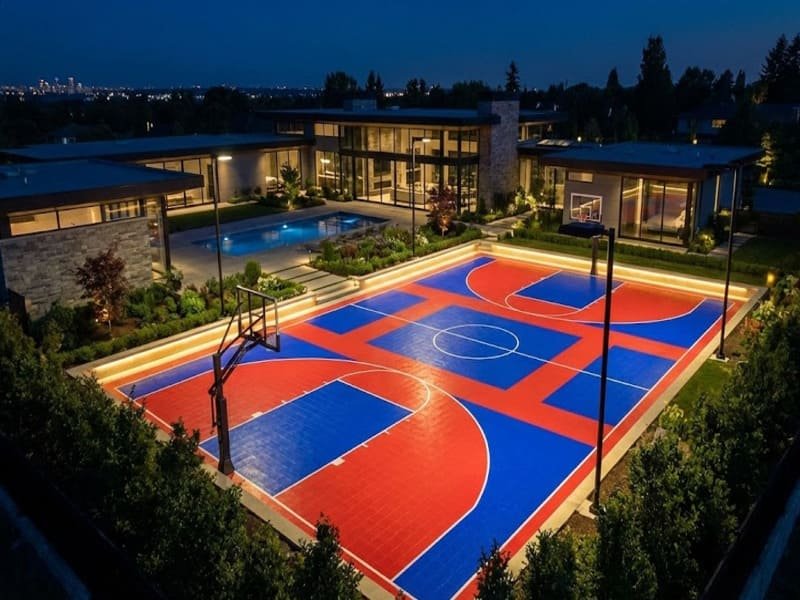
Quels sont les facteurs critiques qui doivent dicter votre choix de matériau ?
Votre décision dépend en grande partie du budget disponible, des extrêmes climatiques locaux, de l'intensité de l'utilisation prévue et des exigences en matière de sécurité. Alors que les joueurs professionnels privilégient l'adhérence et la consistance du rebond que l'on trouve dans les acryliques, les familles devraient privilégier l'absorption des chocs et les capacités de drainage des dalles modulaires afin de prévenir les blessures.
Analyse des compromis : Coût et performance
Lorsque nous concevons le flux de fabrication de ces matériaux, nous observons des structures de coûts distinctes qui vous sont répercutées. La compréhension de ces variables vous aide à prendre une décision d'ingénierie calculée plutôt qu'une décision émotionnelle.
1. Ingénierie climatique
Le climat est le plus grand ennemi des matériaux d'extérieur.
- Congélation/décongélation : D'après mon expérience avec les formulations d'asphalte, la pénétration de l'eau entraîne une dilatation lorsque le sol est gelé, ce qui provoque une défaillance structurelle. Les dalles modulaires sont conçues avec des "joints de dilatation" dans leurs languettes d'emboîtement, ce qui permet au sol de "flotter" sans se déformer lorsque les températures varient.
- Stabilité aux UV : Nous ajoutons des stabilisateurs UV aux mélanges de polymères (comme les HALS - Hindered Amine Light Stabilizers). Sans ces stabilisateurs, les carreaux rouge vif ou bleus se crayonnent et se décolorent au bout de deux ans.
2. Le facteur de sécurité
La sécurité est calculée par la "réduction de la force" (FR).
- Béton/asphalte : <5% FR. Impact important sur les genoux.
- Acrylique : 5-10% FR. Amortissement minimal à moins qu'un tapis en caoutchouc ne soit appliqué en dessous (cushion court).
- Carreaux modulaires : >25% FR. Les pieds (ou piliers) situés sous la surface de la tuile servent d'amortisseurs.
3. Réalité budgétaire
J'ai décomposé le rapport coût-efficacité typique en fonction de la transformation des matières premières et de la main-d'œuvre d'installation :
| Fonctionnalité | Béton (base) | Asphalte | Dalles modulaires en PP | Revêtement acrylique |
|---|---|---|---|---|
| Coût initial | Faible | Faible-Moyen | Moyenne-élevée | Haut |
| Potentiel de bricolage | Faible | Non | Haut | Non |
| Maintenance | Faible | Haut | Faible | Moyen |
| Durée de vie | 30 ans et plus | 10-15 ans | 15 ans et plus | 5-8 ans (resurfaçage) |
Examinons maintenant les matériaux de fondation les plus courants.
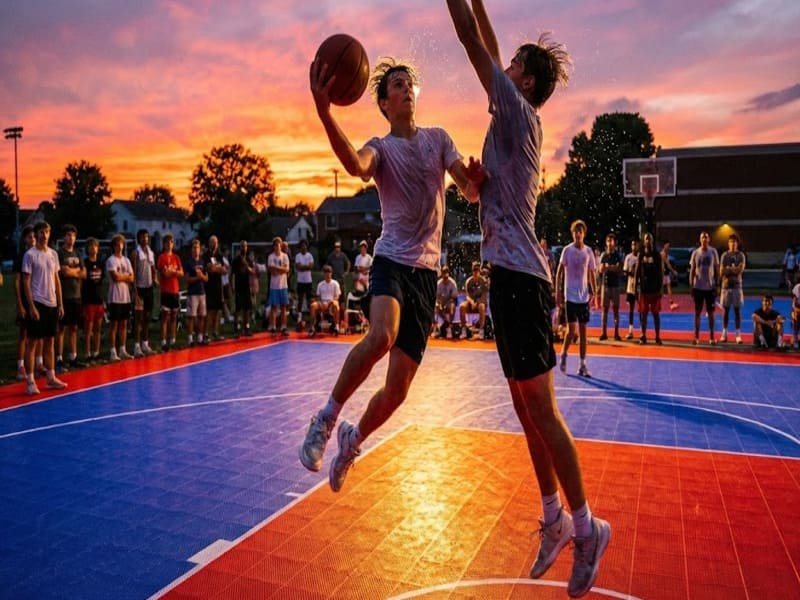
Comment le béton et l'asphalte se comparent-ils en tant que couches de base ?
Le béton est supérieur pour sa longévité et sa consistance, agissant comme une fondation permanente qui a rarement besoin d'être réparée si elle est correctement durcie. L'asphalte est moins cher au départ pour les grandes surfaces, mais il souffre de piqûres, de ramollissement dû à la chaleur et de fissures, ce qui nécessite de fréquentes réparations et le rend moins idéal pour les projets résidentiels de précision.
La sous-base : La fondation de l'industrie manufacturière
Dans le monde de la construction, on dit souvent, "Ne mettez pas un moteur de Ferrari dans un kart. Il en va de même ici. Il n'est pas possible d'installer un carrelage ou une surface acrylique de haute performance sur une base défaillante.
Béton : l'étalon-or
Du point de vue de la science des matériaux, le béton (renforcé par des barres d'armature) durcit pour atteindre une dureté qui résiste aux mouvements du sol.
- psi Ratings : Je recommande un mélange évalué à au moins 4000 psi. Cette densité permet d'éviter les "fissures de tassement" qui gâchent le rebond de la balle.
- Finition : Si vous envisagez de le peindre ou d'y ajouter des carreaux, le béton doit avoir une "finition légère". S'il est trop lisse, le revêtement n'adhère pas ; s'il est trop rugueux, il agit comme du papier de verre sur votre peau.
- Les inconvénients : Il est rigide. Si le sol sous le béton bouge, le béton crée une fissure dure.
Asphalte : L'alternative budgétaire
L'asphalte est un agrégat lié au bitume.
- Questions relatives à la chaleur : Le bitume est un thermoplastique. Par forte chaleur (plus de 90°F/32°C), j'ai vu l'asphalte se ramollir. Si vous dribblez une balle sur de l'asphalte chaud, l'absorption d'énergie augmente, ce qui tue le rebond.
- Oxydation : Avec le temps, le liant s'oxyde et devient gris/fragile. Les agrégats commencent à se détacher, créant une surface rugueuse qui n'est pas propice au jeu et à l'abrasion de la peau.
Pour un propriétaire, je recommande presque toujours d'investir dans une dalle en béton. Elle fournit la géométrie stable et plate nécessaire à la prochaine génération de surfaces dont nous allons parler.
Ensuite, nous examinons la solution la plus populaire sur le marché des pièces détachées.
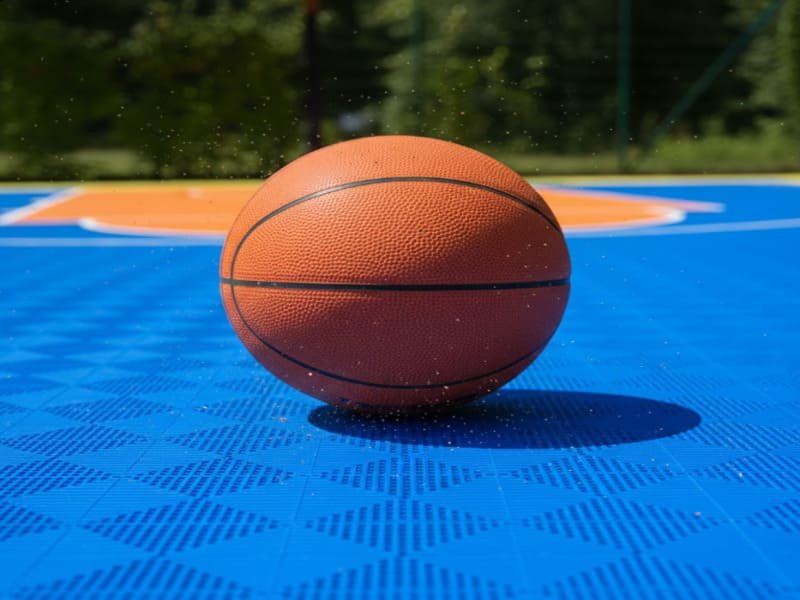
Pourquoi les dalles modulaires en polypropylène sont-elles le premier choix des propriétaires ?
Les dalles modulaires sont dotées d'une grille ouverte suspendue qui permet un drainage instantané de l'eau et offre une tolérance latérale qui réduit la tension des articulations. Dans les installations extérieures polyvalentes ou les zones d'entraînement où la protection contre les chocs doit être renforcée, les revêtements de sol sportifs à base de caoutchouc sont souvent considérés comme des solutions complémentaires, en particulier lorsqu'il s'agit de comparer les performances en matière de durabilité et de résistance aux chocs décrites dans les documents suivants les meilleurs revêtements de sol sportifs en caoutchouc.
Elles sont conçues pour être installées à la main, résister aux UV et réduire le bruit, ce qui en fait la solution la plus pratique et la plus performante pour les arrière-cours résidentielles.
Moulage de précision pour la sécurité et le drainage
En tant que spécialiste du moulage par injection, je suis conscient de la complexité d'un carreau en polypropylène (PP) de haute qualité. Il ne s'agit pas de simples morceaux de plastique, mais de mailles techniques.
1. Le matériau : Copolymère de polypropylène
Nous utilisons du "polypropylène copolymère à fort impact" pour ces tuiles. Pourquoi ?
- Résistance à l'impact : Il ne se brise pas lorsqu'un objet lourd le frappe.
- Rigidité : Il est suffisamment rigide pour permettre un bon rebond de la balle (contrairement au caoutchouc souple).
- Mémoire thermique : Il reprend sa forme après expansion.
2. Le système de suspension
Retournez une tuile. Vous verrez des centaines de petits poteaux ou arcs. C'est la "suspension".
- Choc vertical : Lorsque vous atterrissez après un layup, ces poteaux fléchissent légèrement, absorbant l'énergie qui, autrement, se propagerait dans votre tibia.
- Drainage : La surface de la grille est trouée. La pluie passe directement à travers le béton qui se trouve en dessous et qui doit être incliné (1%) pour évacuer l'eau. J'ai vu des terrains secs et prêts à jouer 10 minutes après un orage à cause de cette conception.
3. La question du bruit
Le bruit "clac-clac" est une plainte fréquente. Ce bruit se produit lorsque le plastique dur heurte le béton dur.
- La solution : Les fabricants haut de gamme co-moulent désormais une sous-couche en caoutchouc ou suggèrent de poser un rouleau de caoutchouc de 3 mm sous les dalles. Cela permet d'amortir les vibrations harmoniques et de donner au terrain un son solide et non creux.
Mais qu'en est-il si vous voulez avoir l'apparence et la sensation de la NBA ?
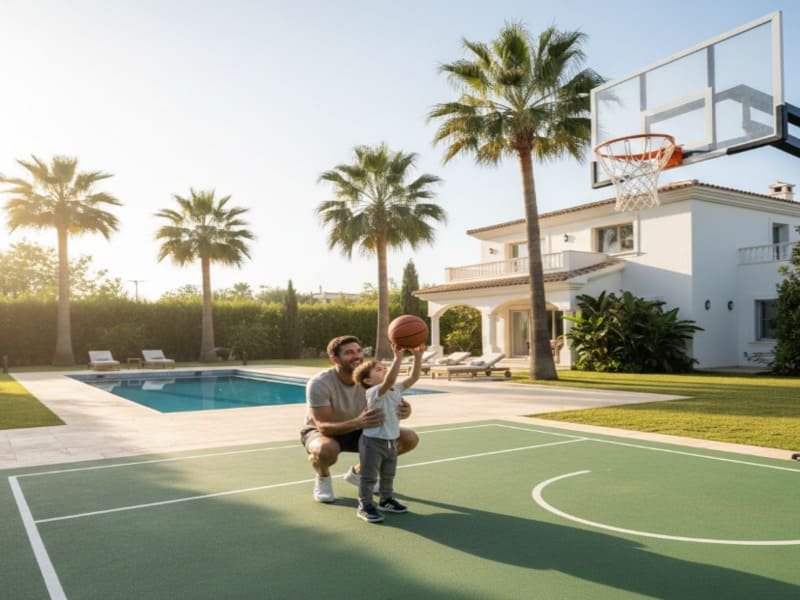
Quand choisir un revêtement acrylique plutôt qu'un carrelage ?
Choisissez les revêtements acryliques si vous exigez une réponse au ballon de niveau NBA, une esthétique professionnelle et une traction maximale, mais préparez-vous à une installation professionnelle et à un resurfaçage nécessaire tous les 5 à 7 ans. Cette option nécessite une base en béton impeccable pour éviter l'écaillage et la formation de bulles.
La chimie du "Hard Court
Le revêtement acrylique est ce que vous voyez à la télévision. Il ne s'agit pas d'une simple peinture, mais d'un système multicouche. Dans la production, nous mélangeons des liants latex acryliques avec du sable de silice.
1. Contrôle de la traction par la taille des particules
Le "grain" de la peinture est fabriqué. Nous classons le sable siliceux en fonction de la taille des mailles. Une peinture générique de quincaillerie n'utilise pas de sable ou des tailles aléatoires, ce qui la rend glissante. Les revêtements professionnels utilisent un profil de maille spécifique pour garantir que lorsque vous posez le pied pour pivoter, le coefficient de frottement est suffisamment élevé pour vous arrêter, mais suffisamment faible pour permettre une légère rotation (ce qui évite les déchirures du ligament croisé antérieur).
2. La barrière de vapeur d'eau
C'est là que la plupart des projets de bricolage échouent. Le béton est comme une éponge dure ; il aspire l'humidité du sol. Si vous scellez le dessus avec de l'acrylique, cette humidité ascendante reste piégée.
- Le résultat : La pression hydrostatique augmente et pousse la peinture sur le béton, créant des bulles ou des cloques.
- La solution : Vous devez installer un apprêt pare-vapeur spécialisé avant d'appliquer les couches de couleur.
3. Réalité de l'entretien
Contrairement aux carreaux, qui sont en plastique solide, l'acrylique est une fine couche.
- Il s'use dans les zones les plus fréquentées (la touche et la ligne des 3 points).
- Il se décolore légèrement plus vite que les carreaux stabilisés aux UV.
- Il n'y a pas de pontage de fissures. Si votre base en béton se fissure, l'acrylique se fissure.
Si vous êtes un joueur sérieux qui s'entraîne au niveau universitaire ou professionnel, l'acrylique est la seule surface qui reproduit fidèlement le jeu de compétition. Mais pour un jardin avec des arbres et des racines ? C'est un risque pour l'entretien.
Conclusion
Pour décider, il faut adapter la surface à l'utilisateur principal. Pour les familles et les climats humides, tuiles modulaires offrent la meilleure sécurité et le meilleur drainage. Pour un entraînement compétitif, choisissez acrylique sur béton. Pour une durabilité pure à un prix abordable, béton ordinaire est imbattable.
A propos de l'auteur
Je suis ingénieur en procédés de production et j'ai plus de 15 ans d'expérience dans la fabrication de polymères et les technologies d'application de surface. Je suis spécialisé dans l'optimisation des flux de production pour les matériaux de revêtement de sol sportif et j'ai été consulté sur la sélection des matériaux pour des centaines d'installations sportives récréatives et professionnelles. Mon objectif est de combler le fossé entre l'ingénierie chimique complexe et les besoins pratiques des utilisateurs.