


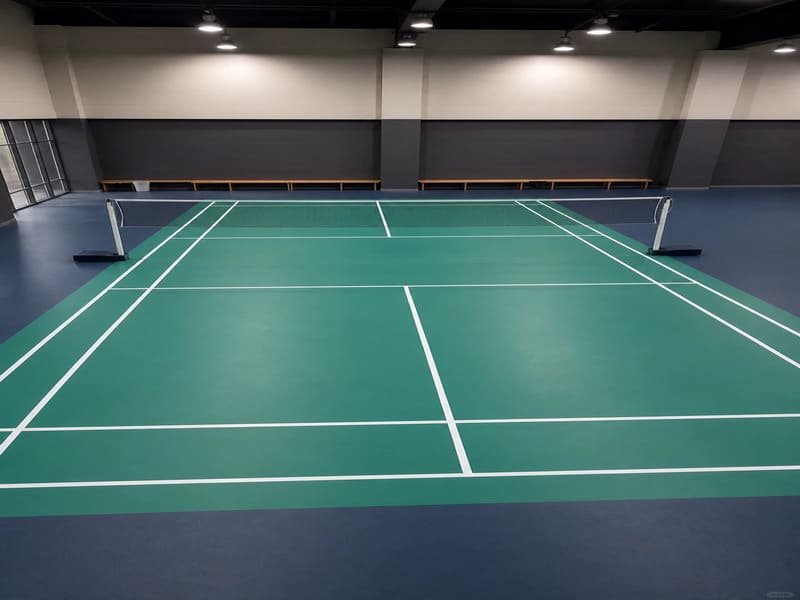
Yes, but with a distinction that matters: sports-grade PVC flooring is a strong choice for indoor volleyball courts because it delivers controlled shock absorption, consistent surface friction, and easy long-term maintenance. Some specific PVC sports flooring systems also hold FIVB homologation for high-level competition, but that approval applies to individual products, not to PVC flooring as a category.
Picking the right floor for a volleyball court is not a small decision. I know facility owners feel the weight of it, because the floor has to protect players, hold up under years of hard play, and still fit the budget. Get it wrong, and you risk injuries, high repair bills, or a court that feels dead under the athletes’ feet. Get it right, and the floor becomes something players barely think about, because it just works every time they jump, land, or dive. In this article, I will walk through why volleyball puts unique stress on a floor, what makes sports-grade PVC handle that stress well, how it compares to hardwood and PU, and what to check before you commit to a specific product.
Before I get into the benefits, it helps to understand why volleyball is actually one of the toughest sports on a floor. Once you see the specific demands of the game, the reasons behind sports-grade PVC’s design choices make a lot more sense.
Why Does Volleyball Need Specialized Court Flooring?
Volleyball needs flooring built for repeated high-impact landings, quick directional changes, and safe sliding, because a standard hard surface cannot handle the joint stress or the friction demands of the game.
Volleyball is not a gentle sport for a floor. Players jump over and over to spike or block, then land hard on the same joints again and again through a match. That repeated impact travels straight into the knees, ankles, and lower back if the surface underneath does not absorb any of the force. On top of that, players need to plant their feet instantly to change direction, then dive across the floor to save a ball without their skin catching and tearing on the surface. A floor that grips too hard causes ankle rolls and burns. A floor that is too slick causes falls. Volleyball flooring has to sit in a narrow, well-tested zone between these two extremes, and that zone is defined by measured performance data, not by guesswork.
The Three Core Demands
| Спрос | Почему это важно |
|---|---|
| Амортизация | Reduces joint and spinal stress from repeated jumping and landing |
| Controlled friction | Lets players stop and pivot fast without slipping or "floor burn" |
| Surface consistency | Keeps footing and ball behavior predictable across the whole court |
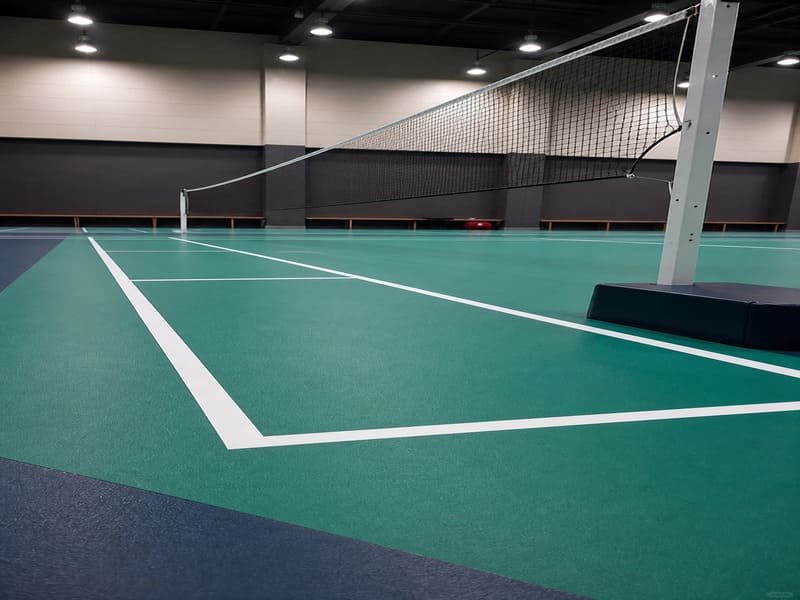
These three demands explain almost every design choice that goes into a proper volleyball floor. Once a manufacturer solves for impact, friction, and consistency at the same time, the floor starts to earn real trust from players and coaches. So let me break down how sports-grade PVC flooring is engineered to meet each one, and what standards actually govern that performance.
What Are the Key Benefits of PVC Flooring for Volleyball Courts?
Sports-grade PVC flooring is engineered in layers to absorb impact, provide controlled surface friction, resist wear, and hold its shape, with performance verified against standards like EN 14904 and, for homologated products, the FIVB’s own test protocol.
The performance of a PVC sports floor comes from its layered construction, not just its surface. Underneath the top layer sits a foam backing that compresses slightly on impact, spreading the landing force instead of sending it straight back into the athlete’s joints. Quality indoor sports flooring is commonly evaluated under EN 14904, which covers force reduction, vertical deformation, surface friction, ball rebound, rolling-load resistance, and wear resistance. Point-elastic floors are typically classified as P1, P2, or P3 based on their force-reduction performance, but these classes describe different performance profiles rather than a simple "higher is always better" ranking, since the right class depends on the intended use. For FIVB-homologated synthetic volleyball flooring specifically, the requirements are stricter than the general EN 14904 minimum, with the FIVB testing protocol calling for synthetic flooring to reach at least 45 percent force reduction. Many, though not all, sports-grade PVC systems also include a fiberglass or other reinforcement layer to help the floor resist shrinking or stretching as room conditions shift, though the exact construction varies by manufacturer and product line.
Layer-by-Layer Breakdown (Typical Construction)
| Слой | Функция |
|---|---|
| Wear layer (PVC + protective coating) | Resists scuffs and abrasion from shoes |
| Textured surface | Provides controlled friction for safe dives and stops |
| Foam backing | Absorbs shock; density and structure drive actual performance |
| Reinforcement layer (where present) | Helps limit dimensional change |
Once you see how these layers work together, it becomes clear why sports-grade PVC is an engineered system rather than a generic vinyl covering. But a good floor still needs to make financial sense next to the other options on the market, so let me put PVC side by side with hardwood and poured PU.
How Does PVC Compare to Hardwood and PU Flooring?
PVC generally costs less to buy and install than hardwood, has lower surface moisture sensitivity than untreated wood, and typically avoids the sanding and multi-stage finishing that hardwood requires, though PVC rolls may still need acclimation before installation.
Hardwood has a classic look and a long history in gyms, but it comes with real trade-offs that sports-grade PVC avoids. Solid maple flooring costs more upfront in both material and skilled labor, and it needs periodic sanding and refinishing to stay playable, which shuts the court down and adds ongoing cost. Wood also reacts badly to moisture: humidity or a spilled water bottle can cause warping, cupping, or buckling over time, and PVC’s surface resistance to this kind of damage is a clear advantage. Where PVC often has a real installation edge is that it avoids the sanding, finishing, and multi-stage construction associated with many hardwood systems, as well as the on-site curing process required by poured PU. That said, PVC rolls themselves typically still need acclimation or relaxation on site before installation, following the manufacturer’s instructions, so it is not correct to say PVC skips this step entirely. Its advantage is avoiding the heavier, slower processes that hardwood and poured PU each require in their own way.
Quick Comparison
| Фактор | ПВХ | Твердая древесина | Poured PU |
|---|---|---|---|
| Moisture sensitivity | Relatively low at the surface; substrate moisture still matters | Higher; wood can swell, cup, or warp | Depends strongly on system, primer, and substrate |
| Техническое обслуживание | Generally low | Higher (sanding, refinishing) | Generally low to moderate |
| Установка | Relatively fast, but acclimation may still be required | More complex; acclimation and finishing required | Requires on-site application and curing |
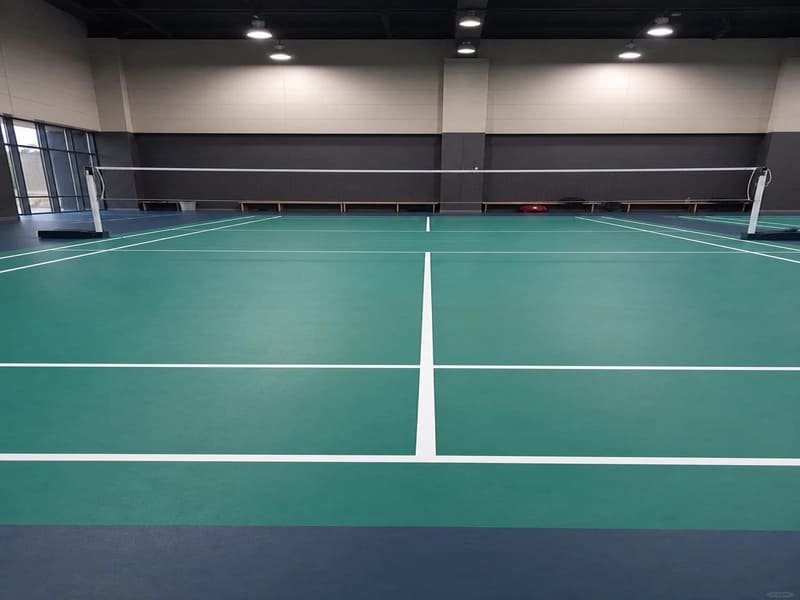
Cost and upkeep matter, but I also know most buyers hesitate over a few specific worries before they commit to PVC. Let me address the ones I hear most often.
What Are Buyers’ Most Common Concerns About PVC Volleyball Flooring?
Quality PVC flooring is tested for indentation and rolling-load resistance, typically lasts 10 to 15 years under normal use, and can be certified for low VOC emissions, though buyers should check what each certification actually covers.
Most hesitation around PVC flooring comes from a handful of specific, honest questions rather than a general doubt about the material. I want to walk through the three I hear most.
Will Heavy Equipment Dent the Floor?
Bleachers, net posts, and volleyball standards apply static point loads to the floor. EN 14904 includes a rolling-load requirement of at least 1,500 N with no visible damage, and quality PVC systems are tested for indentation recovery under static loads as well. That said, this rolling-load figure is a standard test benchmark, not a guarantee against every possible piece of equipment, so for very heavy fixed bleachers, retractable seating, or portable basketball structures, I always recommend checking the specific product’s documented indentation and rolling-load data, and using load-spreading pads under equipment feet.
How Long Does a PVC Volleyball Court Actually Last?
With proper wear-layer thickness and normal gym traffic, a well-maintained PVC court can realistically last in the range of 10 to 15 years or more, though this is a typical service-life expectation rather than a standard’s guaranteed figure. Actual life span depends on wear-layer thickness, daily traffic volume, and how consistently the court is cleaned and protected from grit and moisture.
Does PVC Flooring Smell or Release Harmful Chemicals?
Here it helps to separate two different things. FloorScore is a third-party indoor air quality certification, independently verified against the California Section 01350 VOC emission testing method, and it specifically confirms low VOC emissions from the finished product. REACH is a European Union chemical regulation framework that manufacturers must comply with, but it is a regulatory system rather than a standalone "safety certification" in the same sense as FloorScore. Together, they tell you a product has been checked for VOC output and complies with applicable chemical regulation, which is useful information for indoor air quality, but it is worth knowing what each one actually measures before citing it to a client.
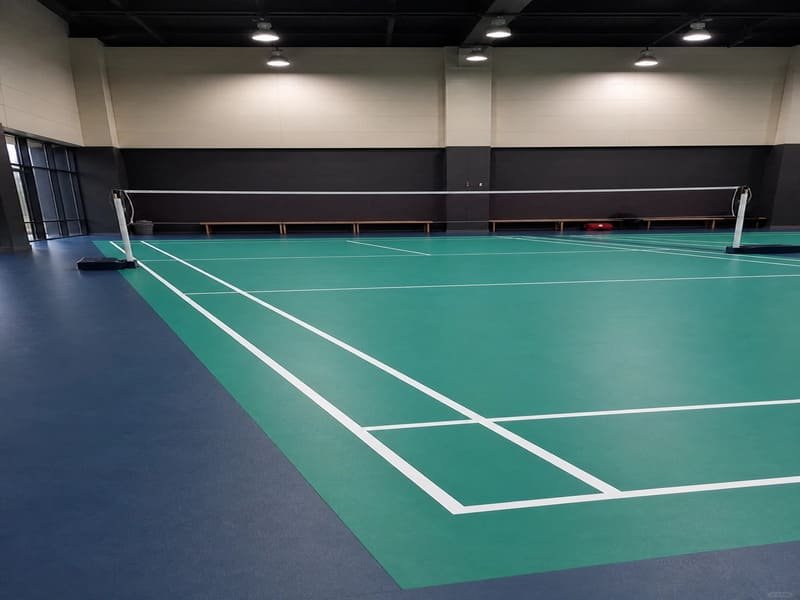
Once these concerns are cleared up, the next step is knowing what to actually check before choosing a product, and just as importantly, when PVC might not be the right fit at all.
How Do You Choose the Right PVC Flooring for Your Court?
Do not choose volleyball flooring by thickness or texture name alone. Prioritize documented EN 14904 performance data, confirm FIVB homologation status if your project requires it, and check the actual friction and force-reduction results rather than the embossing pattern.
Thickness is often the first spec buyers look at, but it is not a reliable stand-alone indicator of performance. Many cushioned PVC sports floors used for competitive volleyball fall around the 6mm to 8mm range, but total thickness does not by itself determine shock absorption. Foam density, closed-cell structure, layer construction, reinforcement, and the design of the complete flooring system all affect how much force reduction a floor actually delivers, so two products at the same thickness can perform quite differently. Surface texture works the same way: do not choose a volleyball floor by embossing pattern alone. Wood-grain, fine-textured, and other sports-specific finishes can all work well, as long as the complete product delivers documented friction and sliding performance within the required range. For competitive projects, I recommend prioritizing documented EN 14904 test data over a minimum thickness number or a texture name, and where the project specifically requires it, confirming that the exact product carries current FIVB homologation, since this is verified per product and can change over time. On certifications generally, it is worth being precise about what each one confirms: EN 14904 compliance speaks to sports-floor performance, FIVB homologation is a product-specific competition approval, and a CE mark reflects compliance with applicable EU product regulations, not a statement about suitability for professional volleyball on its own.
Specification Checklist
| Spec | What to Actually Check |
|---|---|
| Толщина | A data point, not the deciding factor — pair with performance data |
| Текстура поверхности | Sports-specific texture with documented friction/sliding performance |
| Performance data | Documented EN 14904 force reduction, friction, and deformation results |
| Competition approval | Confirm FIVB homologation for the specific product, if required |
When Is PVC Not the Right Choice?
PVC is not automatically the right answer for every project, and a few situations are worth flagging before you commit. General commercial PVC flooring is not the same product category as PVC sports flooring, so specifying "PVC" without confirming it is a genuine sports-grade system is a common and costly mistake. If your governing body or event contract requires a specific FIVB-homologated system, EN 14904 compliance alone will not satisfy that requirement, since homologation is checked product by product. If the venue will carry heavy fixed bleachers, retractable seating, or frequently moved basketball structures, ask for the specific rolling-load and indentation data for that product rather than assuming any EN 14904-compliant floor will handle it. And if the subfloor has known moisture issues, resolving that at the subfloor and adhesive level matters more than the surface material’s water resistance, since no top layer fully compensates for a wet slab underneath.
Getting these specifics right, rather than relying on thickness, texture names, or a single certification logo, is what actually separates a good court from a disappointing one.
Заключение
Sports-grade PVC flooring, when supported by appropriate performance data and matched to the project’s requirements, is a durable and practical option for indoor volleyball courts ranging from school gyms to competitive venues. For FIVB-level projects, confirm that the exact flooring system meets the required homologation criteria.
If you are weighing options for your own facility, feel free to send me a message. I am happy to share a free sample, send over a technical data sheet, or discuss which documented performance specs and, where relevant, FIVB-homologated products fit your project.