


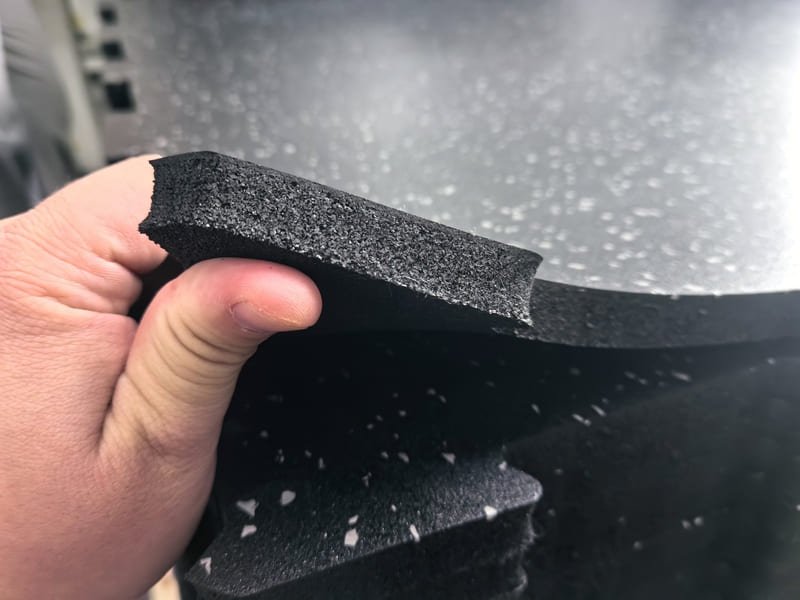
Rubber flooring maintains its functional elasticity for 15 to 25 years on average, though this period is not a static guarantee. Elasticity retention depends on the cross-link density achieved during manufacturing and the "fatigue limit" of the polymers. In professional settings, a floor is considered to have lost its elasticity once its Force Reduction (ASTM F2772) drops below 10% of its original install value.
As an installation director, I have learned that "longevity" is a moving target. Many people believe rubber is "forever," but that is a dangerous myth. In my twenty years on-site, I have seen floors in low-traffic offices stay soft for 30 years, while the same product in a high-intensity "CrossFit" zone loses its rebound in seven. We must view rubber as a mechanical spring; every time a weight hits it, the polymer chains stretch and eventually suffer from "molecular fatigue." To give you an answer you can actually use for a project budget, we have to look at the Shore A hardness migration and the specific binder chemistry. If the hardness increases by more than 1 point per year, your floor is aging prematurely. This guide breaks down the verifiable metrics that separate a 20-year investment from a 5-year failure.
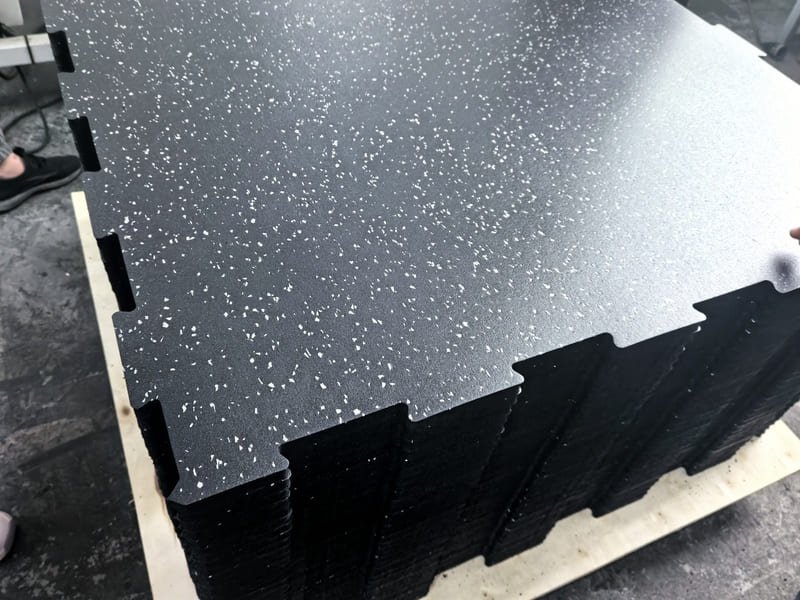
To understand how long your floor will stay "bouncy," we have to stop looking at the thickness and start looking at the chemical bonds. The "bounce" is not magic; it is engineering.
What is the verifiable science behind rubber "rebound"?
The elasticity of rubber flooring is governed by the ratio of "virgin" polymer to "recycled" crumb and the specific type of polyurethane binder. Under ASTM D412, a high-quality gym floor should exhibit a tensile strength of at least 200 psi and a minimum elongation of 150%. If these numbers are lower at the point of purchase, the "elastic memory" will fade significantly faster.
In my practice, I evaluate elasticity using the "Compression Set" (ASTM D395). This test measures how much the rubber stays "dented" after a heavy load is removed. For a floor to maintain its elasticity for 15+ years, the compression set must be under 15%. Many cheap recycled mats use "large-grain" crumb rubber which has less surface area for the binder to grab. This results in a floor that feels soft at first but "bottoms out" within three years because the internal structure collapses.
| Техническая метрика | Профессиональный стандарт | Impact on Elastic Life |
|---|---|---|
| Прочность на разрыв | > 200 psi (1.4 MPa) | Prevents micro-tearing during heavy impacts. |
| Удлинение при разрыве | 150% – 250% | Allows the floor to stretch without losing shape. |
| Твердость по Шору А | 60 – 65 (Initial) | The baseline for comfort; track this over time. |
I once saw a facility where the "elasticity" failed because they chose a floor with 900 kg/m³ density for a heavy lifting area. The rubber was too porous, and the air gaps allowed the polymer chains to over-stretch and snap. For high-impact, you need higher density (1,000+ kg/m³) to support the polymer’s limit.
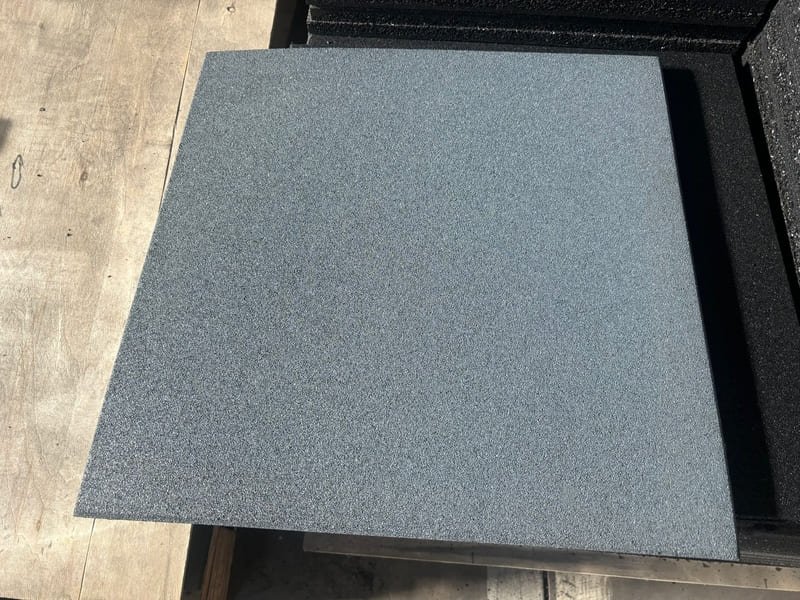
Material science is only half the battle. The environment where you glue that floor down will either preserve the rubber or "cook" it.
Which environmental factors act as the "clocks" for rubber aging?
The "clock" for rubber elasticity is driven by oxidation and "binder crystallization." In indoor, climate-controlled environments, the chemical aging is slow. However, in spaces with high UV exposure or non-neutral pH cleaning, the polyurethane binder can crystallize and turn brittle, ending the floor’s elastic life in under 10 years.
From an engineering standpoint, the "binder" is the weak link. Most rubber floors use MDI-based polyurethane. If the installation site has high humidity (above 60%) or the subfloor has a high moisture vapor rate, the binder can undergo "hydrolysis." This breaks the glue that holds the elastic crumbs together. I always insist on a calcium chloride test for the concrete subfloor. If the moisture is too high, the floor will feel "hard" not because the rubber died, but because the binder turned into a rigid, brittle crystal.
| Фактор | Technical Threshold | Result of Failure |
|---|---|---|
| UV Index | > 5 (Direct Sunlight) | Photo-oxidation; surface becomes chalky/hard. |
| Subfloor MVER | > 5 lbs / 1,000 sq.ft | Hydrolysis; binder fails and rubber crumbles. |
| Cleaning pH | Must be 7.0 – 8.5 | Acid/Base cleaners strip the plasticizers from rubber. |
I remember a project in a sun-drenched atrium where the rubber floor turned brittle in just four years. They didn’t use UV-stabilized EPDM. The sun literally "baked" the flex out of the material. For any area with windows, UV stability is not an "extra"—it is a requirement for elasticity.
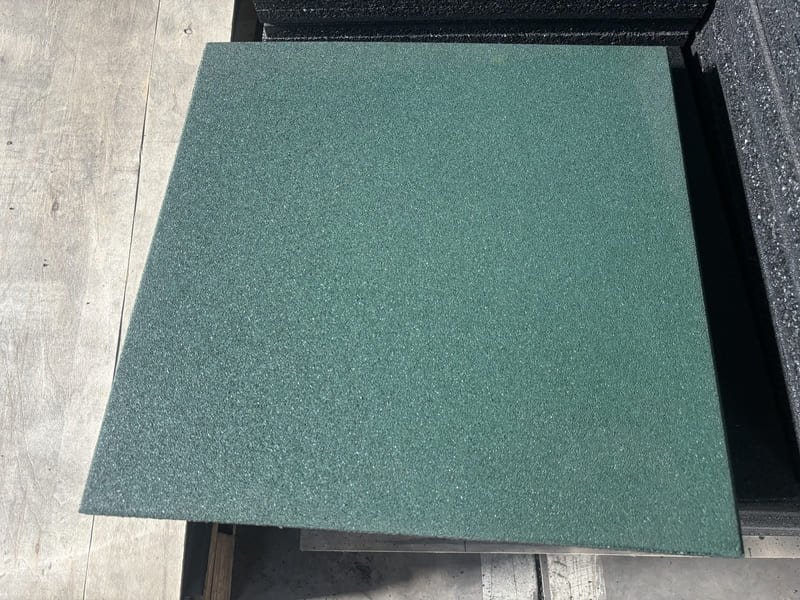
You can have the best environment, but if you use the wrong chemicals, you are essentially dissolving your investment every time you mop.
The most common hidden killers are petroleum-based cleaners and "static fatigue" from heavy point-loading. Petroleum distillates act as a plasticizer solvent; they migrate into the rubber and cause it to swell and lose its structural "memory." Once rubber is "swollen," its elastic return is permanently compromised.
I often have to tell gym owners to throw away their "supermarket" cleaners. If a cleaner has "Lemon" or "Pine" oil, it likely contains terpenes that soften the rubber bonds. Another issue is "Static Load Fatigue." If you place a 400kg rack on 8mm rubber without a load-spreader, the polymers under those feet are in a state of "constant stress." Over time, they undergo "creep"—a slow, permanent deformation. When you finally move that rack, the rubber won’t bounce back. It is "dead" in that spot.
| Killer | Идентификация | Профилактика |
|---|---|---|
| Petroleum/Oils | Floor feels "tacky" or sticky. | Use only specialized rubber floor degreasers. |
| Static Creep | Permanent 2mm+ indentations. | Use 12mm+ thickness or steel load plates. |
| Abrasive Grit | Micro-scratches on the surface. | Daily vacuuming to prevent "sandpaper" wear. |
I have seen high-end training centers lose their floor’s "feel" simply because the cleaning crew used a wax-based polish. The wax filled the microscopic pores of the rubber, creating a rigid top layer that prevented the rubber underneath from flexing.
The "lifespan" also depends on what you are doing on top of the floor. A "yoga" bounce is not the same as a "deadlift" bounce.
How do different applications redefine the "End of Life" for elasticity?
The "End of Life" for elasticity is subjective based on the application. In a physical therapy clinic, the floor is "dead" when its force reduction drops by 15%. In a garage or warehouse, the floor is only "dead" when it starts to crack or "shed" granules.
For professional sports floors, we use the "Vertical Deformation" test (ASTM F2772). A floor that moves more than 3.5mm under a standard load is too soft (unstable), and one that moves less than 0.5mm is too hard (loss of elasticity). As an installer, I track these numbers. For a commercial gym, you can expect the "sweet spot" of elasticity to last about 12 years. After that, the mechanical fatigue from millions of footfalls will have compressed the rubber air-cells beyond the point of optimal recovery.
| Приложение | Primary Stressor | Expected "Elastic" Life |
|---|---|---|
| Коммерческий тренажерный зал | Impact Fatigue | 10 – 15 Years |
| Ice Rink Borders | Lateral Shear (Skates) | 5 - 8 лет |
| Home Basement | Chemical Aging | 20 – 30 Years |
I recently consulted for an ice rink. Their rubber was only five years old but had lost all elasticity because the skate blades had "micro-sliced" the polymer chains. This is "mechanical degradation." In this case, the elasticity didn’t "fade"—it was physically cut away.
You don’t need a lab to tell if your floor is dying. Your joints and your ears will tell you first.
How can you accurately verify if your floor has "gone hard"?
To verify loss of elasticity, perform a "Durometer Migration" test. Measure the Shore A hardness in a low-traffic corner and compare it to a high-traffic area. A difference of more than 10 points indicates significant mechanical fatigue or chemical hardening.
Another practical test I use is the "Acoustic Impact Test." New, elastic rubber "thuds" at a low frequency. Old, hardened rubber "clacks" at a higher frequency. If you drop a 5kg plate and it sounds like it’s hitting wood, your elasticity is gone. At this stage, the floor is no longer protecting the concrete subfloor, and you will likely start seeing cracks in the slab beneath the rubber.
| Detection Method | What it reveals | Urgency |
|---|---|---|
| The Thumb Test | Can you leave a temporary mark? | Low – Early check. |
| Visual "Chalking" | White powder on the surface. | Medium – Needs sealing/UV care. |
| Shedding/Granulation | Black dust in the corners. | High – Floor is disintegrating. |
I always tell my team: if the floor is "shedding," the binder has failed. You cannot "fix" a floor that is granulating. At that point, the elasticity is zero, and the floor is just a pile of loose rubber held together by gravity.
When it’s time to say goodbye to the floor, you need to know the reality of where it’s going. Not all rubber is created equal when it comes to the "green" promise.
What is the reality of rubber flooring sustainability?
While rubber flooring is technically recyclable, its "100% circularity" is a myth. Success depends on the binder type. Sulfur-vulcanized rubber is difficult to re-process, while polyurethane-bound crumb rubber can be mechanically ground and used in lower-tier applications like road base or "pour-in-place" playground safety surfacing.
If your floor is glued down with a permanent epoxy adhesive, it is almost impossible to recycle because the glue contaminates the rubber. The most "sustainable" floor is one that doesn’t need to be replaced. By choosing a high-density, high-binder product, you reduce the carbon footprint by extending the replacement cycle from 10 years to 25 years. This "Longevity First" approach is the only true way to be green in the flooring industry.
Заключение
Rubber maintains its bounce for 15-30 years, but only if you monitor its hardness and avoid oil-based cleaners.
My Insight
Don’t trust a "Life-Time Warranty" on elasticity. Most warranties only cover "manufacturer defects," not the natural loss of rebound due to use. To protect your investment, ask your supplier for a "Compression Set" report и "Force Reduction" certificate. If they can’t provide these, the floor is likely a low-binder product that will harden in under a decade.