


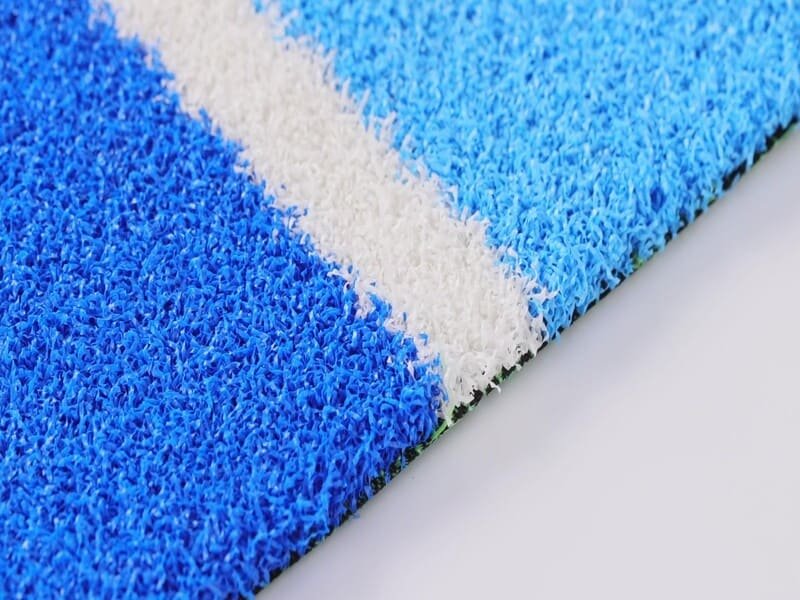
Latex and Polyurethane (PU) backings differ primarily in moisture resistance and lifespan, with PU offering 50% more durability in high-traffic or wet environments.
The green blades of synthetic turf catch your eye, but the backing is what keeps them there for a decade or more. As a technical director, I often see clients focus on pile height while ignoring the foundation. The backing is the "insurance policy" for your investment. It provides the structural integrity needed to withstand thousands of footfalls. SBR Latex has been the industry standard for years due to its cost-effectiveness and heavy feel. However, Polyurethane has emerged as the premium alternative for those who need a product that won’t degrade when the weather turns. The core question isn’t just about the price tag; it is about whether the material can maintain its chemical bond under stress. In my experience, choosing the wrong backing for a specific climate is the most common cause of premature turf failure.
Understanding how these materials react to heat, water, and tension is the first step toward a successful facility design. Let us look at the mechanics that actually keep your turf from falling apart.
1. Why Is the Backing the "Invisible" Foundation of Turf?
The backing determines the lifespan of the turf by locking fibers in place and protecting the primary fabric from environmental rot and mechanical friction.
When we talk about durability, we are really talking about three specific technical functions that the backing must perform perfectly. First is Tuft Bind Strength. This is the force required to pull a single blade out of the turf. Without a strong secondary coating like Latex or PU, the blades would simply slide out during a heavy gym session. Second is Dimensional Stability. Turf is a fabric, and like any fabric, it wants to expand when it gets hot and shrink when it gets cold. A high-quality backing keeps the roll flat and prevents dangerous "ripples" or "bubbles" from forming on your gym floor. Finally, the backing acts as a shield. It protects the delicate primary backing from moisture in the sub-base and the constant friction of athletes moving above.
| Backing Function | Technical Impact | Long-term Result |
|---|---|---|
| Tuft Bind | Secure fiber encapsulation | Prevents "balding" of the turf |
| Stabilitas Dimensi | Thermal expansion control | Prevents tripping hazards/wrinkles |
| Protective Seal | Moisture and UV barrier | Prevents rot and delamination |
I once consulted on a high-end outdoor facility that saved 15% by choosing a basic Latex backing. Two years later, the edges were curling because the material could not handle the expansion cycles of the local climate. This is why I tell my partners that the backing is not just a coating; it is a structural component. It must be engineered to match the intensity of the application. If you are designing for a high-traffic zone, the backing is where you should spend your budget, not just the yarn.
Now that we know what the backing does, we can look at the specific characteristics of the two most common materials used in manufacturing today.
2. Is SBR Latex Backing Still a Reliable Choice for Modern Gyms?
SBR Latex remains a reliable, cost-effective choice for indoor gyms and dry climates where high moisture resistance is not the primary requirement.
SBR (Styrene-Butadiene Rubber) Latex is the traditional workhorse of the turf industry. It is a liquid coating that is applied to the back of the turf and then cured in a large oven to create a hard, heavy finish. The primary advantage is its initial stiffness. It gives the turf a heavy, premium feel right out of the box, which many installers love because it stays in place during the seam-gluing process. In dry, indoor environments, the tuft bind of Latex is excellent. It creates a very strong mechanical bond with the yarn. However, it has an "Achilles Heel": moisture sensitivity. Over long periods, if the turf is constantly wet or exposed to high humidity, the Latex can begin to soften or "crumb."
| Metrik | Performance Data | Analysis |
|---|---|---|
| Kekuatan Adhesi | >30N (Dry) | Excellent for standard foot traffic |
| Weight per SqM | 800g – 1100g | Provides good "heft" and stability |
| Fleksibilitas | Rendah hingga Sedang | Can become brittle in sub-zero temps |
In my manufacturing experience, Latex is perfect for the "weekend warrior" gym or a residential landscape where the budget is tight. It performs remarkably well as long as you keep it dry. The problem starts when people use it in areas with poor drainage or high pet usage. Because Latex is slightly porous, it can absorb liquids. Over time, this leads to delamination—the process where the secondary backing separates from the primary cloth. If you see white flakes under your turf, that is the Latex breaking down. It is a great material, but it has very clear limits that you must respect during the design phase.
For projects that demand a "no-fail" solution regardless of the environment, we usually look toward more advanced polymer coatings like Polyurethane.
3. Why Is Polyurethane (PU) Considered the High-Performance Standard?
PU backing is the high-performance standard because it is completely waterproof, remains flexible in all temperatures, and offers superior resistance to chemical breakdown.
Polyurethane (PU) is a non-porous, plastic-like coating that wraps around each fiber much more tightly than Latex. Think of it as a protective shell rather than just a glue. Because it is chemically inert to moisture, it will not swell, soften, or rot even if it is submerged in water for years. This makes it the go-to choice for any outdoor installation or high-intensity commercial gym. Another massive advantage is its weather resistance. While Latex can become brittle and crack in extreme cold or lose its grip in extreme heat, PU remains flexible. It moves with the turf, which significantly reduces the risk of the fibers pulling out during heavy use.
| Performance Driver | PU Advantage | Wawasan Manufaktur |
|---|---|---|
| Chemical Stability | Resists uric acid/salt | Critical for pet areas and coastal sites |
| Weight/Flexibility | 20% Lighter than Latex | Easier to install and less likely to crease |
| Thermal Range | -40°C hingga +80°C | Maintains tuft bind in all climates |
The "Pet Factor" is another reason I recommend PU to my clients. Pet urine contains uric acid, which can slowly break down the chemical bonds in SBR Latex and trap odors in the porous surface. PU is non-absorbent, so the urine flushes straight through the drainage holes without being absorbed into the backing itself. This leads to a much cleaner, more hygienic surface over time. From an engineering perspective, PU is simply a more robust polymer. It costs more because the raw materials and the specialized "hot melt" application process are more expensive, but the return on investment comes from the extra 5 to 8 years of service life you get from the product.
Comparing these two materials directly helps clarify which one fits your specific project needs and budget constraints.
4. Latex vs. PU: Which One Should You Choose Based on Durability?
Choose PU for long-term durability (15+ years), pets, or wet climates; choose Latex for budget-friendly indoor projects where the lifespan is 8-10 years.
To help you decide, we need to look at the hard data. In our testing labs, we put both backings through "accelerated aging" tests, simulating years of rain, sun, and foot traffic. The results are always consistent. Latex performs beautifully for the first few years but starts to show a decline in tuft bind strength once it has been through multiple wet-dry cycles. PU, on the other hand, maintains almost 100% of its original strength throughout the entire test period. This is why PU is almost always specified for FIFA-certified sports fields or high-end commercial projects where the cost of replacement is much higher than the initial cost of the material.
| Fitur | SBR Latex Backing | Polyurethane (PU) Backing |
|---|---|---|
| Lifespan Expectancy | 8–12 Years | 12–20 Years |
| Tahan terhadap kelembapan | Moderate (can soften) | Excellent (Waterproof) |
| Tuft Bind | High (Dry) / Lower (Wet) | Consistently High |
| Extreme Heat/Cold | May become brittle | Remains flexible |
| Pet Urine Resistance | Lower (Absorbs acid) | High (Non-absorbent) |
I often hear the myth that Latex "peels" off like a sticker. In reality, it doesn’t peel unless it was manufactured poorly, but it does lose its structural integrity over time. If you are building a backyard for a family with three large dogs, Latex is a poor choice because it will eventually smell and break down. However, if you are setting up a temporary indoor functional training zone in a rented warehouse, Latex is the smarter financial move. You aren’t paying for "over-engineered" moisture resistance that you don’t actually need. The key is to match the backing to the "worst-case scenario" of your specific site.
Many people have lingering questions about the feel and environmental impact of these materials, so let us address the most common concerns.
5. Frequently Asked Questions About Turf Backing
The backing choice affects everything from drainage speed to installation ease, but it does not significantly change the softness of the grass blades themselves.
Can you tell the difference by looking at the back of the turf?
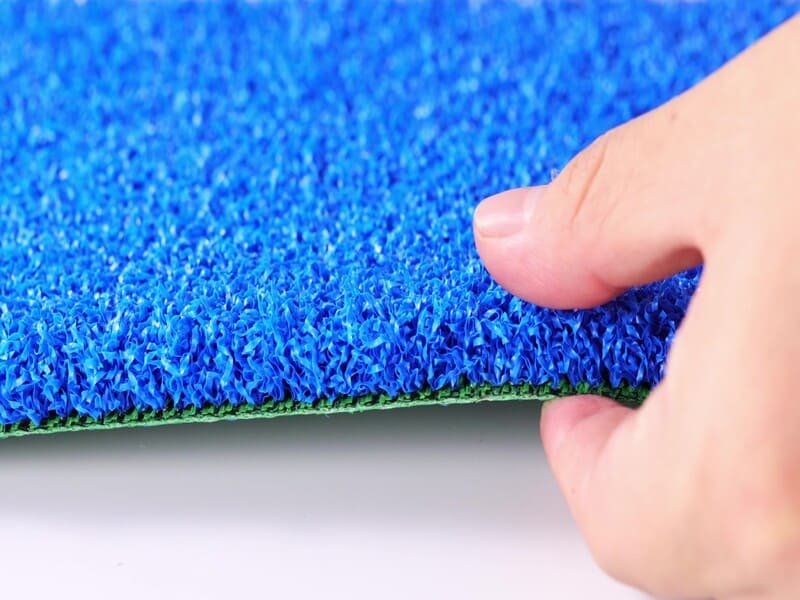
Yes, usually. SBR Latex is almost always black and has a matte, slightly rough, rubbery texture. You might even see a bit of "dust" if you rub it hard. Polyurethane (PU) is usually green, gray, or black, but it has a smoother, shiny, plastic-like appearance. It feels more like a solid coating and less like a painted-on layer.
Does PU backing make the grass feel stiffer?
Actually, the opposite is often true. Because PU is more flexible and can be applied in a thinner, stronger layer, the turf roll is often easier to bend and move. Latex can feel very stiff and heavy, especially in cold weather, which can make it harder to get the turf to lay perfectly flat during a winter installation.
Is one backing more eco-friendly than the other?
This is a complex question. Both are petroleum-based products. However, PU is often considered more "sustainable" in the long run because it lasts significantly longer, meaning the turf doesn’t end up in a landfill as quickly. Some newer PU backings are also easier to recycle because they can be melted down more cleanly than the composite mix found in SBR Latex.
Kesimpulan
Backing is the structural foundation that dictates your turf’s lifespan.
If you need expert advice on selecting the right turf backing for your specific project or want a quote for high-performance PU turf, send me a private message today.