



The roll width that divides most closely into your total installation width produces the least material waste. A wider roll, like 1.8m or 2.0m, usually reduces seam count, but it does not automatically waste less material than a narrower 1.5m roll.
I have seen buyers assume that a wider roll always saves money. That assumption is wrong more often than people expect. Waste depends on one simple relationship: how many times the roll width fits into the width you need to cover, and how much is left over after that. A 1.5m roll can sometimes leave zero side-trim, while a 2.0m roll leaves over a meter of unused material on the same surface. In this article, I walk through the real math, using actual court dimensions, so you can see which width fits your project instead of guessing based on a general rule.
Getting this right changes your material cost, your seam count, and your labor hours. Let me start with why "wider is better" is only half true.
What Really Determines PVC Flooring Waste?
Waste is controlled by the remainder left over when you divide the total installation width by the roll width, not by the roll width alone.
If a roll width divides evenly into your installation width, you get zero side-trim waste, no matter how narrow or wide the roll is. If it does not divide evenly, you are left with a leftover strip on every run, and that leftover strip is where waste comes from. Wider rolls tend to reduce how many strips and seams you need, which cuts labor. But fewer strips does not always mean less material waste. These are two separate outcomes:
| Hasil | What Drives It |
|---|---|
| Material (trim) waste | How closely roll width divides into installation width |
| Seam count | How many strips are needed to cover the width |
A width that wins on one measure can lose on the other. I will show you exactly this pattern in the basketball and volleyball examples below.
Once you separate these two outcomes, the roll width decision becomes a real calculation instead of a rule of thumb. Here is what widths are actually available before we run the numbers.
What Are the Standard PVC Sports Flooring Roll Widths?
Common sports flooring roll widths are approximately 1.5m, 1.8m, and 2.0m, though exact widths vary by manufacturer, product structure, and market.
I would be careful about treating these as fixed industry standards. Different manufacturers run different extrusion and calendering equipment, so available widths differ from one supplier to the next. Some sports PVC lines only offer 1.5m or 1.8m, others produce 2.0m as their commercial standard, and some offer specific court-width or custom-cut options on request.
| Width Range | General Fit |
|---|---|
| ~1.5m | Easier manual handling, common for smaller sites |
| ~1.8m | Balance of coverage and manageable weight |
| ~2.0m | Fewer strips across large open areas, heavier to handle |
Before you order based on any published width, confirm what your specific supplier actually produces. A width that looks ideal on paper is useless if it is not part of that manufacturer’s real production range.
With the available widths clear, the next step is the calculation method you need to test any width against your own installation area.
How Do You Calculate Roll Width Waste?
Waste rate equals the leftover purchased area beyond the installation width, divided by the total purchased area, expressed as a percentage.
Here is the full calculation, step by step:
- Number of strips needed = round up (installation width ÷ roll width)
- Purchased width = number of strips × roll width
- Purchased area = purchased width × cut length
- Waste area = (purchased width − installation width) × cut length
- Waste rate = waste area ÷ purchased area × 100
This is the formula I use on every project before ordering, because it tells me the real number instead of a general assumption. Note that "installation width" should reflect the full area you are covering, not just the marked playing lines. I cover that distinction next, because it changes the outcome significantly.
Let me apply this formula to a real basketball court, and show you why the playing lines alone do not tell the full story.
Basketball Court: Playing Lines vs. Full Installation Area
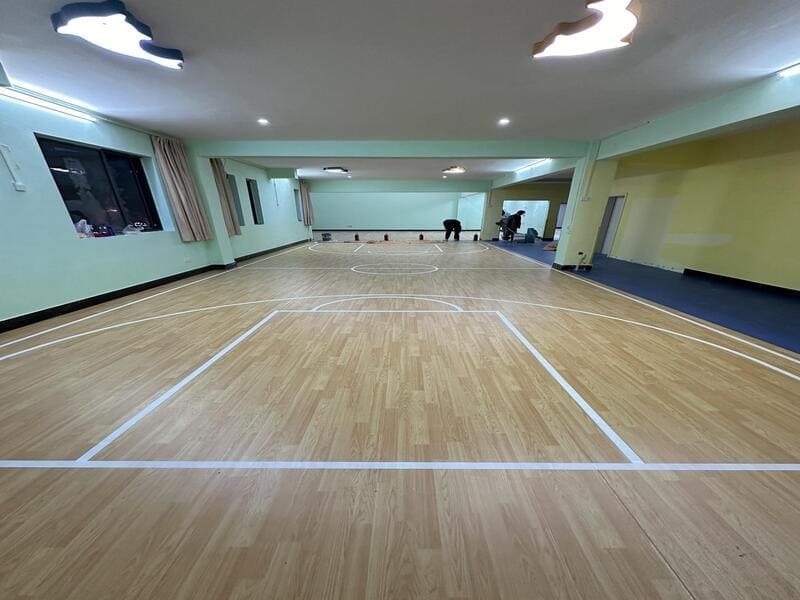
On a 15m × 28m playing area, 1.5m rolls produce zero side-trim waste, while wider rolls reduce seams but leave more material unused.
Using the formula above on the 15m playing width:
| Lebar Gulungan | Strips | Cakupan | Waste Rate | Internal Seams |
|---|---|---|---|---|
| 1.5m | 10 | 15.0m | 0% | 9 |
| 1.8m | 9 | 16.2m | 7.41% | 8 |
| 2.0m | 8 | 16.0m | 6.25% | 7 |
The 1.5m roll wins on raw material waste here. The wider rolls only win on seam count.
But a real installation is rarely just the marked court. FIBA guidance calls for a minimum surround zone around the playing area, which brings the full flooring dimensions closer to 32m × 19m. Recalculating on the 19m total width:
| Lebar Gulungan | Strips | Cakupan | Extra Width | Waste Rate |
|---|---|---|---|---|
| 1.5m | 13 | 19.5m | 0.5m | 2.56% |
| 1.8m | 11 | 19.8m | 0.8m | 4.04% |
| 2.0m | 10 | 20.0m | 1.0m | 5.00% |
The 1.5m roll still produces the least material waste, even at full installation size, though it now needs the most seams. This is the calculation I recommend running before ordering: always use the total flooring area, including surround and safety zones, never the playing lines alone.
Court width is only one variable. The direction you lay the roll can change these numbers too.
Does Roll Direction Change the Waste Outcome?
Running rolls along the court’s length instead of its width, or the reverse, can shift which roll width produces the least waste.
If you rotate the layout 90 degrees, the dimension the roll width has to divide into changes completely. A width that leaves a large remainder against the 19m dimension might divide almost evenly into the 32m dimension, or the opposite. I always run both orientations through the waste formula above before committing to a layout, because the better direction is not always the intuitive one. This is a zero-cost adjustment. It only takes a few minutes with a layout plan, and it can lower the waste rate without changing the roll width or the supplier order at all.
Basketball courts are large, rectangular, and fairly forgiving. Smaller courts like badminton show a different pattern.
Badminton Court Roll Width Comparison
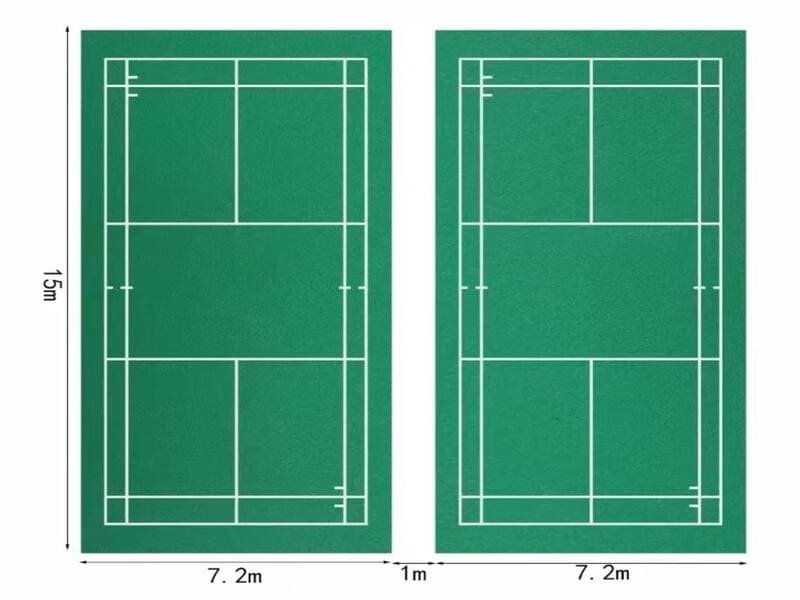
On a 13.4m × 6.1m badminton court, 1.8m rolls produce less waste than 1.5m or 2.0m rolls, but the difference is not close to zero.
Running the formula on the 6.1m playing width:
| Lebar Gulungan | Strips | Cakupan | Extra Width | Waste Rate |
|---|---|---|---|---|
| 1.5m | 5 | 7.5m | 1.4m | 18.66% |
| 1.8m | 4 | 7.2m | 1.1m | 15.28% |
| 2.0m | 4 | 8.0m | 1.9m | 23.75% |
1.8m is the best of these three options, but a 15.28% waste rate is still meaningful, not negligible. This also does not include the surrounding safety zone, adjacent court spacing, umpire area, or any pre-printed line work most badminton installations require. Multi-court layouts change these numbers further, since shared runs between courts can absorb some of this leftover material. I recommend running a full layout plan for badminton installations rather than relying on the single-court width alone.
Volleyball courts show a case where two different widths tie on material waste, which makes the comparison worth a closer look.
Volleyball Court Roll Width Comparison
On a standard 18m × 9m volleyball court, both 1.5m and 1.8m rolls cover the width with zero side-trim waste, but 1.8m needs fewer seams.
Running the formula on the 9m playing width:
| Lebar Gulungan | Strips | Cakupan | Waste Rate | Internal Seams |
|---|---|---|---|---|
| 1.5m | 6 | 9.0m | 0% | 5 |
| 1.8m | 5 | 9.0m | 0% | 4 |
| 2.0m | 5 | 10.0m | 10.0% | 4 |
This is the clearest case for choosing based on seams rather than material. Since 1.5m and 1.8m tie at zero waste, the 1.8m roll is the better choice here, purely because it needs one fewer seam for the same material outcome. The 2.0m roll loses on both counts. This example is worth remembering: when two widths tie on waste, the one with fewer seams wins on total installation cost, without any material trade-off at all. Standard volleyball installations also require a surrounding free zone, so this same calculation should be repeated using your project’s full flooring dimensions before ordering.
Material and seam count are only part of the cost picture. A few other factors decide the real total.
What Other Factors Affect Total Installation Cost?
Seam welding labor, roll handling risk, and off-cut reuse all affect total cost, sometimes more than the waste rate itself.
A few things I always weigh alongside the waste percentage:
- Seam Welding Labor: Sports PVC flooring seams are normally butt-jointed and heat-welded, not permanently overlapped. Fewer seams generally means less welding time, but the labor difference should be priced against the actual material savings, not assumed.
- Handling Risk: Wider, heavier rolls carry more risk of damage or miscuts if the crew is not equipped for them. This risk cost is real, even when it does not show up in a waste formula.
- Off-Cut Reuse: Leftover strips are not automatically waste. I have used them for safety-zone padding, wall margins, or smaller adjacent rooms, which reduces the effective loss.
Roll width gets most of the attention, but roll length is just as important, and often overlooked.
How Does Roll Length Affect Waste?
Standard versus custom roll lengths change how much material is trimmed at the start and end of every run, independent of roll width.
Roll width controls side-trim. Roll length controls end-trim, which includes cut allowances, damaged ends, pattern alignment, and any pre-marked line work that needs to align across strips. If your court length does not divide evenly into standard roll lengths, you get waste at the ends of runs even when the width calculation is perfect. Ordering factory-cut custom lengths, matched to your exact court plus surround dimensions, removes this category of waste entirely. I treat roll length as a primary variable in every waste calculation, not a secondary detail to handle later.
With both width and length accounted for, here is how I approach minimizing waste on any project.
Best Practices to Minimize Waste During Procurement and Installation
Running the full calculation before ordering, testing both orientations, and confirming custom lengths with your supplier are the most reliable ways to cut waste.
- Calculate Before Ordering: Apply the waste formula to your full installation area, not just the playing lines, for every width option you are considering.
- Test Both Orientations: Run the same calculation with the roll direction rotated 90 degrees, since the better layout is not always the obvious one.
- Confirm Custom Lengths: Ask your supplier whether factory-cut lengths matched to your exact dimensions are available, since this removes end-trim waste separately from width waste.
- Plan for Off-Cuts: Design safety zones or adjacent spaces to absorb leftover strips instead of treating them as disposal.
The right width depends on your project’s real numbers, not a fixed recommendation. Here is a summary to guide that check.
Kesimpulan
| Jenis Pengadilan | Widths to Check | Confirm Before Ordering |
|---|---|---|
| Badminton | 1.5m, 1.8m | Safety zones, multi-court layout, pre-printed lines |
| Bola Basket | 1.5m, 1.8m, 2.0m | Full installation area, not just playing lines |
| Bola Voli | 1.5m, 1.8m | Both can tie on waste, 1.8m wins on seams |
| Multi-Purpose Hall | 1.8m, 2.0m | Room shape, color zoning, handling access |
Calculate waste and seams for your exact dimensions before choosing a roll width.
If you want help running these calculations for your own court dimensions, message me directly and I will work through the numbers with you.