


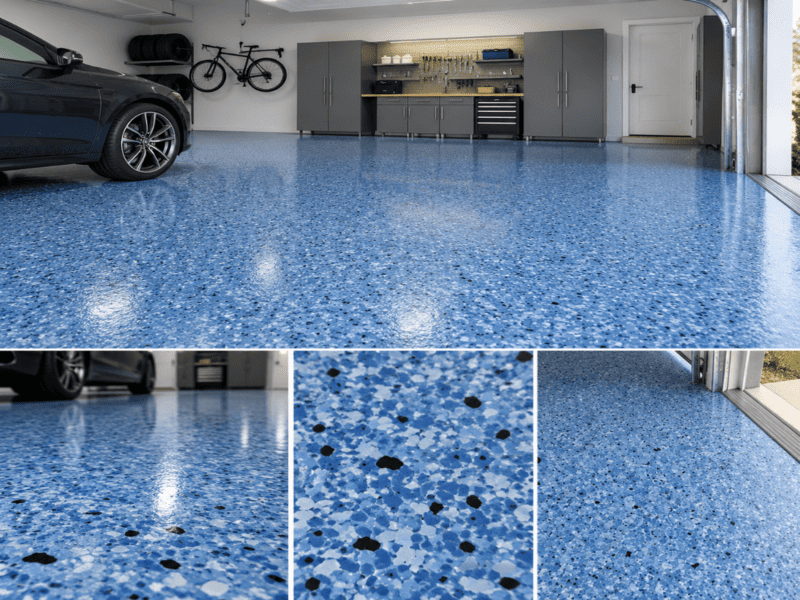
Yes, in many cases. Interlocking PVC garage tiles can guide people and vehicles with contrasting colors for walkways, parking spots, and work zones. Fit depends on wear resistance, slip resistance, chemical contact, and expected loads.
Floor wayfinding means using color, pattern, and symbols on the floor to show people where to walk, where to park, and where to work. Tiles suit this job because each tile has a fixed size and color. Lines stay straight and zones stay sharp. You also get a floor you can change later. You pull out a few tiles and snap in new colors, and you do not need to wait for paint or coatings to cure. But I want to be clear about the limits. A colored floor is a visual aid. It does not replace required signs, barriers, or traffic controls. Tile quality also matters. Wear resistance, slip resistance, and chemical resistance change from one product to another. A tile that works well in a home garage may not suit a busy forklift route. In this article, I explain where PVC tiles work well, where they do not, and how to plan a layout that holds up.
The method is simple, but the details decide the result. Let me start with how tiles create guidance on the floor.
How Do PVC Tiles Create Visual Guidance?
They use color, pattern, and shape. Contrasting tiles form borders, lanes, and zones. Arrow or icon tiles can add direction. Texture can help tell areas apart, but it is a visual aid, not a certified touch guide.
Three Common Guidance Tools
| Alat | Bagaimana cara kerjanya | Contoh |
|---|---|---|
| Color coding | Each color has one clear meaning | Blue walkway, yellow parking border, gray work area |
| Surface pattern | Different looks separate zones | Coin-top for work areas, diamond plate for walkways |
| Arrow and icon tiles | Symbols show direction or use | Exit arrow, parking marker |
Color does most of the work. Pick one color for one meaning and keep it the same across the whole site. A simple color legend near the entrance helps new users read the floor. Surface patterns can help people tell zones apart by sight, and they may change underfoot grip. But standard garage tile textures are not certified tactile guidance or accessibility warning surfaces. Arrows and icons work best when you pair them with wall signs.
The gains are practical. Clear lanes separate foot traffic from vehicles. Parking guides help drivers stop in the same place each time. In customer-facing shops, a tidy floor also looks professional. Some flexible PVC tiles may feel more comfortable than bare concrete for people who stand all day. That depends on tile construction, hardness, and thickness, so I do not assume it for every product.
Guidance tools work differently in each type of space, so the next section looks at fit by space.
Where Do Color-Coded PVC Garage Tiles Work Best?
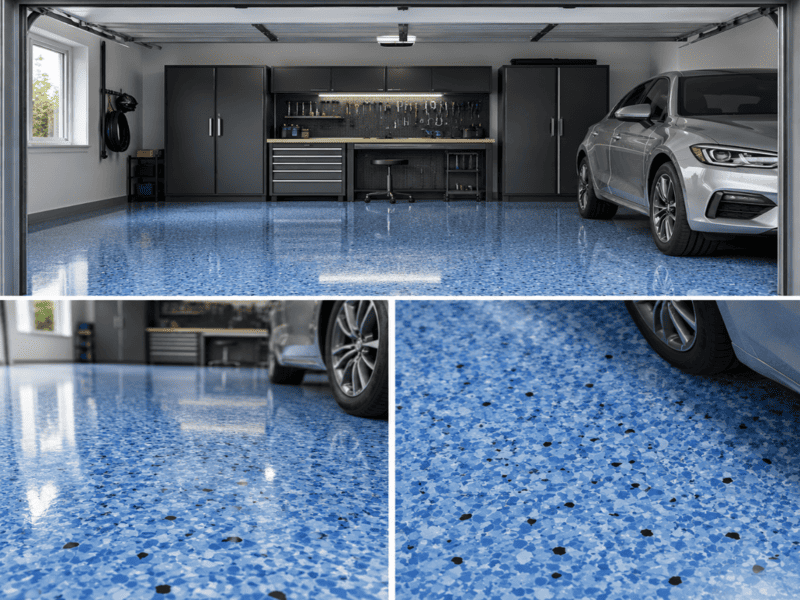
They work best in home garages, home gyms, auto detailing shops, and light-duty workshops. Warehouses can use them for walking routes and zones. Forklift lanes need tile systems proven for those wheel loads.
Fit by Space Type
| Ruang | Penggunaan Khas | Fit Level |
|---|---|---|
| Home garage | Parking spot, tool zone, walkway | Kesesuaian yang kuat |
| Home gym in garage | Fitness area next to parking | Kesesuaian yang kuat |
| Auto detailing shop | Wash bay, polish area, customer walkway | Good fit, check chemical contact |
| Light workshop | Work zones, pedestrian path | Good fit |
| Warehouse or factory | Pedestrian paths, machine clearance | Conditional fit |
| Forklift lanes | Vehicle traffic route | Only with approved, tested tile systems |
In a detailing shop, customers often walk through the building. A clear walkway keeps them away from wet areas and cleaning products. In a home garage, the goal is order. A bright border around the parking spot and a separate tool zone make daily use easier.
Warehouses and factories need more care. Pedestrian routes and machine clearance zones are reasonable uses. Forklift lanes are different. Wheel loads, sharp turns, and daily repeat traffic put far more stress on the tile and the locking system. I only recommend tiles for those lanes when the manufacturer has tested them for the real wheel load and turning force. If a supplier cannot share that data, I treat the product as a pedestrian-and-light-vehicle floor.
Once you know your space type, you can turn it into a layout plan with real tile counts.
How Should You Design a Color-Coded Floor Layout?
Start with traffic paths, then assign colors to zones. Use a small, consistent color palette and count tiles by color before you order. A simple grid example makes the math clear.
Example: 20 ft x 20 ft Garage
This simplified example assumes 12 x 12-inch tiles (approximately 30.5 x 30.5 cm) in a 20 x 20-foot area, which gives a 20 x 20 grid of 400 tiles. It does not allow for expansion gaps, edge cuts, or manufacturing tolerances. It also does not show required aisle widths or safety distances.
| Zona | Tata letak | Tile Color | Tile Count |
|---|---|---|---|
| Walkway | 3 tiles wide x 20 tiles long, along one wall (rows 1 to 3) | Biru | 60 |
| Parking border | One-tile frame, 12 x 17 tiles outside size, in the remaining 17 rows (inner area is 10 x 15, border does not overlap the walkway) | Kuning | 54 |
| Parking inner area | 10 x 15 tiles inside the frame | Gray | 150 |
| Remaining floor | All other tiles in the remaining 17 rows | Gray | 136 |
| Total | 20 x 20 grid | 400 |
Here is how I read this layout. The walkway takes the first three rows, so nobody needs to cross the parking area. The yellow frame shows the driver where to stop. Gray fills the rest and keeps cost and visual noise down. The check is simple: 60 + 54 + 150 + 136 = 400. Ask your supplier how many spare tiles to add for cuts and future repairs.
For design patterns, I use bright borders for parking, solid color channels for walkways, and black-and-yellow checker borders around lifts and power tools. Use a limited, consistent color palette to keep the layout easy to understand. Three or four colors may be enough for a simple garage. Larger facilities may need more colors, patterns, and signs. Whatever you choose, keep the same legend in every area.
A good layout also has to respect safety rules, which I cover next.
Are PVC Tile Wayfinding Floors Safe and Compliant?
Floor colors can support safety, but they do not replace required signs, barriers, or local code. Follow the rules that apply to your site for safety colors, marked aisles, and slip resistance, and ask your local authority when unsure.
What the Main Rules Say
The following examples refer to U.S. requirements. Other countries and jurisdictions may have different rules.
| Topik | What to Know |
|---|---|
| Safety colors (OSHA 29 CFR 1910.144) | Sets meanings for some colors, such as red for danger and stop-related marking and yellow for caution. It does not require green for every walkway. |
| Marked aisles (OSHA 29 CFR 1910.176(a)) | Requires safe clearance for mechanical handling equipment and proper marking of permanent aisles. Colored tiles alone do not prove compliance. |
| Accessible routes (ADA 2010 Standards, where they apply) | Floor surfaces on accessible routes need to be stable, firm, and slip resistant. |
| Local codes | Fire exit and emergency routes follow local rules and may need signs and lighting. |
Colors on your own site should follow one legend and match the safety rules that apply to you. A blue or green walkway is a good design choice, but it is not a legal marking by itself. I also tell customers not to treat decorative tile as a full replacement for fire, escape, or hazard warning systems.
For slip safety, ask for tested slip resistance data. Think about the likely contaminants, such as water, oil, or cleaning chemicals. A textured surface does not guarantee better grip in every condition. Wet areas and ramps need extra attention.
Safety is one factor. Cost and downtime are the others, so I compare tiles with the other ways to mark a floor.
How Do PVC Tiles Compare to Epoxy Lines and Floor Marking Tape?
Tiles cut installation downtime and make layout changes easier. But upfront cost can be higher, especially when you only need a few lines. Epoxy lines and tape each fit different needs.
Tabel Perbandingan
| Faktor | Ubin Saling Mengunci PVC | Epoxy or Floor Coating Lines | Floor Marking Tape |
|---|---|---|---|
| Biaya di muka | Depends on covered area, can be higher | Often lower for a few lines | Often lower |
| Install downtime | Usually short | May need curing time | Usually short |
| Local repair | Possible, depends on locking design | Needs patch repair | Can be re-applied |
| Wheeled traffic | Verify product performance | Depends on coating system | Depends on tape grade |
| Layout change | Mudah | Usually needs rework | Mudah |
| Long-term cost | Depends on use and care | Depends on wear and recoating | Depends on how often you replace it |
The right pick depends on what you want from the floor. If you only need a few guide lines on a good slab, painted lines or tape may cost less. If you also want floor protection, a cleaner look, and a layout you can change, tiles make more sense. I do not claim tiles always cost less over time. No fair claim can be made without your area, traffic, and care plan. I suggest comparing quotes for the full area and the full life of the project.
If tiles are the right call, the next choice is the tile material itself.
Should You Choose PVC or PP Garage Tiles for Wayfinding?
Both PVC and PP garage tiles come in different surface designs. Many flexible PVC tiles use solid surfaces, and open-grid PP tiles are common for drainage. Drainage and moisture performance depend on the specific tile design, not the material alone.
Quick Comparison
| Faktor | Flexible PVC Tiles | Ubin PP |
|---|---|---|
| Common surface design | Often solid | Often open grid, but solid designs exist |
| Water and moisture | Depends on design. Do not assume joints are watertight. | Open-grid designs can drain and let air move |
| Feel underfoot | Can feel softer, depends on product | Often firmer |
| Tire contact | Check stain resistance, especially on light colors | Check by product |
| Look for wayfinding | Solid color blocks give crisp zones and icons | Grid designs can make fine lines less sharp |
These are common patterns, not rules. A solid PVC tile can give a clean, sharp color block, which helps with clear zones. But interlocking joints should not be assumed to be watertight, so water can still reach the slab below. Check slab moisture before you install any solid tile. Open-grid PP tiles can suit wet areas such as wash bays, and their pattern can make fine lines and icons less crisp.
I suggest you ask the supplier for the load rating, slip data, and chemical guidance for the exact tile. Then choose based on your site, not on the material name alone.
Even a good tile does not fit every site, so here are the cases where I would look elsewhere.
When Should You Avoid PVC Garage Tiles for Wayfinding?
Avoid them where chemicals or solvents sit on the floor, where forklifts turn often on unverified tiles, where the slab stays damp, or where you only need a few lines on a low budget.
Situations That Need Another Solution
| Situasi | Why It Is a Problem | Better Direction |
|---|---|---|
| Heavy solvent or chemical exposure | Some chemicals can damage or mark PVC | Chemical-rated coating or resistant tile, confirm with the supplier |
| Frequent forklift turns | Shear force can stress locking edges | Tested tile system or coated concrete |
| Damp slab or poor drainage | Trapped moisture can cause problems under solid tile | Fix moisture first, or use a drainage-style tile |
| Strict fire escape or accessibility design | Needs code-compliant design | Work with a qualified designer |
| A few guide lines only | Tiling the whole area costs more than needed | Paint or tape |
I include this list because honest advice builds trust. A tile floor is not the best answer for every space. When I review a project as a manufacturer, I ask about the slab, the vehicles, the chemicals, and the layout plan. Those answers tell me if tiles are a good match. If they are not, I say so early, before the customer spends money.
If tiles do fit your site, here are the limits to check with the supplier before you buy.
What Limits Should You Check Before You Buy?
Check tire staining, color fading, chemical contact, point loads, expansion gaps, and moisture under the tile. Each limit depends on the product, so ask for test data and installation instructions.
Common Concerns and Practical Steps
| Keprihatinan | Apa yang Bisa Terjadi | Apa yang Harus Dilakukan |
|---|---|---|
| Tire staining | Rubber can leave marks on some tiles, especially light colors | Ask about stain resistance. Use darker tiles in parking spots. Clean marks early. |
| Memudar | Long direct sun can change bright colors over time | Ask about UV stability. Limit bright colors in sunny spots. |
| Oil and chemicals | Some products resist spills better than others | Get chemical guidance for your products. Wipe spills fast. |
| Jacks and lifts | They create high concentrated loads | Use load-spreading protection only where tile and equipment makers allow it. Fixed lifts follow the lift maker’s anchoring rules, which may need direct support on the concrete. |
| Temperature change | Tiles expand and shrink | Leave expansion clearance around walls, columns, and fixed objects as the tile maker states. |
| Moisture below | Water can enter through joints and stay under tiles | Test the slab. Fix leaks. Consider drainage-style tiles for wet areas. |
Thickness alone does not tell you if a tile is right for heavy use. Material hardness, formula, backing design, locking size, and slab condition all change the result. Ask for the maker’s tested load rating and compare it to your wheel loads and point loads. Expansion gaps also vary by product. Different makers state different gap sizes, so follow the instruction sheet for your tile.
With the right tile chosen and the limits checked, installation and care keep the floor working.
How Do You Install and Maintain a Wayfinding Tile Floor?
Plan the layout, clean and check the slab, mark reference lines, and follow the manufacturer’s starting point and direction. Clean with compatible products and replace damaged tiles as needed.
Four Install Phases
| Fase | Key Task | Hasil |
|---|---|---|
| 1. Plan | Measure the space and map traffic paths. Count tiles by color. | Correct order |
| 2. Choose | Match tile construction, load rating, and surface to your use. | Right fit |
| 3. Prepare | Clean the slab, check moisture, mark chalk lines. | Straight lines |
| 4. Memasang | Follow the maker’s starting point and direction. Use reference lines to keep colors aligned. Add edge trims and ramps. | Clean finish |
Some interlocking tiles must start from a set corner or reference point and run in a set direction. If you lay the colored channels first without checking this, the locking edges may not match, or the final edge cuts may come out poorly. Use your reference lines to keep the color layout aligned. Then check the final edge cuts and expansion clearances before you lay the remaining tiles. Add edge trims and ramps at the end so carts and feet can cross the edge smoothly.
For care, sweep often and mop with warm water. Use only cleaning agents that are compatible with the specific PVC formulation and surface finish. Wipe oil and chemical spills fast, and avoid harsh solvents on bright colors. Inspect high-traffic areas, joints, and turning points at intervals that match traffic intensity and the manufacturer’s maintenance guidance. Damaged tiles can often be replaced without removing the whole floor. Depending on the locking system, you may need to disconnect several tiles around the damaged one. Keep spare tiles from the original production batch. This helps reduce visible color differences when you swap a tile.
Kesimpulan
PVC garage tiles can guide traffic well when you match the product to the load and follow safety rules. Choose by tested data, not color alone.