


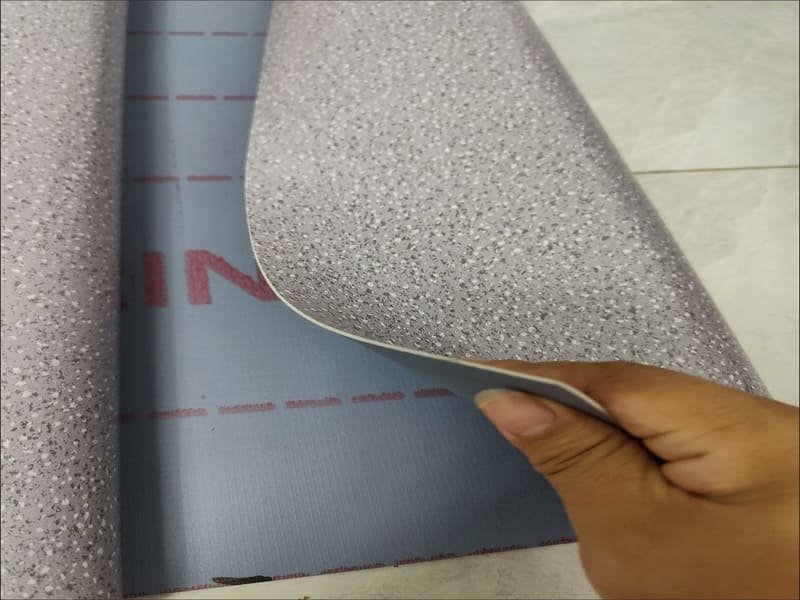
Not over an open or untreated joint. A stable, non-moving saw-cut control joint can usually be filled and smoothed, and then PVC sheet can cover it. A moving joint must never be bridged. Stop the flooring at it and fit a movement-joint profile.
I am the engineering and installation director at a PVC flooring manufacturer. Joint problems are some of the most common causes of site callbacks I handle. The first thing I check on any slab is what type of joint I am looking at, because the answer decides the whole method.
A saw-cut control joint creates a weak line in the slab. Drying shrinkage cracks form there and not across the middle of a panel. Many control joints become stable after the slab cures. Some keep showing movement because of temperature changes, slab conditions or structural behavior. An expansion or isolation joint is different. The designer places it so two parts of the structure can move against each other.
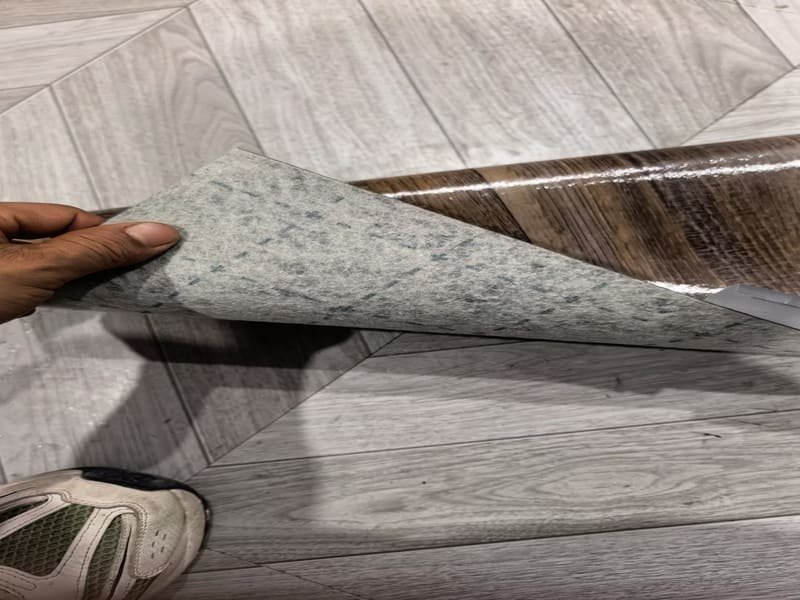
PVC sheet flooring is flexible and bends well over a flat subfloor. But it has little strength against sharp, repeated movement at one point. A stable joint can be filled and made flat. A moving joint cannot be hidden under vinyl.
In this guide you will learn:
- How a control joint differs from an expansion joint
- How to check if a joint is stable
- How to prepare a stable joint step by step
- What to do with a joint that still moves
- How to repair a floor that was already installed over a joint
Everything starts with the type of joint, so I will cover that first.
What Is the Difference Between a Saw-Cut Control Joint and an Expansion Joint?
A saw-cut control joint guides shrinkage cracking to a planned line and is often stable after curing. An expansion or isolation joint is built to allow movement. You can fill a stable control joint. You must always honor an expansion joint.
How the two joint types compare
| الميزة | Saw-cut control joint | Expansion or isolation joint |
|---|---|---|
| الغرض | Guides drying shrinkage cracks to a planned line | Lets structural sections move against each other |
| العمق | Cut to a fraction of the slab depth | Typically extends through the slab to separate adjacent slab or structural sections |
| Movement | Often stable after curing, but not always | Designed to move |
| Flooring treatment | Fill and smooth if stable | Stop the flooring and use a movement-joint profile |
Why this matters for PVC sheet
Vinyl stretches and recovers over a smooth surface. It does not handle point stress. Movement at a joint stretches the sheet, breaks the adhesive bond or leaves a visible line on the surface.
Do not confuse an active control joint with a designed expansion or isolation joint. A control joint that still moves needs special care. An expansion or isolation joint must always be honored through the flooring system. ASTM F710 allows control joints and other non-moving joints to be filled or smoothed. Flooring manufacturers generally require structural movement joints to be honored through the flooring system, and I follow that rule on every project.
What goes wrong when joints are covered badly
| الفشل | What you see | السبب |
|---|---|---|
| التلغراف | A straight ridge or dent over the joint | Joint gap or edge shows through the sheet |
| Shear cracking | Split or torn sheet along the joint | Slab movement stretches the vinyl past its limit |
| فشل المادة اللاصقة | Lifted sheet, hollow sound when tapped | Movement, air or moisture breaks the glue bond |
| Blistering | Bubbles in a straight line | Moisture vapor from a damp slab, often using the open joint as a path |
Once you know the joint type, you need to know if it is stable. I will cover the checks next.
How Do I Know If a Saw-Cut Joint Is Stable?
Check slab condition, moisture, pH, traffic load and joint movement. Do not rely on slab age alone. A joint that shows no change in width through a temperature swing is a good candidate for filling.
Checks I run before choosing a method
| العامل | What to check | Typical guide |
|---|---|---|
| Slab condition | Has the slab cured enough to be sound and stable? | Do not rely on age alone. Verify moisture, pH and manufacturer requirements |
| الرطوبة | Test with ASTM F2170, ASTM F1869 or the method your flooring and adhesive manufacturer requires | Stay within the limits in the installation guide |
| الرقم الهيدروجيني | Test the slab surface | Stay within the adhesive manufacturer’s limits |
| Traffic load | Residential or light commercial, or heavy rolling loads such as hospitals, warehouses and commercial kitchens | Heavier loads need a filler that supports the joint edges |
| Joint activity | Is the joint still moving? | Monitor before you decide |
How I judge joint activity
I look for fresh cracks branching from the joint, spalled edges and gaps that change width between seasons. For a clear answer, I fix a crack monitor or a tell-tale gauge across the joint and read it over several weeks. A joint with no measurable change during the observation period is more likely to be stable. It is not a guarantee. Seasonal changes, an HVAC system that is not yet running, a new building that is still drying out and changes in building load can all start movement later. Treat the result as stable only within the project specification and the flooring manufacturer’s requirements. A joint that keeps moving is not stable.
Quick decision guide
| Joint condition | الإجراء |
|---|---|
| Stable control joint | Clean, fill with an approved filler or patch, then grind flat |
| Control joint that still moves | Treat it as a moving joint and honor it with a movement-joint profile |
| Expansion or isolation joint | Always honor it. Stop the flooring and fit a movement-joint profile |
If the joint is stable, the next step is to fill it the right way.
How Do I Prepare a Stable Saw-Cut Joint Before PVC Installation?
Clean the joint, prime the edges if the product needs it, fill it with a compatible semi-rigid filler or cementitious patch, then grind it flush with the slab. Use only products approved for use under resilient flooring.
Choosing the filler
The right filler depends on your flooring manufacturer, the filler supplier and the traffic on the floor. These are the common choices:
- Polymer-modified cementitious patch
- Epoxy repair material approved for use under resilient flooring
- Semi-rigid epoxy or polyurea joint filler
Some semi-rigid fillers used in heavy rolling-load areas are fairly hard, often around Shore A 80 or above. The hardness you need should follow the filler and flooring manufacturer’s advice. It is not a fixed industry rule.
Step-by-step
- Clean and vacuum the joint. Remove dust, debris and laitance.
- Prime the joint edges if your filler or patch needs a primer.
- Fill the joint flush or slightly proud.
- Grind it smooth to match the slab surface.
- Apply a moisture mitigation system if your test results call for one.
Test moisture again after any water-based patch has cured, because added water can raise readings.
Heavy traffic and semi-rigid fillers
I avoid filling a joint where thermal or structural movement continues. Heavy rolling traffic does not rule out a semi-rigid filler by itself. A good filler supports the joint edges so wheels do not crush them. It must also stay compatible with the flooring system.
Some joints will not settle. Those need a different approach.
What Do I Do With a Joint That Still Moves?
Do not fill it rigidly and do not cover it with bare vinyl. Stop the PVC flooring at the joint and fit a proprietary movement-joint or expansion-joint system made for resilient flooring.
Why bridging fails
Patch, self-leveling compound and adhesive are rigid once they cure. They crack along the joint line when the slab moves. A sheet laid across the joint takes all of that movement at one point. The movement continues through every layer, so the joint must continue through the finished floor.
Movement-joint system options
| System type | How it works | الأفضل لـ |
|---|---|---|
| Flush movement-joint profile | Sheet stops at the joint and the profile moves with the slab | Areas where a level surface matters |
| Surface-mounted cover | Cover plate fixed on one side and free to slide on the other | Larger movement and long runs |
| Proprietary PVC or rubber movement profile | Made to match the flooring and joint width | Healthcare, education and retail spaces |
The profile maker decides if a sealant or backer rod goes in the joint, and which one. Follow that specification and do not guess.
Design tip
I always ask for the joint width and the expected movement before I suggest a profile. This is where early talks between the designer, the installer and the manufacturer save money. A small layout change at the design stage can keep seams and joints apart and avoid a hard fix later.
A good method is only half the work. You also need to follow the rules that protect your warranty.
Which Standards and Warranty Rules Apply to Joint Preparation?
ASTM F710 is the main standard for preparing concrete floors for resilient flooring. Major manufacturers also ask for moisture testing, pH testing and correct joint treatment. Skipping joint treatment can void the warranty.
What the standards and manufacturers expect
| المنطقة | What to follow |
|---|---|
| Slab preparation | ASTM F710, Standard Practice for Preparing Concrete Floors to Receive Resilient Flooring |
| اختبار الرطوبة | ASTM F2170, ASTM F1869 or another method the manufacturer requires |
| pH testing | Follow ASTM F710 and the adhesive manufacturer’s limits |
| Moving joints | Honor them through the flooring according to the manufacturer’s installation requirements |
| الضمان | Manufacturers such as Armstrong, Tarkett, Forbo and Gerflor generally ask for documented slab prep and joint treatment |
Why warranties matter here
A warranty claim on a joint failure often starts with one question: was the joint treated as the installation guide says? If the answer is no, the claim usually fails. I tell customers to keep their test results, product data sheets and photos of the joint work. Always check the current installation guide for your exact product, because rules change between ranges.
Adhesive choice
Use the adhesive specified for your PVC sheet flooring and your substrate. A treated stable joint becomes a smooth, sound part of the slab, so it needs no special glue. A stronger adhesive will not fix a joint that is still moving or was poorly filled.
What if the floor is already down and the joint lines are showing? I will cover that next.
How Do I Repair PVC Flooring Already Installed Over a Saw-Cut Joint?
Check if the problem is only cosmetic. If the sheet is bonded and intact and the joint is stable, you may leave it. If the line is getting worse, the bond has failed or the joint moves, open the floor and fix the substrate.
Common symptoms
| العَرَض | Likely cause |
|---|---|
| Straight dents or raised lines that match the joint | Telegraphing from an unfilled or poorly filled joint |
| Bubbling in a straight line | Moisture vapor from the slab using the joint as a path |
| Split or torn sheet or seam near a joint | حركة المفاصل |
When you can leave it
If the telegraphing is cosmetic, the sheet is firmly bonded and the joint is stable, replacement may not be needed. I suggest the owner monitors it over several months and records any change.
When you need to open the floor
- Cut back the sheet in a strip along the joint.
- Find the cause: a poorly filled joint, a moving joint or moisture.
- Correct the substrate with the right filler, or fit a movement-joint profile if the joint moves.
- Lay a new strip and heat-weld the seams.
For tearing, replace the full damaged section. Patching a torn sheet over a moving joint only gives you the same crack again in a few months.
What it costs to skip prep
A repair means lost trading time, new material and a second crew. Joint prep at the start costs a small fraction of that.
Here are the questions I hear most from installers and product developers.
Frequently Asked Questions About PVC Sheet Flooring and Saw-Cut Joints
Can I just use standard spackle or thin-set mortar to fill saw-cut joints?
No. Spackle is soft and crumbles under rolling loads. Standard thin-set mortar is not designed as a saw-cut joint filler beneath resilient flooring and may crack or debond under joint movement or traffic. Use a patch or filler approved for use under resilient flooring, and follow its data sheet.
How long after filling saw-cut joints can I lay PVC sheet flooring?
It depends on the product. Rapid-setting cementitious patches can be ready in a few hours. Epoxy fillers and self-leveling compounds often need a day or more. Read the data sheet, and retest moisture if the product is water-based.
Is self-leveling compound enough by itself to bridge saw-cut joints?
No. Self-leveling compound is rigid and can crack along the joint line, which is called reflective cracking. Fill and level the joint first with an approved filler. Dam or seal the gap so the compound does not run into it. Never use it to bridge a moving joint.
Does heat-welding seams over a saw-cut joint prevent cracking?
No. Heat welding fuses the sheet edges and makes the seam watertight. It does not absorb slab movement. A seam placed right over a joint takes all the stress at one point. Where the layout allows, I keep seams away from joints.
Do I need a different adhesive near a treated joint?
Usually not. Use the adhesive specified for your sheet and substrate. Once a stable joint is filled and ground flat, the adhesive sees a smooth, sound surface. If a joint is still moving, a stronger adhesive will not stop the movement. Fit a movement-joint profile instead.
الخاتمة
Fill stable control joints. Honor moving joints. Test first, follow the manufacturer’s guide, and never cover an open joint with bare vinyl.
نبذة عن المؤلف: I am the engineering and installation director at a PVC flooring manufacturer. I have worked on custom and bulk PVC flooring projects across commercial, healthcare and industrial sites. My focus is manufacturing process, material selection and design optimization, so installation details like joint treatment work in the field and not only on paper.
Not sure how to treat the joints in your project? Send me a private message with your slab details, joint photos and flooring spec, and I will help you choose the right approach.